LLM‑8850 Card
SKU:AI-001


Description
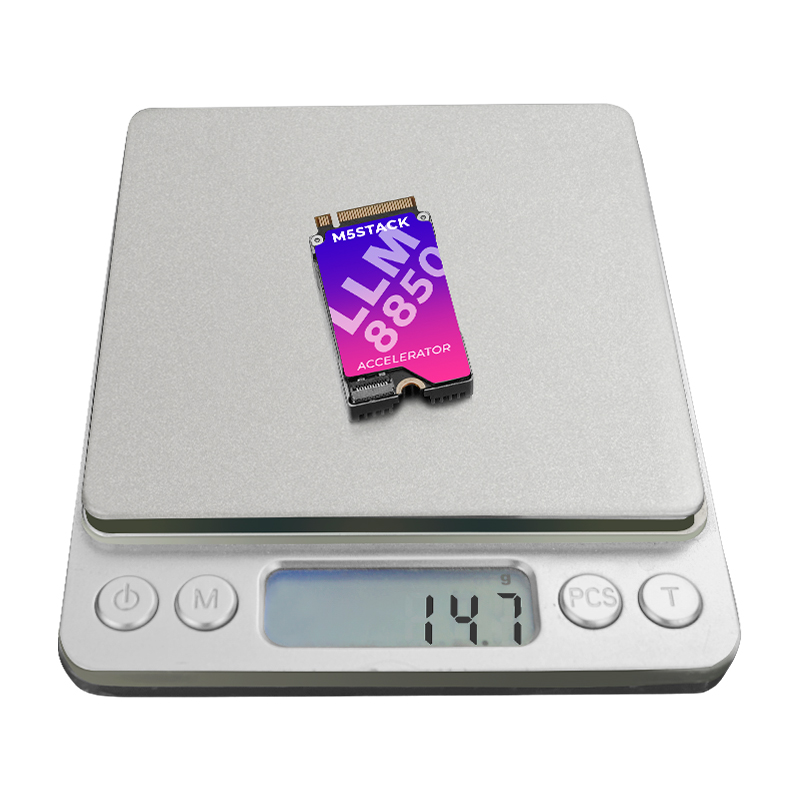
LLM‑8850 Card is an M.2 M-KEY 2242 AI accelerator card designed for edge devices. It combines a compact 42 mm form factor with the Axera AX8850 SoC delivering 24 TOPS @ INT8 compute performance, enabling “plug-and-boost” multimodal large model and video analytics acceleration for hosts such as Raspberry Pi 5, RK3588 SBCs, and x86 PCs. The card integrates an active cooling system consisting of a micro centrifugal fan and a CNC aluminum heatsink. Fan speed is intelligently regulated by the onboard EC based on temperature–current curves, ensuring stable low-temperature operation even under sustained full load and preventing thermal throttling in enclosed chassis environments.
The onboard DCDC + PMIC power architecture is managed in real time by the EC to achieve “power on demand, cooling on demand,” significantly improving overall system stability. It supports AXCL Runtime with C / Python APIs for one-click deployment of mainstream CNN, Transformer, LLM, and multimodal models such as YOLO‑v8/11, CLIP, Whisper, Llama3.2, InternVL3, and Qwen3. Leveraging the AX8850 VPU hardware pipeline, it also provides H.264/H.265 8K video encoding/decoding, simultaneous encode–decode transcoding acceleration, and scaling / cropping. AI inference and video stream processing can be handled concurrently, with host-side support for directly invoking the hardware video codec via ffmpeg.
Tutorial

Features
- Ultra-compact form factor: NGFF M.2 M-KEY 2242 size, plug-and-play with PCIe 2.0 ×2 lanes
- High-performance NPU: 24 TOPS @ INT8, octa-core Cortex‑A55 1.7 GHz CPU
- Intelligent cooling / power management: onboard centrifugal fan + CNC aluminum integrated heatsink, EC closed-loop monitoring of temperature–current–RPM
- High-bandwidth memory: 64-bit LPDDR4x, 4266 Mbps data rate, 8GB capacity
- Hardware video engine: 8 K @ 30 fps H.264/H.265 encoding, 8 K @ 30 fps decoding, supports 16-channel 1080P parallel decoding
- Secure boot & encryption: AES / DES / 3DES / SHA‑256 hardware security module
- Native AXCL support: one-click execution of CNN, Transformer, CLIP, Whisper, Llama3.2, Qwen3, InternVL3, and more, with H.264/H.265 simultaneous encode–decode transcoding
Includes
- 1 x LLM‑8850 Card
Applications
- Industrial / commercial SBC compute upgrades: local object detection and defect inspection on Raspberry Pi 5, RK3588, TI AM62x, and similar boards
- Embodied intelligence robots: plug-and-play local “perception–decision–control” pipelines for AMR / AGV / service robots
- AIPC & edge intelligent terminals: offline Copilot, customer service Q&A, meeting subtitles, and real-time translation inside mini PCs
- NVR / NAS intelligent upgrades: add multi-channel AI license plate recognition, event summarization, and hardware transcoding to legacy storage devices
- Intelligent interactive devices: low-latency local LLM + TTS for voice assistants, smart doorbells, and digital signage
- AI vision gateways: real-time inference for traffic intersections and campus access control, including people flow statistics and hazardous behavior alerts
Specifications
| Specification | Parameter |
|---|---|
| SoC | Axera AX8850 |
| CPU | Octa-core Cortex‑A55 1.7 GHz |
| NPU | 24 TOPS @ INT8 |
| Video Encoder | 8 K @ 30 fps H.264/H.265 encoding, supports scaling / cropping |
| Video Decoder | 8 K @ 30 fps H.264/H.265 decoding, supports 16-channel 1080P parallel decoding, scaling / cropping |
| Memory | 64-bit LPDDR4x, 4266 Mbps, 8GB capacity |
| Storage | 32Mbits QSPI NOR Flash (bootloader only) |
| Form Factor | M.2 M-KEY 2242, PCIe 2.0 ×2 |
| Cooling | Micro centrifugal fan + CNC aluminum integrated heatsink, EC smart thermal control |
| Operating Temperature | 0 ~ 60 °C |
| Full-load Temperature (Ambient) | 70 °C |
| Power Supply | 7W @ 3.3V |
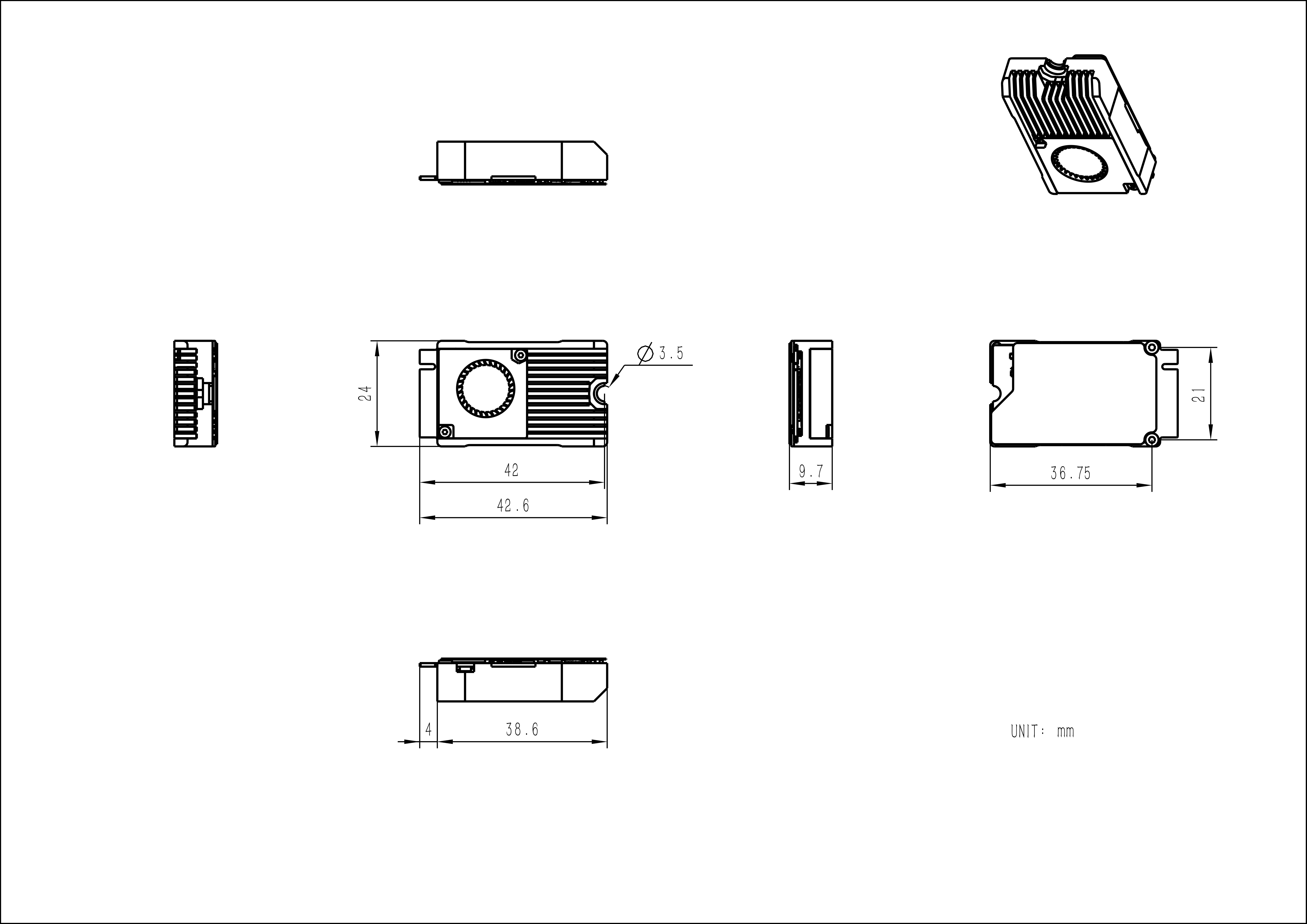
| Product Size | 42.6 x 24.0 x 9.7mm |
| Product Weight | 14.7g |
| Package Size | 66.0 x 44.0 x 13.5mm |
| Gross Weight | 19.8g |
Learn
- Form factor requirement: PCIe M.2 M-Key
- Interface requirement: Supports PCIe 2.0 ×2 lanes, backward compatible with x1 (e.g., Raspberry Pi PCIe 2.0 x1). Note: NVMe-protocol M.2 SSD interfaces are not supported.
- Hardware requirement: When used with Raspberry Pi, the official Raspberry Pi controller and adapter board or an M5Stack adapter board is recommended. Third-party hardware may have compatibility issues.
- System requirement: Refer to the system compatibility table below. Other systems may not install drivers correctly.
Hardware Compatibility
The following boards have been tested by official and third-party users and work properly with the LLM‑8850 Card:
| Board | Supported |
|---|---|
| Raspberry Pi 5 | ✅ |
| Radxa Rock 5B RK3588 | ✅ |
System Compatibility
| Operating System | Supported |
|---|---|
| Ubuntu20.04 | ✅ |
| Ubuntu22.04 | ✅ |
| Ubuntu24.04 | ✅ |
| Debian12 | ✅ |
| Debian13 | ✅ |
| Windows10 | ✅ |
| Windows11 | ✅ |
| macOS | ❌ |
| WSL | ❌ |
| VMware | ❌ |
| VBox | ❌ |
Model Size
Datasheets
Softwares
Quick Start
Video
- LLM‑8850 Card Product Introduction and Feature Demonstration