

















Arduino 上手教程
2. 设备开发 & 案例程序
3. M5Unified
4. M5GFX
5. 拓展模块
Unit
Base
Cap
IoT
Atom DTU NBIoT2 v1.1 Arduino 使用教程
1. 准备工作
环境配置: 参考Arduino IDE上手教程完成 IDE 安装,并根据实际使用的开发板安装对应的板管理,与需要的驱动库。
使用到的驱动库:
注意
需要在 GitHub 上下载最新的库版本,库地址: TinyGSM - M5Stack GitHub,请勿在 Arduino Library 中下载。(如有疑问,请参考此教程)
- 3. 使用到的硬件产品:
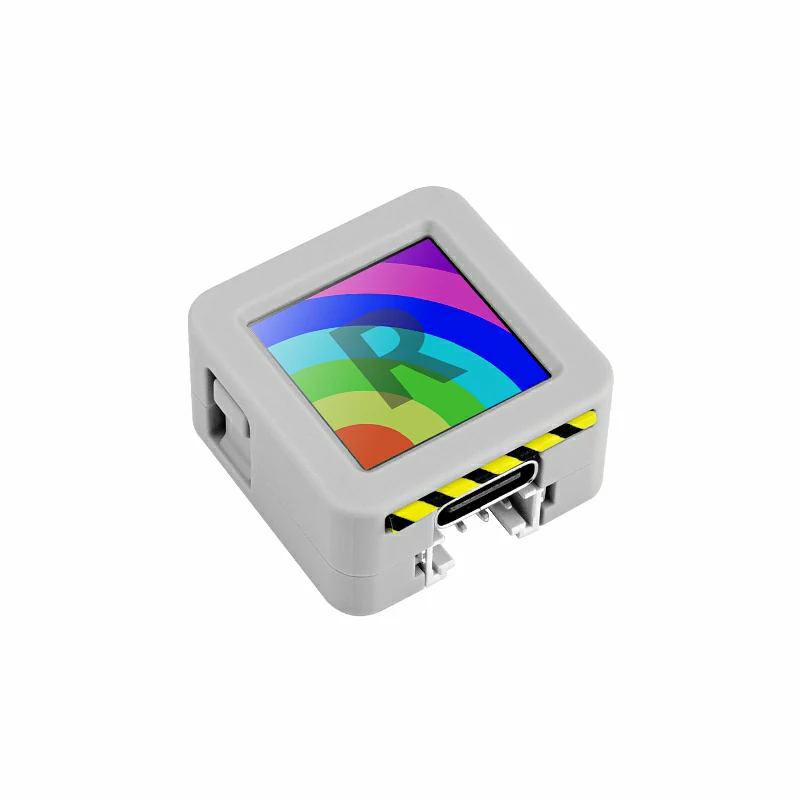
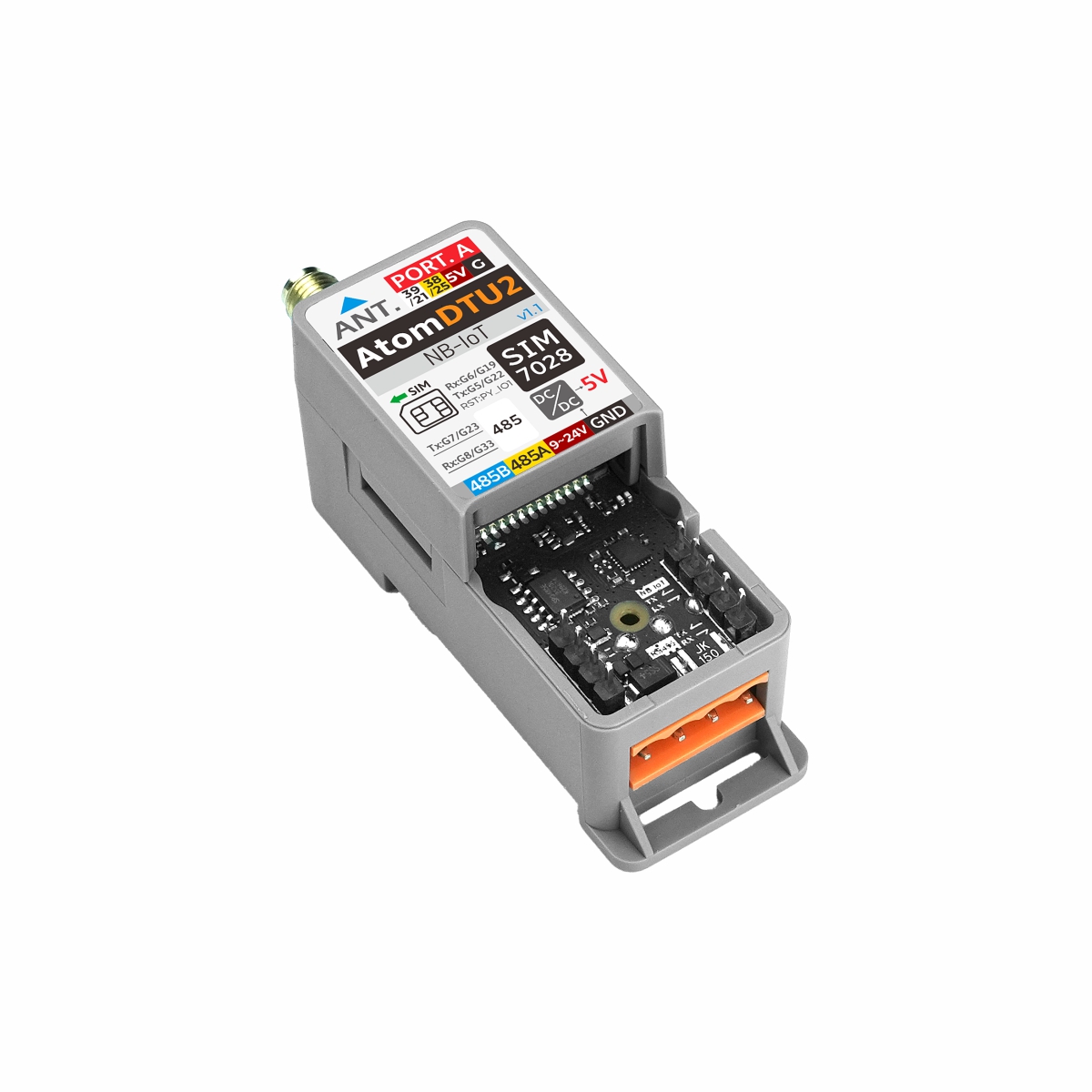
2. 注意事项
SIM 卡兼容性
本模块需使用 Micro SIM 规格的物联网卡,请确保卡片支持 Cat-M1 或 NB-IoT 网络,并建议优先选用经过以下运营商认证的卡片:Deutsche Telekom、Vodafone、Telefonica 以及中国电信、中国移动、中国联通。
注意
请勿在未断开电源的情况下对物联网卡进行插拔,或者把同一张 SIM 卡在不同的设备中使用,否则可能会触发物联网卡自动锁卡而联网失败,锁卡后需要联系运营商解除。
引脚兼容性
由于每款主机的引脚配置不同,使用前请参考产品文档中的引脚兼容表,并根据实际引脚连接情况修改案例程序。
3. 案例程序
- 本教程中使用的主控设备为 AtomS3,搭配 Atom DTU NBIoT v1.1。本模块采用串口的方式通讯,根据实际的电路连接修改程序中的引脚定义,设备连接后对应的串口 IO 为
G5 (TX)、G6 (RX),RS485 IO 为G7 (TX),G8 (RX)(下方例程中定义后未实际使用)。
说明
下方例程默认使用 SIM 卡的 CAT 模式,若需要切换至 NB-Iot 模式,请把
TinyGSM 库中 TinyGsmClientSIM7028.h 文件 line 32 的 MODE_NB_IOT 的宏定义注释去掉;如果需要 debug ,同理可将 TINY_GSM_DEBUG 及下方代码中的 DUMP_AT_COMMANDS 宏定义取消注释。3.1 MQTT
cpp
1 2 3 4 5 6 7 8 9 10 11 12 13 14 15 16 17 18 19 20 21 22 23 24 25 26 27 28 29 30 31 32 33 34 35 36 37 38 39 40 41 42 43 44 45 46 47 48 49 50 51 52 53 54 55 56 57 58 59 60 61 62 63 64 65 66 67 68 69 70 71 72 73 74 75 76 77 78 79 80 81 82 83 84 85 86 87 88 89 90 91 92 93 94 95 96 97 98 99 100 101 102 103 104 105 106 107 108 109 110 111 112 113 114 115 116 117 118 119 120 121 122 123 124 125 126 127 128 129 130 131 132 133 134 135 136 137 138 139 140 141 142 143 144 145 146 147 148 149 150 151 152 153 154 155 156 157 158 159 160 161 162 163 164 165 166 167 168 169 170 171 172 173 174 175 176 177 178 179 180 181 182 183 184 185 186 187 188 189 190 191 192 193 194 195 196 197 198 199 200 201 202 203 204 205 206 207 208 209 210 211 212 213 214 215 216 217 218 219 220 221 222 223 224 225 226 227 228 229 230 231
#include "M5Unified.h"
#define TINY_GSM_MODEM_SIM7028  // Specify to use SIM7028 module; TinyGsm library adapts instruction set based on this macro, must be placed here
#include "PubSubClient.h"
#include "TinyGsmClient.h"
#include "StreamDebugger.h"
#include "M5IOE1.h"

#define SerialMon        Serial             // MCU -> PC for log output
#define MONITOR_BAUDRATE 115200
#define SerialAT         Serial1            // MCU <-> SIM7028 module communication
#define SIM7028_BAUDRATE 115200
#define SIM7028_RESET    -1
#define MCU_TX           5
#define MCU_RX           6
#define RS485_TX         7
#define RS485_RX         8
#define IO_SCL           39
#define IO_SDA           38
#define MQTT_BROKER      "mqtt.m5stack.com" // MQTT broker address
#define MQTT_PORT        1883               // MQTT service port
#define mqtt_devid       "XXXXXXXX"         // MQTT client ID
#define mqtt_pubid       "XXXXXXXX"         // MQTT username
#define mqtt_password    "XXXXXXXX"         // MQTT authentication key
#define UPLOAD_INTERVAL  10000              // Data upload interval, 10s

// M5IOE1 device instance
M5IOE1 ioe1;

// M5IOE1 I2C address (default 0x6F)
#define I2C_ADDR M5IOE1_DEFAULT_ADDR

// Pin definitions for M5IOE1 GPIOs
#define SIM_PWR_EN M5IOE1_PIN_9
#define SIM_RST M5IOE1_PIN_11
#define VIN_ADC M5IOE1_PIN_2

// If you need to see log detail, you can open the following macro definition
// #define DUMP_AT_COMMANDS
// If you need to debug, you can open the following macro definition in TinyGsmClientSIM7028.h line 13
// #define TINY_GSM_DEBUG Serial
#ifdef DUMP_AT_COMMANDS
StreamDebugger debugger(SerialAT, SerialMon);
TinyGsm modem(debugger);
#else
TinyGsm modem(SerialAT);
#endif

TinyGsmClient tcpClient(modem); // Create TCP client based on TinyGsm (MQTT relies on TCP connection)
PubSubClient mqttClient(MQTT_BROKER, MQTT_PORT, tcpClient); // Create MQTT client instance (specify broker, port and TCP client)

void mqttCallback(char *topic, byte *payload, unsigned int len); // Callback function for receiving MQTT messages
bool mqttConnect(void); // Function to establish MQTT connection
void nbConnect(void);   // Function to initialize SIM7028 and connect to NB-IoT network

const char* topicSub = "Atom DTU NBIoT v1.1 Receive"; // MQTT topic for receiving messages (replace with your actual subscribe topic)
const char* topicPub = "Atom DTU NBIoT v1.1 Send";    // MQTT topic for sending messages (replace with your actual publish topic)
int         num               = 0; // Counter for published messages
uint32_t lastReconnectAttempt = 0; // Timestamp for last MQTT reconnection attempt (avoid frequent retries)
bool lastMqttState = false; // Track MQTT connection status
const char apn[] = "cmnbiot";

void log(String info)
{
    SerialMon.println(info);
}

void SIM7028_EN()
{
    if (ioe1.begin(&Wire, I2C_ADDR, IO_SDA, IO_SCL, M5IOE1_I2C_FREQ_100K, M5IOE1_INT_MODE_POLLING) == M5IOE1_OK){
        ioe1.pinMode(SIM_PWR_EN, OUTPUT);
        ioe1.digitalWrite(SIM_PWR_EN, HIGH); // Enable SIM power
        delay(100);
        ioe1.pinMode(SIM_RST, OUTPUT);
        ioe1.digitalWrite(SIM_RST, LOW); // SIM reset
        delay(100);
        ioe1.digitalWrite(SIM_RST, HIGH);
        log("SIM power enabled");
    }
    else{
        log("Failed to enable SIM power");
    }
}

void setup()
{
    M5.begin();
    SerialMon.begin(115200);
    SerialMon.println(">>SIM7028 MQTT TEST");
    SerialAT.begin(SIM7028_BAUDRATE, SERIAL_8N1, MCU_RX, MCU_TX);
    M5.Display.setFont(&fonts::FreeMonoBold9pt7b);
    M5.Display.setTextDatum(middle_center);
    M5.Display.drawString("NBIoT MQTT", M5.Display.width() / 2, 10);
    M5.Display.drawString("Init...", M5.Display.width() / 2, 60);
    delay(500);
    SIM7028_EN();
    nbConnect(); // Initialize SIM7028 module and connect to network
    mqttClient.setServer(MQTT_BROKER, MQTT_PORT);  // Set MQTT broker address and port
    mqttClient.setKeepAlive(120);                  // MQTT keep-alive interval (120 seconds)
    mqttClient.setSocketTimeout(15000);            // TCP connection timeout (15 seconds)
    mqttClient.setCallback(mqttCallback);          // Register MQTT message receive callback
}

void loop()
{
    static unsigned long timer = 0;
    M5.update();

    // Check for MQTT connection status change (connected <-> disconnected)
    if (mqttClient.connected() != lastMqttState) {
        if (mqttClient.connected()) {
            log("=== MQTT CONNECTED ===");
            M5.Display.fillRect(0, 20, 128, 20, TFT_BLACK);
            M5.Display.setTextColor(TFT_GREEN);
            M5.Display.drawString("CONNECTED", M5.Display.width() / 2, 30);
        } else {
            log("=== MQTT DISCONNECTED ===");
            M5.Display.fillRect(0, 20, 128, 20, TFT_BLACK);
            M5.Display.setTextColor(TFT_RED);
            M5.Display.drawString("DISCONNECTED", M5.Display.width() / 2, 30);
        }
        lastMqttState = mqttClient.connected();
    }

    // MQTT reconnection logic (retry every 3 seconds if disconnected)
    if (!mqttClient.connected()) {
        log(">> MQTT NOT CONNECTED");
        log("MQTT state code: " + String(mqttClient.state()));
        M5.Display.fillRect(0, 20, 128, 20, TFT_BLACK);
        M5.Display.setTextColor(TFT_RED);
        M5.Display.drawString("DISCONNECTED", M5.Display.width() / 2, 30);
        uint32_t t = millis();
        if (t - lastReconnectAttempt > 3000L) {
            lastReconnectAttempt = t;
            if (mqttConnect()) {
                lastReconnectAttempt = 0;
            }
        }
        delay(100);
    }

    // Periodic data publishing (triggered when timer expires)
    if (millis() >= timer) {
        timer = millis() + UPLOAD_INTERVAL;
        if (mqttClient.connected()) {
            char jsonBuf[256];
            snprintf(jsonBuf, sizeof(jsonBuf), "SIM7028 MQTT #%d", num);
            log(">> [MQTT SEND] Topic: " + String(topicPub));
            log("Info: " + String(jsonBuf));
            mqttClient.publish(topicPub, jsonBuf);
            M5.Display.fillRect(0, 40, 128, 40, TFT_BLACK);
            M5.Display.setTextColor(TFT_WHITE);
            M5.Display.drawString("Send:", M5.Display.width() / 2, 50);
            M5.Display.drawString("#" + String(num++), M5.Display.width() / 2, 70);
        }
    }

    mqttClient.loop();// Process MQTT incoming messages, maintain connection and handle keep-alive
    delay(10);
}

void mqttCallback(char *topic, byte *payload, unsigned int len)
{
    String payloadStr;
    for (unsigned int i = 0; i < len; i++) {
        payloadStr += (char)payload[i];
    }
    log(">> [MQTT RECEIVE] Topic: " + String(topic) + "\nInfo: " + payloadStr);
    M5.Display.fillRect(0, 90, 128, 38, TFT_BLACK);
    M5.Display.setTextColor(TFT_WHITE);
    M5.Display.drawString("Rece:", M5.Display.width() / 2, 90);
    M5.Display.drawString(String(payloadStr), M5.Display.width() / 2, 110);
}

bool mqttConnect(void)
{
    log(">> Connecting to MQTT broker: " + String(MQTT_BROKER));
    bool status = mqttClient.connect(mqtt_devid, mqtt_pubid, mqtt_password);
    if (!status) {
        log("!! MQTT Connection FAILED, code: " + String(mqttClient.state()));
        return false;
    }
    log(">> MQTT CONNECTED, subscribing: " + String(topicSub));
    mqttClient.subscribe(topicSub);
    return true;
}

void nbConnect(void)
{
    unsigned long start = millis();
    log("Initializing modem...");
    while (!modem.init()) {
        log("waiting...." + String((millis() - start) / 1000) + "s");
    };

    start = millis();
    log("Waiting for network...");
    while (!modem.waitForNetwork()) {
        log("waiting...." + String((millis() - start) / 1000) + "s");
    }
    log("success");

    log("Waiting for GPRS connect...");
    if (!modem.gprsConnect(apn)) {
        log("waiting...." + String((millis() - start) / 1000) + "s");
    }
    log("success");

    // Get CCID for IoT SIM card
    SerialAT.println("AT+CICCID");
    delay(100);  // Short delay for response
    String resp = "";
    while (SerialAT.available()) {
        resp += (char)SerialAT.read();
    }
    int pos = resp.indexOf("+CICCID:");
    if (pos != -1) {
        String ccid = resp.substring(pos + 9, resp.indexOf("\r", pos));
        ccid.trim();
        Serial.println("CCID: " + ccid);
    } else {
        Serial.println("CCID: Not found");
    }

    // Acquire signal strength
    int csq = modem.getSignalQuality();
    Serial.println("Signal quality: " + String(csq));
    // Example Query the IP address of a device
    String ip = modem.getLocalIP();
    log("Device IP address: " + ip);
    log("success");
}3.2 HTTP
cpp
1 2 3 4 5 6 7 8 9 10 11 12 13 14 15 16 17 18 19 20 21 22 23 24 25 26 27 28 29 30 31 32 33 34 35 36 37 38 39 40 41 42 43 44 45 46 47 48 49 50 51 52 53 54 55 56 57 58 59 60 61 62 63 64 65 66 67 68 69 70 71 72 73 74 75 76 77 78 79 80 81 82 83 84 85 86 87 88 89 90 91 92 93 94 95 96 97 98 99 100 101 102 103 104 105 106 107 108 109 110 111 112 113 114 115 116 117 118 119 120 121 122 123 124 125 126 127 128 129 130 131 132 133 134 135 136 137 138 139 140 141 142 143 144 145 146 147 148 149 150 151 152 153 154 155 156 157 158 159 160 161 162 163 164 165 166 167 168 169 170 171 172 173 174 175 176 177 178 179 180
#include "M5Unified.h"
#define TINY_GSM_MODEM_SIM7028  // Specify to use SIM7028 module; TinyGsm library adapts instruction set based on this macro, must be placed here
#include "ArduinoHttpClient.h"
#include "TinyGsmClient.h"
#include "StreamDebugger.h"
#include "M5IOE1.h"

#define SerialMon        Serial             // MCU -> PC for log output
#define MONITOR_BAUDRATE 115200
#define SerialAT         Serial1            // MCU <-> SIM7028 module communication
#define SIM7028_BAUDRATE 115200
#define SIM7028_RESET    -1
#define MCU_TX           5
#define MCU_RX           6
#define RS485_TX         7
#define RS485_RX         8
#define IO_SCL           39
#define IO_SDA           38

// M5IOE1 device instance
M5IOE1 ioe1;

// M5IOE1 I2C address (default 0x6F)
#define I2C_ADDR M5IOE1_DEFAULT_ADDR

// Pin definitions for M5IOE1 GPIOs
#define SIM_PWR_EN M5IOE1_PIN_9
#define SIM_RST M5IOE1_PIN_11
#define VIN_ADC M5IOE1_PIN_2

// If you need to see log detail, you can open the following macro definition
// #define DUMP_AT_COMMANDS
// If you need to debug, you can open the following macro definition in TinyGsmClientSIM7028.h line 13
// #define TINY_GSM_DEBUG Serial
#ifdef DUMP_AT_COMMANDS
StreamDebugger debugger(SerialAT, SerialMon);
TinyGsm modem(debugger);
#else
TinyGsm modem(SerialAT);
#endif

// Server details
const char server[]   = "httpbin.org";
const char resource[] = ""; // API endpoint path
const int port        = 80;    // HTTP port
TinyGsmClient client(modem); // Create TCP client based on TinyGsm (HTTP relies on TCP connection)
HttpClient http(client, server, port); // Create HTTP client instance (specify TCP client, server and port)

void modemConnect(void);// Initialize ML307 module and establish network connection
const char apn[] = "cmnbiot";

void log(String info)
{
    SerialMon.println(info);
}

void SIM7028_EN()
{
    if (ioe1.begin(&Wire, I2C_ADDR, IO_SDA, IO_SCL, M5IOE1_I2C_FREQ_100K, M5IOE1_INT_MODE_POLLING) == M5IOE1_OK){
        ioe1.pinMode(SIM_PWR_EN, OUTPUT);
        ioe1.digitalWrite(SIM_PWR_EN, HIGH); // Enable SIM power
        delay(100);
        ioe1.pinMode(SIM_RST, OUTPUT);
        ioe1.digitalWrite(SIM_RST, LOW); // SIM reset
        delay(100);
        ioe1.digitalWrite(SIM_RST, HIGH);
        log("SIM power enabled");
    }
    else{
        log("Failed to enable SIM power");
    }
}

void setup()
{
    M5.begin();
    SerialMon.begin(115200);
    SerialMon.println(">>SIM7028 HTTP TEST");
    SerialAT.begin(SIM7028_BAUDRATE, SERIAL_8N1, MCU_RX, MCU_TX);
    M5.Display.setFont(&fonts::FreeMonoBold9pt7b);
    M5.Display.setTextDatum(middle_center);
    M5.Display.drawString("NBIoT HTTP", M5.Display.width() / 2, 10);
    M5.Display.drawString("Init...", M5.Display.width() / 2, 60);
    delay(500);
    SIM7028_EN();
    modemConnect();
}

void loop()
{
    // --- GET request ---
    M5.Display.fillRect(0, 30, 128, 98, TFT_BLACK);
    M5.Display.drawString("GET", M5.Display.width() / 2, 40);
    Serial.println("making GET request");

    http.get("/get");
    // read the status code and body of the response
    int statusCode  = http.responseStatusCode();
    String response = http.responseBody();

    Serial.print("Status code: ");
    Serial.println(statusCode);
    Serial.print("Response: ");
    Serial.println(response);
    Serial.println("Wait five seconds");

    M5.Display.drawString("STATUS:", M5.Display.width() / 2, 70);
    M5.Display.drawString(String(statusCode), M5.Display.width() / 2, 100);

    delay(5000);

    // --- POST request ---
    M5.Display.fillRect(0, 30, 128, 98, TFT_BLACK);
    M5.Display.drawString("POST", M5.Display.width() / 2, 40);
    Serial.println("making POST request");

    String contentType = "application/x-www-form-urlencoded";
    String postData    = "name=Alice&age=12";

    http.post("/post", contentType, postData);

    // read the status code and body of the response
    statusCode = http.responseStatusCode();
    response   = http.responseBody();

    Serial.print("Status code: ");
    Serial.println(statusCode);
    Serial.print("Response: ");
    Serial.println(response);
    Serial.println("Wait five seconds");

    M5.Display.drawString("STATUS:", M5.Display.width() / 2, 70);
    M5.Display.drawString(String(statusCode), M5.Display.width() / 2, 100);

    delay(5000);
}

void modemConnect(void)
{
    unsigned long start = millis();
    log("Initializing modem...");
    while (!modem.init()) {
        log("waiting...." + String((millis() - start) / 1000) + "s");
    };

    start = millis();
    log("Waiting for network...");
    while (!modem.waitForNetwork()) {
        log("waiting...." + String((millis() - start) / 1000) + "s");
    }
    log("success");

    log("Waiting for GPRS connect...");
    if (!modem.gprsConnect(apn)) {
        log("waiting...." + String((millis() - start) / 1000) + "s");
    }
    log("success");
    // Get CCID for SIM card
    SerialAT.println("AT+CICCID");
    delay(100);  // Short delay for response
    String resp = "";
    while (SerialAT.available()) {
        resp += (char)SerialAT.read();
    }
    int pos = resp.indexOf("+CICCID:");
    if (pos != -1) {
        String ccid = resp.substring(pos + 9, resp.indexOf("\r", pos));
        ccid.trim();
        Serial.println("CCID: " + ccid);
    } else {
        Serial.println("CCID: Not found");
    }
    // Acquire signal strength
    int csq = modem.getSignalQuality();
    log("Signal quality: " + String(csq));
    // Example Query the IP address of a device
    String ip = modem.getLocalIP();
    log("Device IP address: " + ip);
    log("success");
}4. 编译上传
- 1. AtomS3R 长按复位按键 (大约 2 秒) 直到内部绿色 LED 灯亮起,便可松开,此时设备已进入下载模式,等待烧录。
说明
不同设备进行程序烧录前需要进入下载模式,不同的主控设备该步骤可能有所不同。详情可参考Arduino IDE上手教程页面底部的设备程序下载教程列表,查看具体的操作方式。
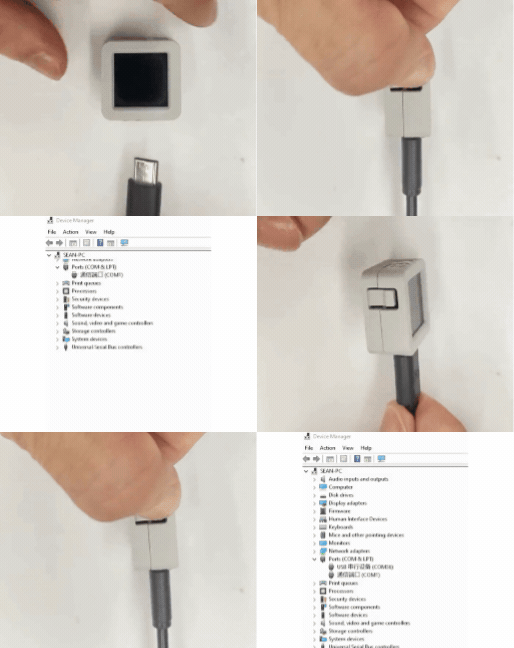
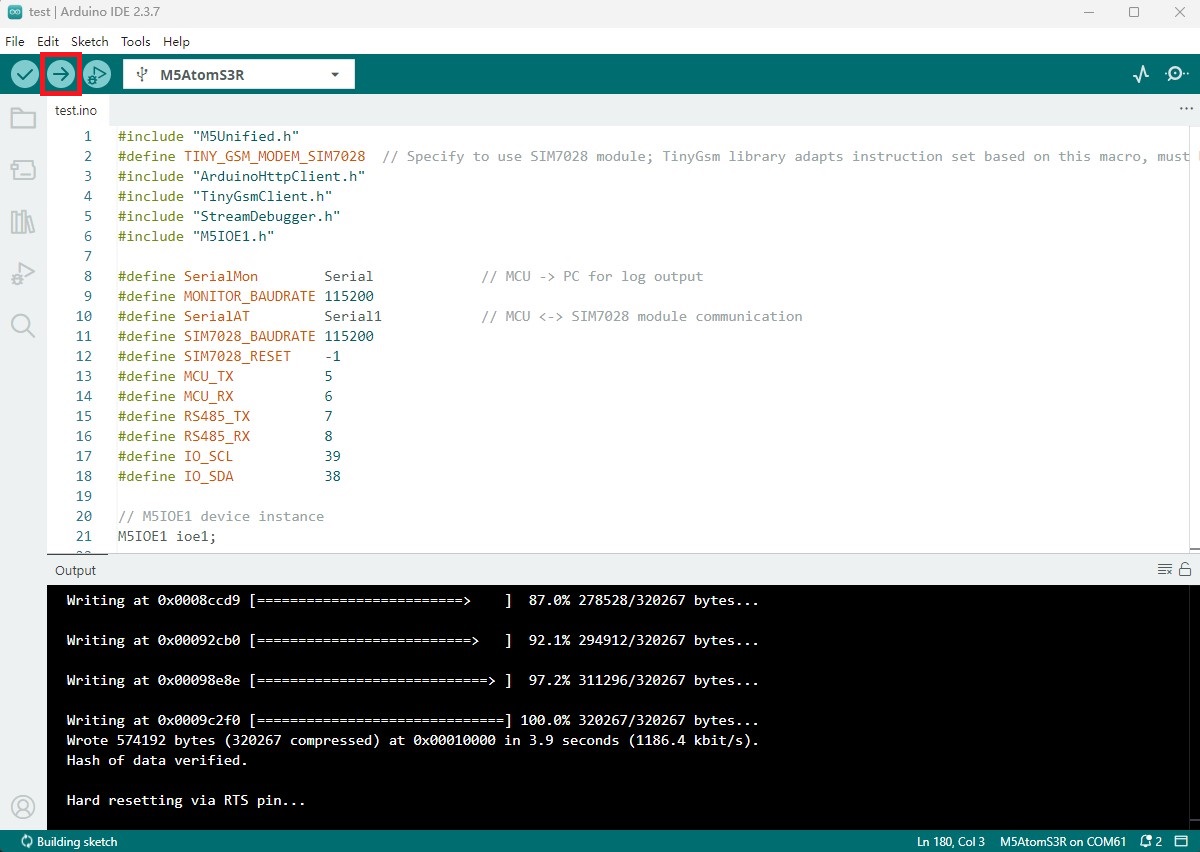
- 2. 选中设备端口,点击 Arduino IDE 左上角编译上传按钮,等待程序完成编译并上传至设备。
5. 通信效果
- MQTT 通信
设备上电后,串口监视器会输出通信模块及 MQTT 服务器相关信息,连接成功后每隔 10 秒会向服务器发布一条消息,同时订阅的主题有消息时会打印接收到的消息内容。
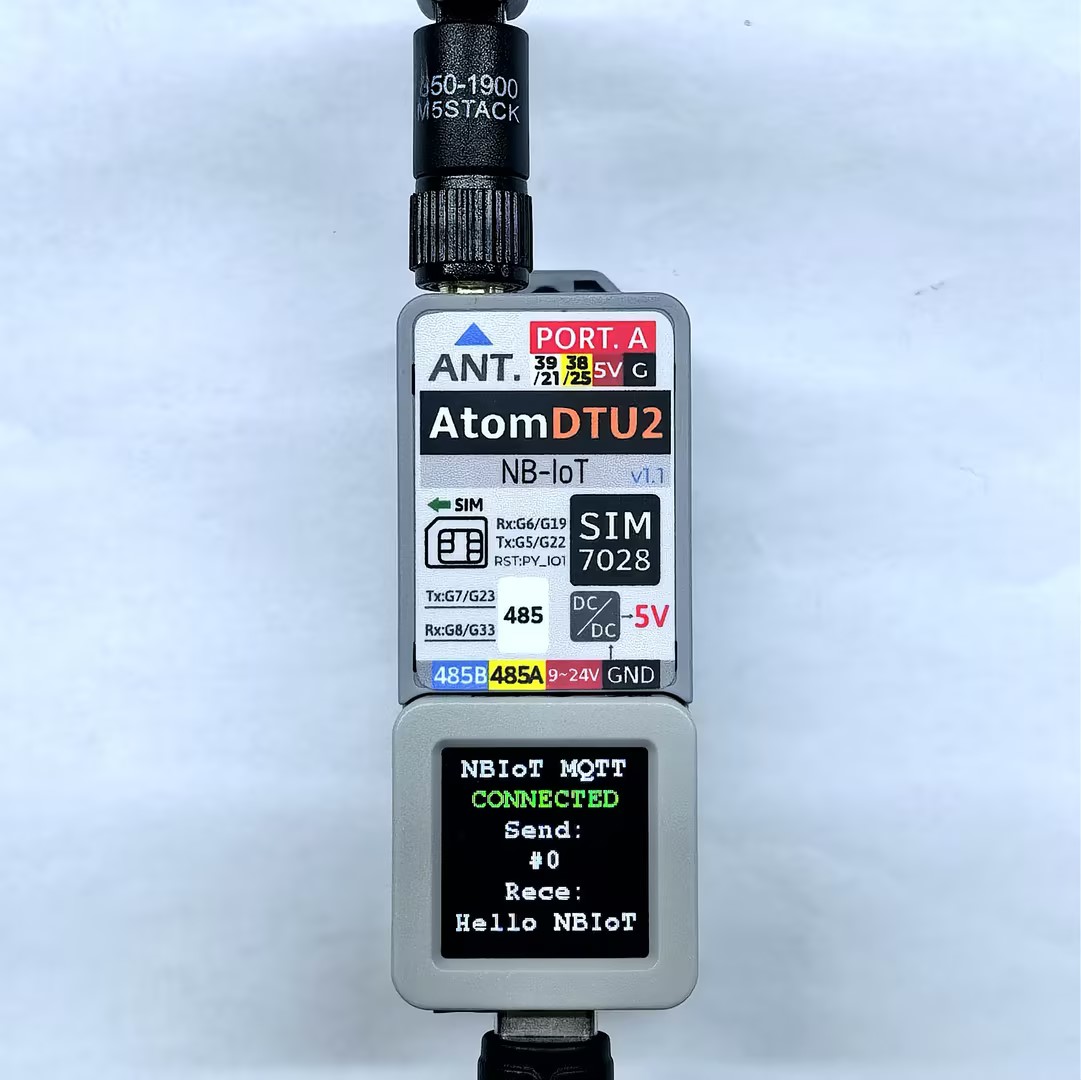
串口监视器反馈如下所示:
>>SIM7028 MQTT TEST
Initializing modem...
Waiting for network...
success
Waiting for GPRS connect...
success
CCID: 898607B01022C0006068
Signal quality: 18
Device IP address: 100.50.14.152

OK
success
>> MQTT NOT CONNECTED
MQTT state code: -1
>> Connecting to MQTT broker: mqtt.m5stack.com
>> MQTT CONNECTED, subscribing: Atom DTU NBIoT v1.1 Receive
>> [MQTT SEND] Topic: Atom DTU NBIoT v1.1 Send
Info: SIM7028 MQTT! #0
=== MQTT CONNECTED ===
>> [MQTT RECEIVE] Topic: Atom DTU NBIoT v1.1 Receive
Info: Hello NBIoT- HTTP 通信
设备上电后,串口监视器会输出通信模块相关信息,连接成功后会向指定服务器循环发送 GET 和 POST 请求,主控屏幕会显示请求状态,串口可查看详细信息。
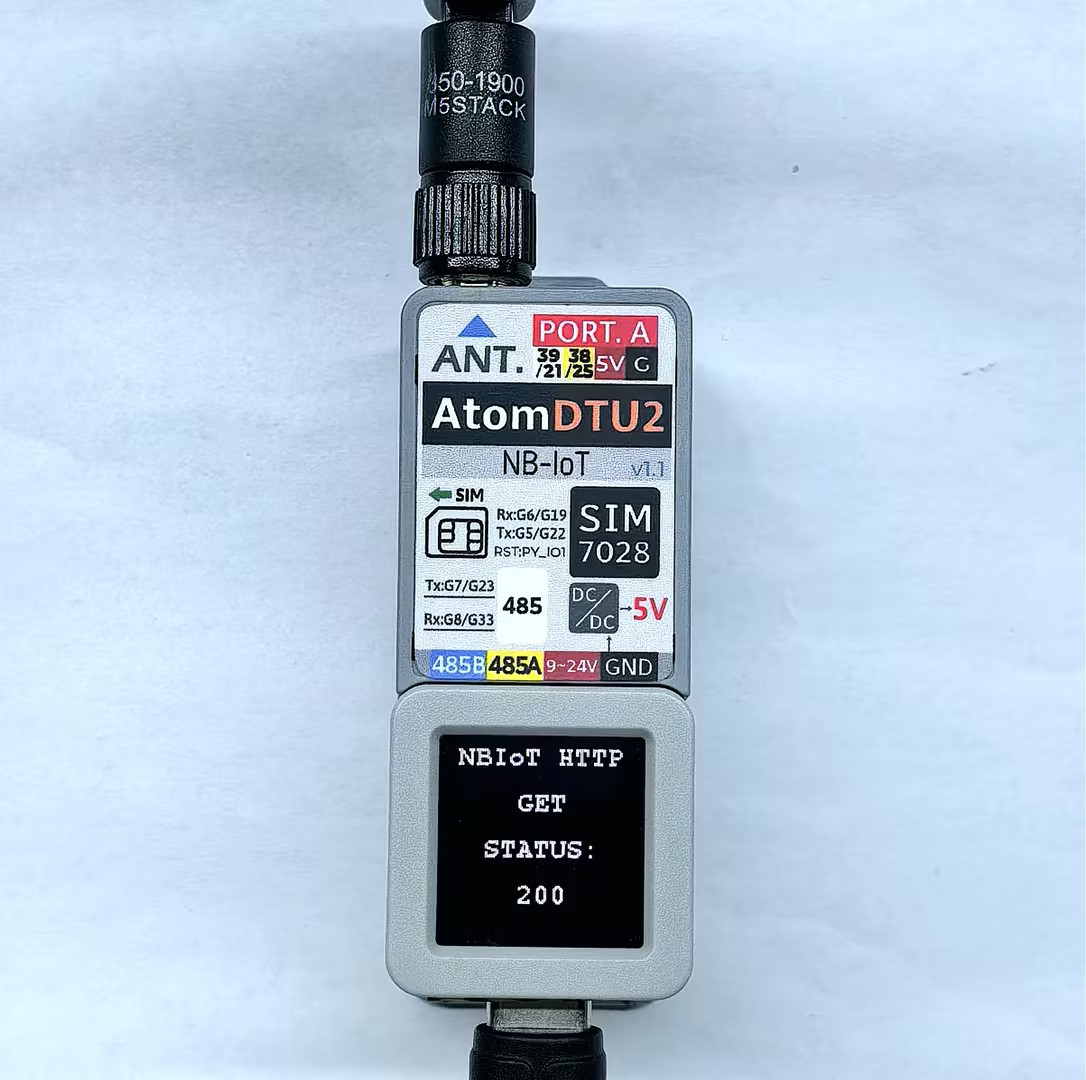
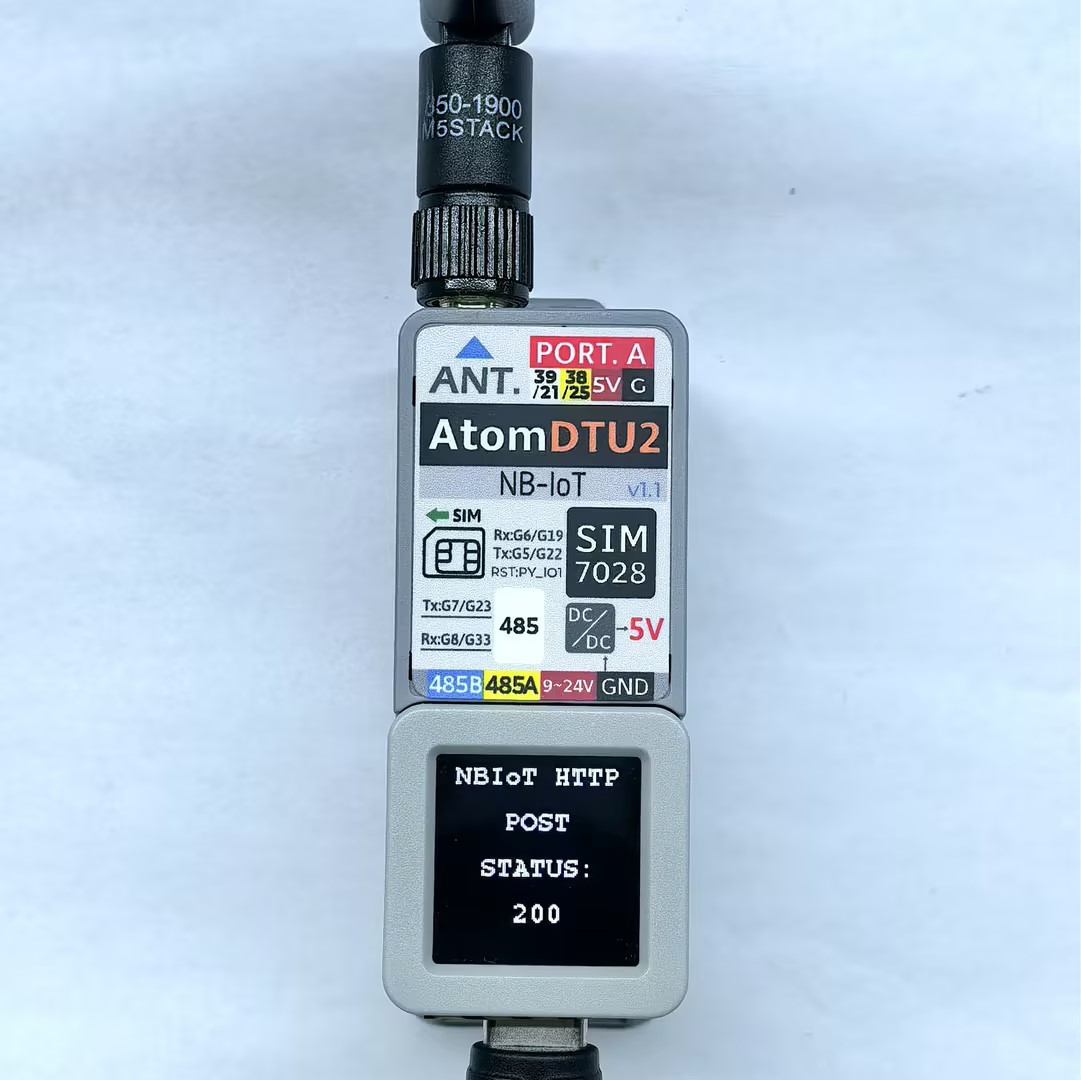
串口监视器反馈如下所示:
>>SIM7028 HTTP TEST
[M5IOE1] Initializing M5IOE1 with 100KHz (device default)
[M5IOE1] Device UID: 0xDF0E, FW Version: 41
[M5IOE1] Current I2C speed matches user request (100K)
[M5IOE1] I2C config set and verified: sleep=0, speed=100K, wake=falling, pull=on
[M5IOE1] M5IOE1 initialized at address 0x6F (I2C: 100000 Hz)
[M5IOE1] Interrupt mode -> POLLING (pause if I2C sleep on; resume when off)
[M5IOE1] Pin 1 interrupt detached and verified
[M5IOE1] Pin 8 mode set and verified: 0x03
[M5IOE1] Pin 10 mode set and verified: 0x03
SIM power enabled
Initializing modem...
Waiting for network...
success
Waiting for GPRS connect...
success
CCID: 898607B01022C0006068
Signal quality: 16
Device IP address: 100.65.16.242

OK
success
making GET request
Status code: 200
Response: {
  "args": {},
  "headers": {
    "Host": "httpbin.org",
    "User-Agent": "Arduino/2.2.0",
    "X-Amzn-Trace-Id": "Root=1-6961fd12-1549e2280f15840b34db2c4e"
  },
  "origin": "111.55.204.81",
  "url": "http://httpbin.org/get"
}

Wait five seconds
making POST request
Status code: 200
Response: {
  "args": {},
  "data": "",
  "files": {},
  "form": {
    "age": "12",
    "name": "Alice"
  },
  "headers": {
    "Content-Length": "17",
    "Content-Type": "application/x-www-form-urlencoded",
    "Host": "httpbin.org",
    "User-Agent": "Arduino/2.2.0",
    "X-Amzn-Trace-Id": "Root=1-6961fd1a-4d5c07665fbd6ae37525cd8d"
  },
  "json": null,
  "origin": "111.55.204.81",
  "url": "http://httpbin.org/post"
}

Wait five seconds