

Arduino Quick Start
2. Devices & Examples
3. M5Unified
4. M5GFX
5. Extensions
Unit
Module
Atomic
Tab5
IoT
Accessories
NanoH2 Thread Arduino
NanoH2 OpenThread Arduino–related example programs.
Preparation
Compilation Requirements
- M5Stack Board Manager version >= 3.2.5
- Development board option = M5NanoH2
Basic Configuration Steps
- Open Arduino IDE
- Click Examples:
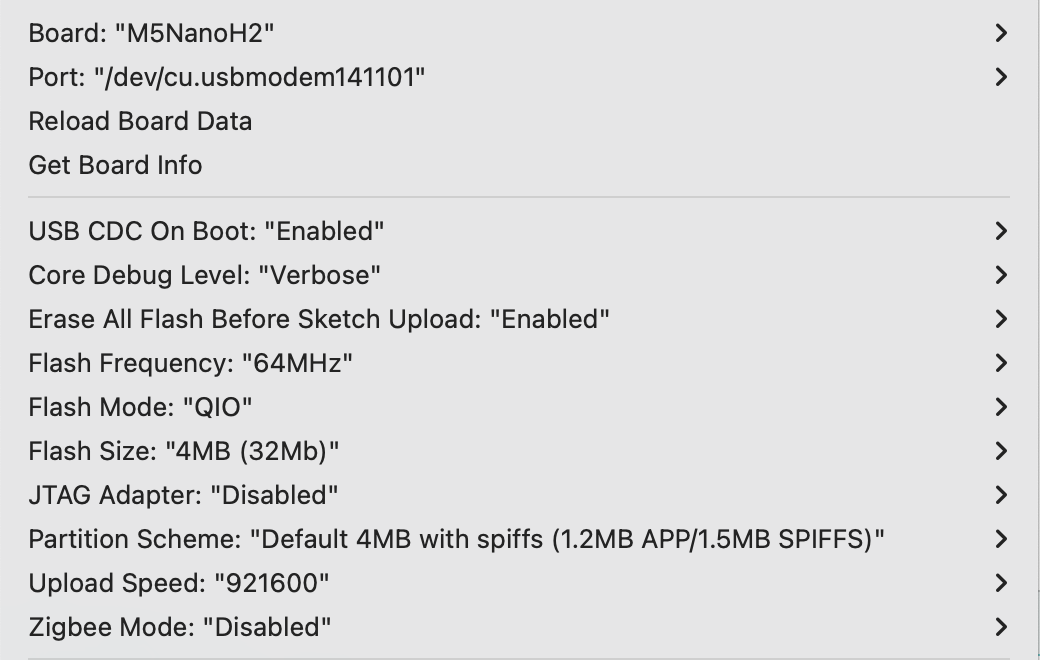
File -> Examples -> OpenThread - Select the correct development board:
Tools -> Board: M5NanoH2 - Enable USB CDC on boot:
Tools -> USB CDC On Boot: Enabled - Select flash size:
Tools -> Flash Size: 4MB - Select partition scheme:
Tools -> Partition Scheme: Default 4MB with spiffs (1.2MB APP/1.5MB SPIFFS) - Select the correct serial port:
Tools -> Port - Upload the firmware to the device
- The device will automatically start and try to join the network
- Check the network status via the Serial Monitor

Example Programs
1. Simple Node
This example demonstrates how to create a basic Thread node.
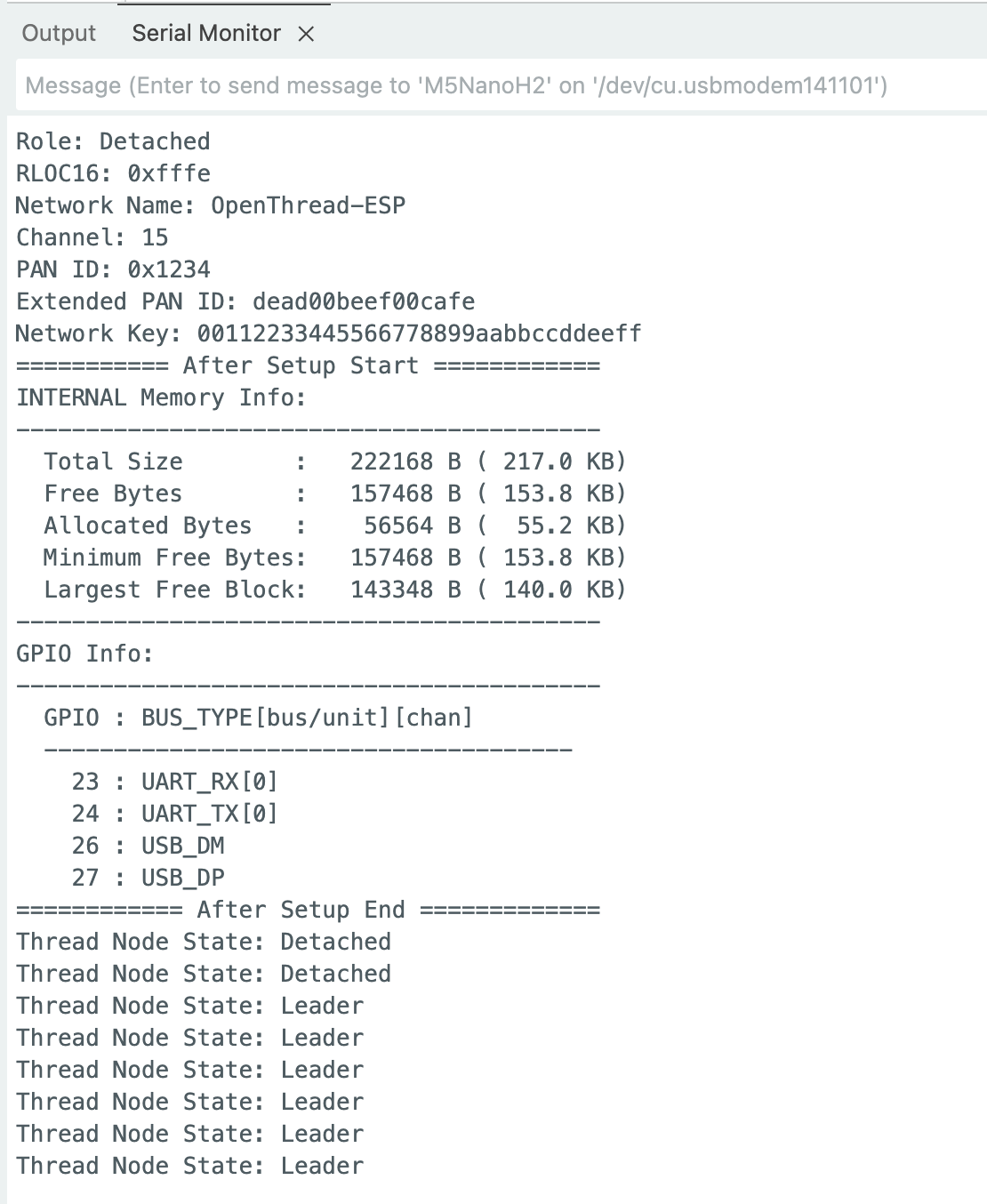
- Automatically starts and joins a Thread network. If no existing Thread network is found, it starts as a Leader node.
- Uses the default network configuration:
- Network Name: OpenThread-ESP
- Network Prefix: fd00:db8:a0:0::/64
- Network Channel: 15
- PAN ID: 0x1234
- Extended PAN ID: dead00beef00cafe
- Network Key: 00112233445566778899aabbccddeeff
- Displays the node status every 5 seconds
cpp
1 2 3 4 5 6 7 8 9 10 11 12 13 14 15 16 17 18
#include "OThreadCLI.h"
#include "OThreadCLI_Util.h"

// The first device to start Thread will be the Leader
// Next devices will be Router or Child

void setup() {
  Serial.begin(115200);
  OThread.begin();  // AutoStart using Thread default settings
  OThreadCLI.begin();
  OThread.otPrintNetworkInformation(Serial);  // Print Current Thread Network Information
}

void loop() {
  Serial.print("Thread Node State: ");
  Serial.println(OThread.otGetStringDeviceRole());
  delay(5000);
}
2. Thread Network (CLI)
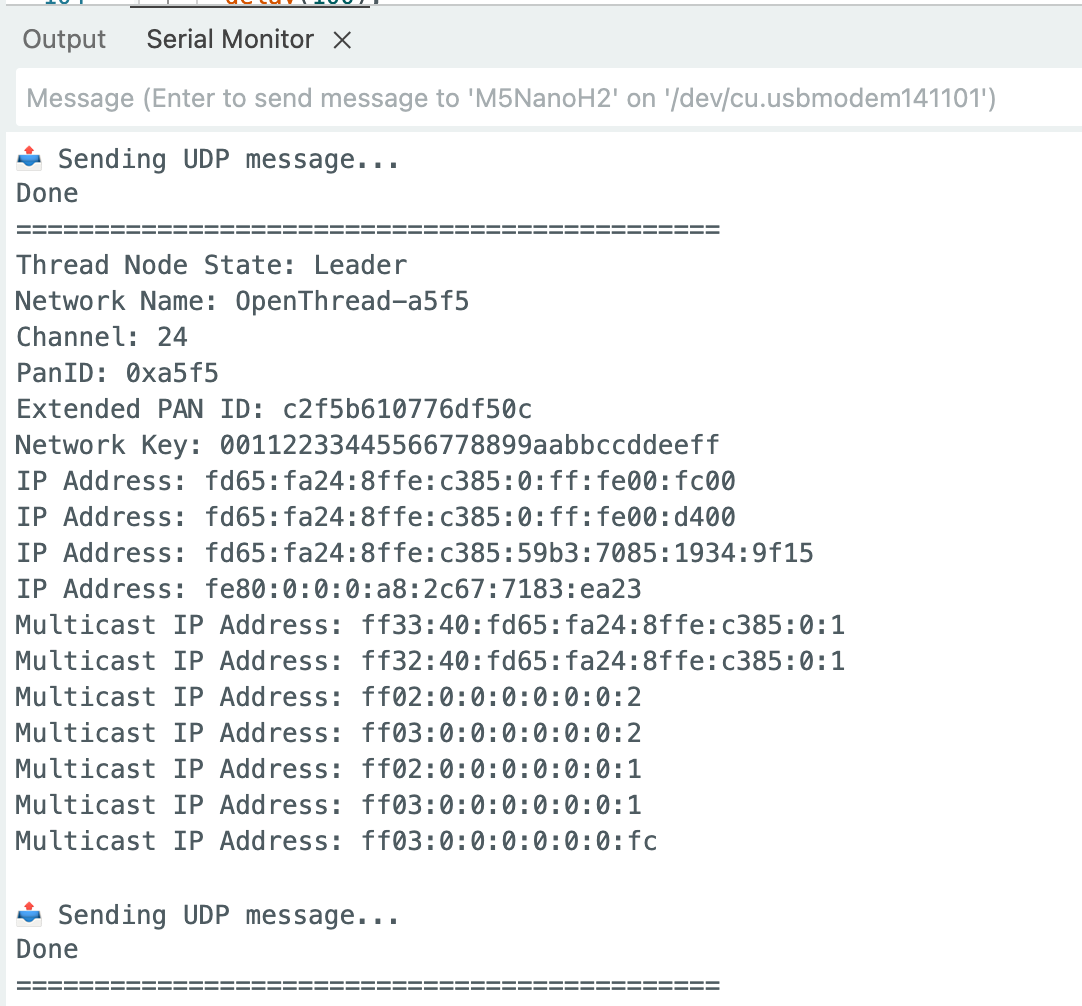
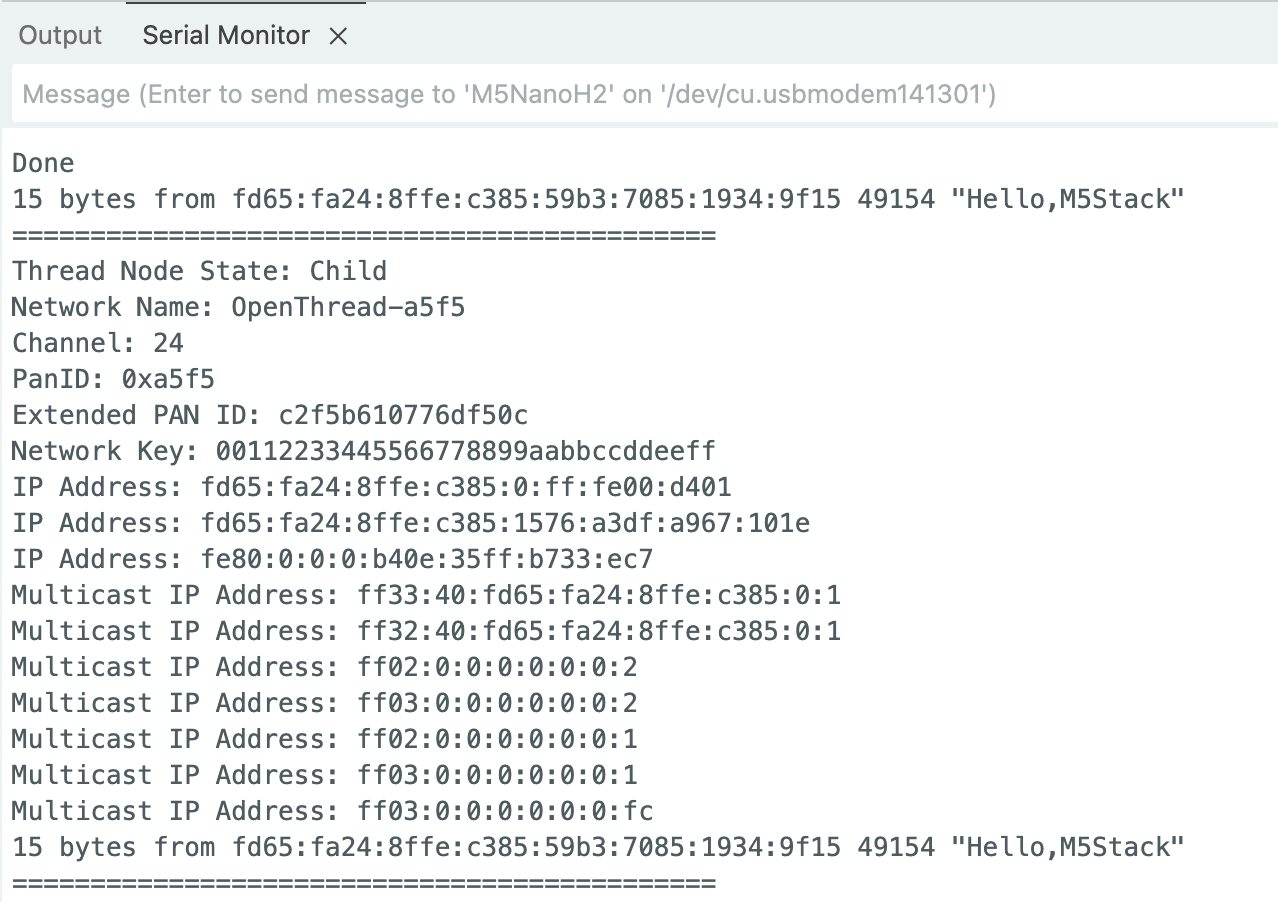
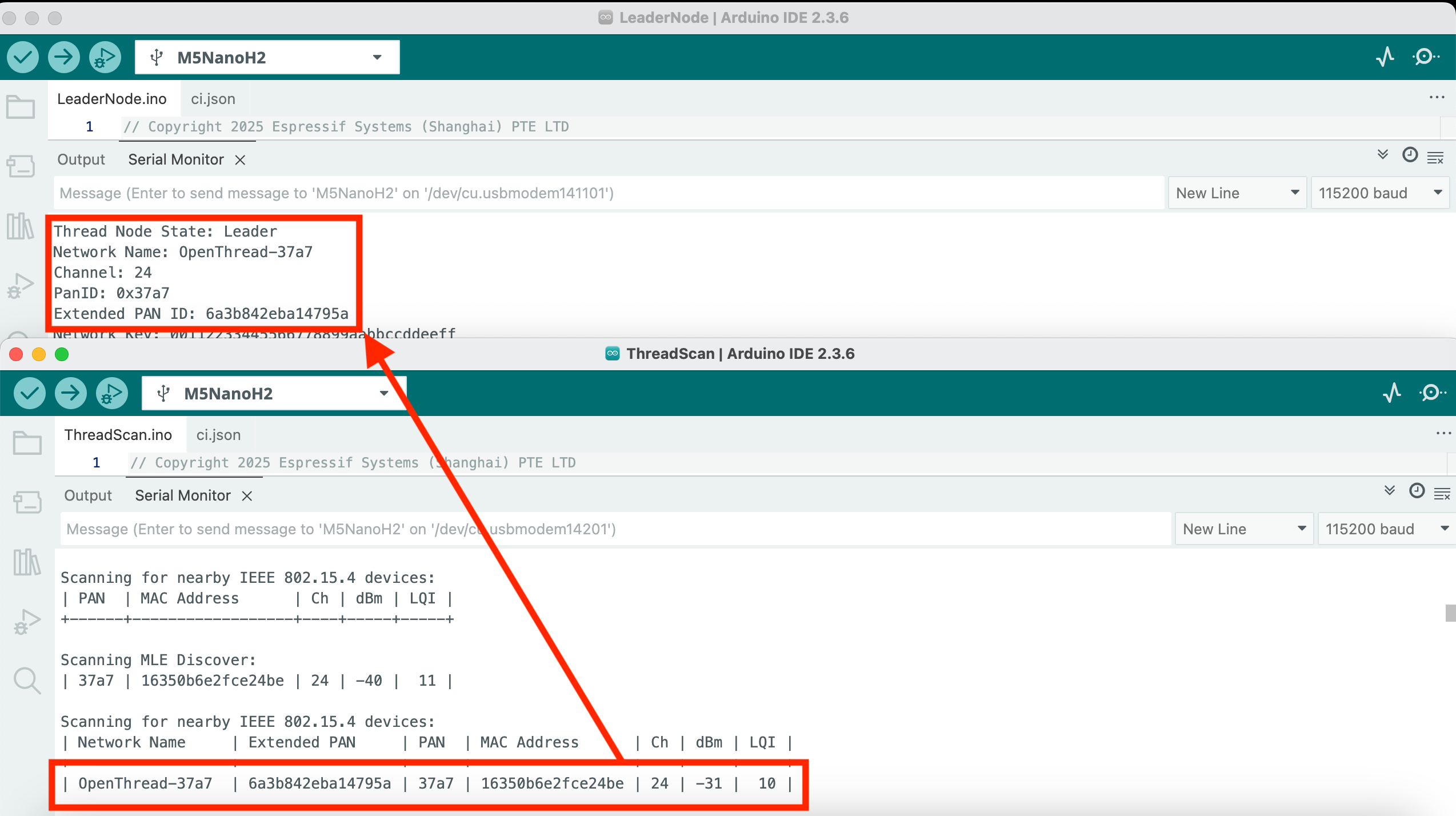
This example demonstrates how to build a complete Thread network with two different types of nodes. The Leader Node sends a "Hello, M5Stack!" message to the Router Node.
2.1 Leader Node
- Creates and manages the Thread network as the first device
- Provides a complete network dataset
- Displays detailed network information:
- Network Name
- Channel
- PAN ID
- Extended PAN ID
- Network Key
- IP Addresses
- Multicast Addresses
- Transmission prompts
cpp
1 2 3 4 5 6 7 8 9 10 11 12 13 14 15 16 17 18 19 20 21 22 23 24 25 26 27 28 29 30 31 32 33 34 35 36 37 38 39 40 41 42 43 44 45 46 47 48 49 50 51 52 53 54 55 56 57 58 59 60 61 62 63 64 65 66 67 68 69 70 71 72 73 74 75 76 77 78 79 80 81 82 83
#include "OThreadCLI.h"
#include "OThreadCLI_Util.h"

#define CLI_NETWORK_KEY    "dataset networkkey 00112233445566778899aabbccddeeff"
#define CLI_NETWORK_CHANEL "dataset channel 24"

otInstance *aInstance = NULL;

bool udpInitialized = false;

void setup() {
  Serial.begin(115200);
  OThread.begin(false);
  OThreadCLI.begin();
  Serial.println();
  Serial.println("Setting up OpenThread Node as Leader");
  aInstance = esp_openthread_get_instance();

  OThreadCLI.println("dataset init new");
  OThreadCLI.println(CLI_NETWORK_KEY);
  OThreadCLI.println(CLI_NETWORK_CHANEL);
  OThreadCLI.println("dataset commit active");
  OThreadCLI.println("ifconfig up");
  OThreadCLI.println("thread start");
}

void loop() {
  while (OThreadCLI.available()) {
    Serial.write(OThreadCLI.read());
  }

  Serial.println("=============================================");
  Serial.print("Thread Node State: ");
  Serial.println(OThread.otGetStringDeviceRole());

  if (OThread.otGetDeviceRole() == OT_ROLE_LEADER) {
    const char *networkName = otThreadGetNetworkName(aInstance);
    Serial.printf("Network Name: %s\r\n", networkName);
    uint8_t channel = otLinkGetChannel(aInstance);
    Serial.printf("Channel: %d\r\n", channel);
    uint16_t panId = otLinkGetPanId(aInstance);
    Serial.printf("PanID: 0x%04x\r\n", panId);
    const otExtendedPanId *extPanId = otThreadGetExtendedPanId(aInstance);
    Serial.printf("Extended PAN ID: ");
    for (int i = 0; i < OT_EXT_PAN_ID_SIZE; i++) {
      Serial.printf("%02x", extPanId->m8[i]);
    }
    Serial.println();
    otNetworkKey networkKey;
    otThreadGetNetworkKey(aInstance, &networkKey);
    Serial.printf("Network Key: ");
    for (int i = 0; i < OT_NETWORK_KEY_SIZE; i++) {
      Serial.printf("%02x", networkKey.m8[i]);
    }
    Serial.println();
    char buf[OT_IP6_ADDRESS_STRING_SIZE];
    const otNetifAddress *address = otIp6GetUnicastAddresses(aInstance);
    while (address != NULL) {
      otIp6AddressToString(&address->mAddress, buf, sizeof(buf));
      Serial.printf("IP Address: %s\r\n", buf);
      address = address->mNext;
    }
    const otNetifMulticastAddress *mAddress = otIp6GetMulticastAddresses(aInstance);
    while (mAddress != NULL) {
      otIp6AddressToString(&mAddress->mAddress, buf, sizeof(buf));
      printf("Multicast IP Address: %s\n", buf);
      mAddress = mAddress->mNext;
    }

    if (!udpInitialized) {
      Serial.println("\nInitializing UDP sender...");
      OThreadCLI.println("udp open");
      delay(100);
      udpInitialized = true;
      Serial.println("UDP initialized");
    }

    Serial.println("\nSending UDP message...");
    OThreadCLI.println("udp send ff03::1 12345 \"Hello,M5Stack\"");
  }

  delay(5000);
}
2.2 Router Node
- Joins an existing Thread network and forwards network data
- Displays connection status and network information
- Prints received messages to the serial monitor
cpp
1 2 3 4 5 6 7 8 9 10 11 12 13 14 15 16 17 18 19 20 21 22 23 24 25 26 27 28 29 30 31 32 33 34 35 36 37 38 39 40 41 42 43 44 45 46 47 48 49 50 51 52 53 54 55 56 57 58 59 60 61 62 63 64 65 66 67 68 69 70 71 72 73 74 75 76 77 78 79 80 81 82 83 84
#include "OThreadCLI.h"
#include "OThreadCLI_Util.h"

#define CLI_NETWORK_KEY    "dataset networkkey 00112233445566778899aabbccddeeff"
#define CLI_NETWORK_CHANEL "dataset channel 24"

otInstance *aInstance = NULL;

bool udpInitialized = false;

void setup() {
  Serial.begin(115200);
  OThread.begin(false);
  OThreadCLI.begin();
  Serial.println();
  Serial.println("Setting up OpenThread Node as Router/Child");
  Serial.println("Make sure the Leader Node is already running");
  aInstance = esp_openthread_get_instance();

  OThreadCLI.println("dataset clear");
  OThreadCLI.println(CLI_NETWORK_KEY);
  OThreadCLI.println(CLI_NETWORK_CHANEL);
  OThreadCLI.println("dataset commit active");
  OThreadCLI.println("ifconfig up");
  OThreadCLI.println("thread start");
}

void loop() {
  while (OThreadCLI.available()) {
    Serial.write(OThreadCLI.read());
  }

  Serial.println("=============================================");
  Serial.print("Thread Node State: ");
  Serial.println(OThread.otGetStringDeviceRole());

  if (OThread.otGetDeviceRole() == OT_ROLE_CHILD || OThread.otGetDeviceRole() == OT_ROLE_ROUTER) {
    const char *networkName = otThreadGetNetworkName(aInstance);
    Serial.printf("Network Name: %s\r\n", networkName);
    uint8_t channel = otLinkGetChannel(aInstance);
    Serial.printf("Channel: %d\r\n", channel);
    uint16_t panId = otLinkGetPanId(aInstance);
    Serial.printf("PanID: 0x%04x\r\n", panId);
    const otExtendedPanId *extPanId = otThreadGetExtendedPanId(aInstance);
    Serial.printf("Extended PAN ID: ");
    for (int i = 0; i < OT_EXT_PAN_ID_SIZE; i++) {
      Serial.printf("%02x", extPanId->m8[i]);
    }
    Serial.println();
    otNetworkKey networkKey;
    otThreadGetNetworkKey(aInstance, &networkKey);
    Serial.printf("Network Key: ");
    for (int i = 0; i < OT_NETWORK_KEY_SIZE; i++) {
      Serial.printf("%02x", networkKey.m8[i]);
    }
    Serial.println();
    char buf[OT_IP6_ADDRESS_STRING_SIZE];
    const otNetifAddress *address = otIp6GetUnicastAddresses(aInstance);
    while (address != NULL) {
      otIp6AddressToString(&address->mAddress, buf, sizeof(buf));
      Serial.printf("IP Address: %s\r\n", buf);
      address = address->mNext;
    }
    const otNetifMulticastAddress *mAddress = otIp6GetMulticastAddresses(aInstance);
    while (mAddress != NULL) {
      otIp6AddressToString(&mAddress->mAddress, buf, sizeof(buf));
      printf("Multicast IP Address: %s\n", buf);
      mAddress = mAddress->mNext;
    }

    if (!udpInitialized) {
      Serial.println("\nInitializing UDP receiver...");
      OThreadCLI.println("udp open");
      delay(100);
      OThreadCLI.println("udp bind :: 12345");
      delay(100);
      udpInitialized = true;
      Serial.println("UDP listening on port 12345");
      Serial.println("Waiting for messages...\n");
    }
  }

  delay(5000);
}
3. Thread Scan
This example demonstrates how to scan nearby Thread networks.
- Scan IEEE 802.15.4 devices
- Display device addresses
- Display signal strength
- Display channel information
- Scan Thread networks (the device must be at least in Child state)
- Display network name
- Display extended PAN ID
- Display RLOC16
- Display version information
- Supports continuous scanning mode
cpp
1 2 3 4 5 6 7 8 9 10 11 12 13 14 15 16 17 18 19 20 21 22 23 24 25 26 27 28 29 30 31
#include "OThreadCLI.h"
#include "OThreadCLI_Util.h"

void setup() {
  Serial.begin(115200);
  OThread.begin(true);  // For scanning, AutoStart must be active, any setup
  OThreadCLI.begin();
  OThreadCLI.setTimeout(100);  // Set a timeout for the CLI response
  Serial.println();
  Serial.println("This sketch will continuously scan the Thread Local Network and all devices IEEE 802.15.4 compatible");
}

void loop() {
  Serial.println();
  Serial.println("Scanning for nearby IEEE 802.15.4 devices:");
  if (!otPrintRespCLI("scan", Serial, 3000)) {
    Serial.println("Scan Failed...");
  }
  delay(5000);
  if (OThread.otGetDeviceRole() < OT_ROLE_CHILD) {
    Serial.println();
    Serial.println("This device has not started Thread yet, bypassing Discovery Scan");
    return;
  }
  Serial.println();
  Serial.println("Scanning MLE Discover:");
  if (!otPrintRespCLI("discover", Serial, 3000)) {
    Serial.println("Discover Failed...");
  }
  delay(5000);
}
4. Simple CLI
This example provides a complete OpenThread CLI console.
- Provides a full CLI command interface
- Supports all OpenThread CLI commands:
- Network management commands
- Device configuration commands
- Diagnostic commands
- Security commands
- Real-time command responses
- Supports command history
- Convenient for debugging and configuration
cpp
1 2 3 4 5 6 7 8 9 10 11
#include "OThreadCLI.h"

void setup() {
  Serial.begin(115200);
  OThread.begin(false);  // No AutoStart - fresh start
  OThreadCLI.begin();
  Serial.println("OpenThread CLI started - type 'help' for a list of commands.");
  OThreadCLI.startConsole(Serial);
}

void loop() {}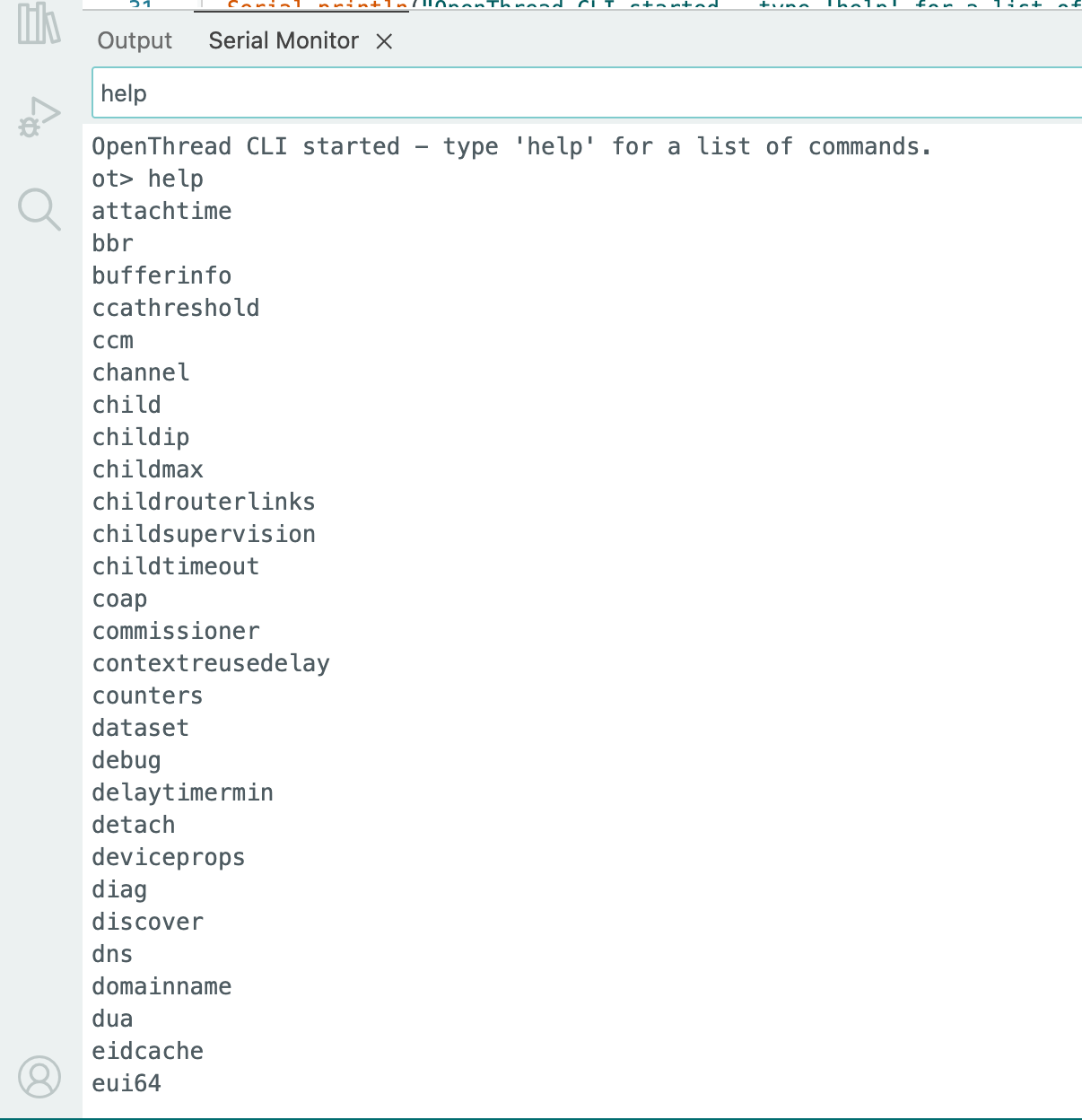
5. Receive Callback (onReceive)
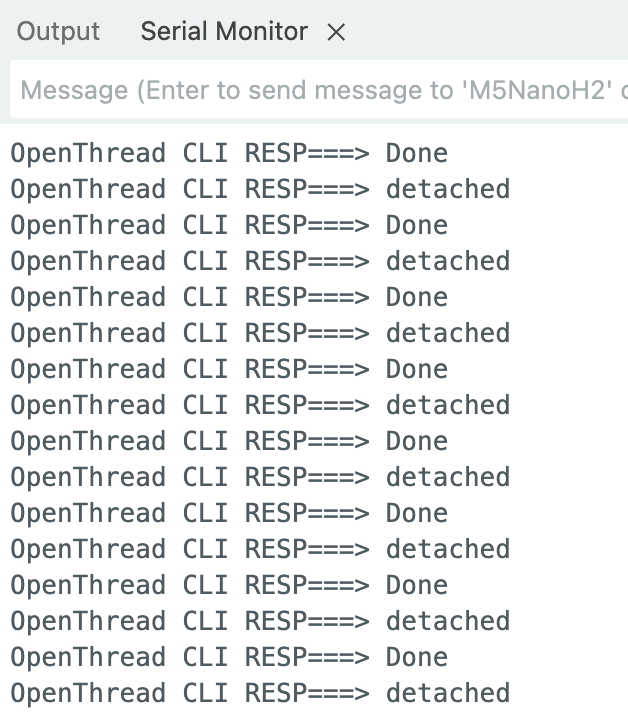
This example demonstrates how to handle CLI responses using callback functions.
- Capture CLI responses
- Custom response processing
- Status monitoring
- Supports asynchronous processing
cpp
1 2 3 4 5 6 7 8 9 10 11 12 13 14 15 16 17 18 19 20 21 22 23 24 25 26 27 28 29
#include "OThreadCLI.h"

// reads all the lines sent by CLI, one by one
// ignores some lines that are just a sequence of \r\n
void otReceivedLine() {
  String line = "";
  while (OThreadCLI.available() > 0) {
    char ch = OThreadCLI.read();
    if (ch != '\r' && ch != '\n') {
      line += ch;
    }
  }
  if (line.length() > 0) {
    Serial.print("OpenThread CLI RESP===> ");
    Serial.println(line.c_str());
  }
}

void setup() {
  Serial.begin(115200);
  OThread.begin();  // AutoStart
  OThreadCLI.begin();
  OThreadCLI.onReceive(otReceivedLine);
}

void loop() {
  OThreadCLI.println("state");
  delay(1000);
}
Page Tools