

Arduino Quick Start
2. Devices & Examples
3. M5Unified
4. M5GFX
5. Extensions
Unit
Module
Atomic
Tab5
IoT
Accessories
StackChan NFC Near Field Communication
Basic Description
Compilation Requirements
- M5Stack Board Manager Version >= 3.2.2
- Development Board Selection = M5CoreS3
- M5Unified Library Version >= 0.2.11
- M5StackChan Library Version >= 1.0.0
Core Objects
// NFC protocol layer instances
m5::nfc::NFCLayerA nfc_a{unit};             // NFC-A protocol layer (reader mode)
m5::nfc::EmulationLayerA emu_a{unit};       // NFC-A emulation layer (tag emulation mode)

// Card object
PICC picc{}; // Represents a detected cardMIFARE Classic Key
constexpr Key keyA = DEFAULT_KEY;
constexpr Key keyB = DEFAULT_KEY;
// DEFAULT_KEY is 0xFFFFFFFFFFFF (Default value)Reader Basic Workflow
A typical NFC reader operation flow includes the following steps:
- Initialization:
M5.begin()andWire.begin() - Detection: Use
nfc_a.detect()ornfc_a.detect(piccs)to find cards - Identification: Use
nfc_a.identify()to determine card type and memory layout - Activation: Use
nfc_a.reactivate()to obtain complete communication parameters - Authentication: For MIFARE Classic cards, use
mifareClassicAuthenticateA/B()for authentication - Operation: Perform read, write, or special operations
- Deactivation: Use
nfc_a.deactivate()to release the card
Card Object Common Methods
| Method | Return Type | Description |
|---|---|---|
picc.isMifareClassic() | bool | Check if it is Classic1K/4K |
picc.isMifareUltralight() | bool | Check if it is Ultralight series |
picc.isMifareDESFire() | bool | Check if it is DESFire series |
picc.isUserBlock(block) | bool | Check if block is user-usable |
picc.uidAsString() | string | Get UID as hex string |
picc.typeAsString() | string | Get card type name |
picc.userAreaSize() | uint16_t | Get user area size |
picc.totalSize() | uint16_t | Get card total capacity |
Tag Emulation Basic Concept
Tag Emulation enables a device to act as an NFC card, allowing other NFC readers to detect and communicate with it. This is commonly used in applications that need to emulate various NFC card types (such as MIFARE Ultralight, NTAG, etc.).
Main steps for tag emulation:
- Create PICC object: Represents the virtual card to be emulated
- Define card type and UID: Choose the specific card type to emulate and its unique identifier
- Prepare memory data: Set data in the card memory (may include NDEF messages)
- Embed UID: Write the UID correctly to the specified location in memory
- Start emulation: Call
emu_a.begin()to start emulation - Update state: In the main loop, call
emu_a.update()to handle reader queries
Tag Information Definition
constexpr Type type{Type::MIFARE_Ultralight};  // Select tag type to emulate (e.g., MIFARE_Ultralight or NTAG_213)
constexpr uint8_t uid[] = {0x04, 0x34, 0x56, 0x78, 0x9A, 0xBC, 0xDE};  // 7-byte UID
uint8_t picc_memory[64]{}; // Emulated tag memory buffer (size depends on card type)Tag Emulation API
Emulation Operations
| Method | Function |
|---|---|
picc.emulate(type, uid, uid_len) | Configure card type and UID to emulate |
emu_a.begin(picc, memory, mem_size) | Start emulation with card and memory data |
emu_a.emulatePICC() | Get current emulated PICC object |
emu_a.update() | Update emulation state (call in main loop) |
emu_a.state() | Get current emulation state |
State Values
The emulator has the following states:
None(none),Off(off),Idle(idle),Ready(ready),Active(active),Halt(halt)
Helper Functions
| Function | Function |
|---|---|
embed_uid(memory, uid) | Embed 7-byte UID into Ultralight/NTAG memory layout |
bcc8(data, len, init) | Calculate BCC (Block Check Character) for UID validation |
Quick Scan Identification
This example demonstrates how to quickly scan and identify NFC cards. The program continuously detects cards within the reader range. For each detected card, it executes a two-step identification process: first using detect() for preliminary classification, then using identify() for precise identification. After successful identification, it outputs card information including UID, type, ATQA, and SAK. This is a fundamental step for implementing NFC applications.
#include <M5StackChan.h>
#include <M5UnitUnified.h>
#include <M5UnitUnifiedNFC.h>
#include <M5Utility.h>
#include <vector>

using namespace m5::nfc::a; // Use NFC-A protocol namespace (ISO 14443-3A)
using namespace m5::nfc::a::mifare; // MIFARE card common operations
using namespace m5::nfc::a::mifare::classic; // MIFARE Classic card specific operations

namespace {
auto& lcd = M5StackChan.Display();
m5::unit::UnitUnified Units; // Unit unified manager instance
m5::unit::UnitNFC unit{};  // NFC Unit instance (I2C interface)
m5::nfc::NFCLayerA nfc_a{unit}; // NFC-A protocol layer instance for ISO 14443-3A cards

// KeyA that can authenticate all blocks
// If it's a different key value, change it
constexpr Key keyA = DEFAULT_KEY;  // Default as 0xFFFFFFFFFFFF
}  // namespace

void setup()
{
    M5StackChan.begin();
    // The screen shall be in landscape mode
    if (lcd.height() > lcd.width()) {
        lcd.setRotation(1);
    }

    bool unit_ready{};// Unit initialization status flag

    // Add NFC Unit to manager and initialize
    unit_ready = Units.add(unit, M5.In_I2C) && Units.begin();
    if (!unit_ready) {
        // Initialization failed: turn screen red and enter infinite loop
        M5_LOGE("Failed to begin");
        lcd.fillScreen(TFT_RED);
        while (true) {
            m5::utility::delay(10000);
        }
    }
    M5_LOGI("M5UnitUnified initialized");
    M5_LOGI("%s", Units.debugInfo().c_str());

    lcd.setFont(&fonts::FreeMonoBold9pt7b);
    lcd.fillScreen(0);
    lcd.printf("Place tag on the top\nand touch screen to detect");
    M5.Log.printf("Place tag on the top and touch screen to detect\n");
}

void loop()
{
    M5StackChan.update();
    Units.update();// Update all registered Units

    if (M5.Touch.getCount() && M5.Touch.getDetail(0).wasClicked()) {
        lcd.fillScreen(0);
        lcd.setCursor(0, 0);
        PICC picc{}; // Create card object
        if (nfc_a.detect(picc)) { // Detect a single card
            // Identify card type and reactivate (get full communication parameters)
            if (nfc_a.identify(picc) && nfc_a.reactivate(picc)) {
                lcd.printf("%s\n%s", picc.uidAsString().c_str(), picc.typeAsString().c_str());
                // Print detailed info: UID, type, user area size, total size
                M5.Log.printf("==== Dump %s %s %u/%u ====\n", picc.uidAsString().c_str(), picc.typeAsString().c_str(),
                              picc.userAreaSize(), picc.totalSize());
                // Dump all card data (needs key for MIFARE Classic, key parameter ignored for other types)
                nfc_a.dump(keyA);  // Need key if MIFARE classic, Ignore key if not MIFARE classic
                nfc_a.deactivate();
            } else {
                lcd.printf("Failed to identify");
                M5_LOGE("Failed to identify/activate %s", picc.uidAsString().c_str());
            }
        } else {
            lcd.printf("PICC NOT exists");
            M5.Log.printf("PICC NOT exists\n");
        }
    }
}After uploading the above code to the main controller, open the serial monitor and place one or more tag cards near the top sensing surface of StackChan to see the identification results.
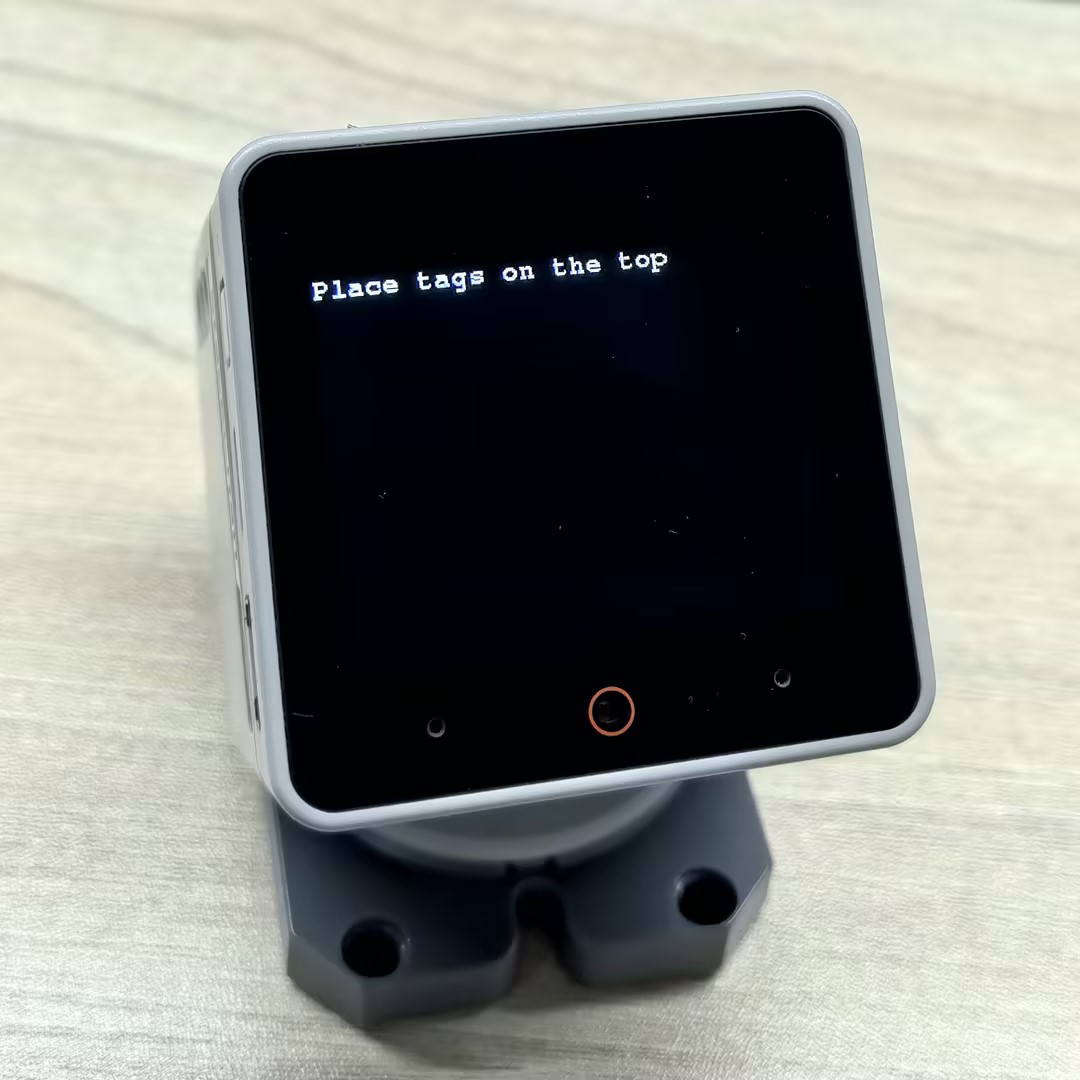
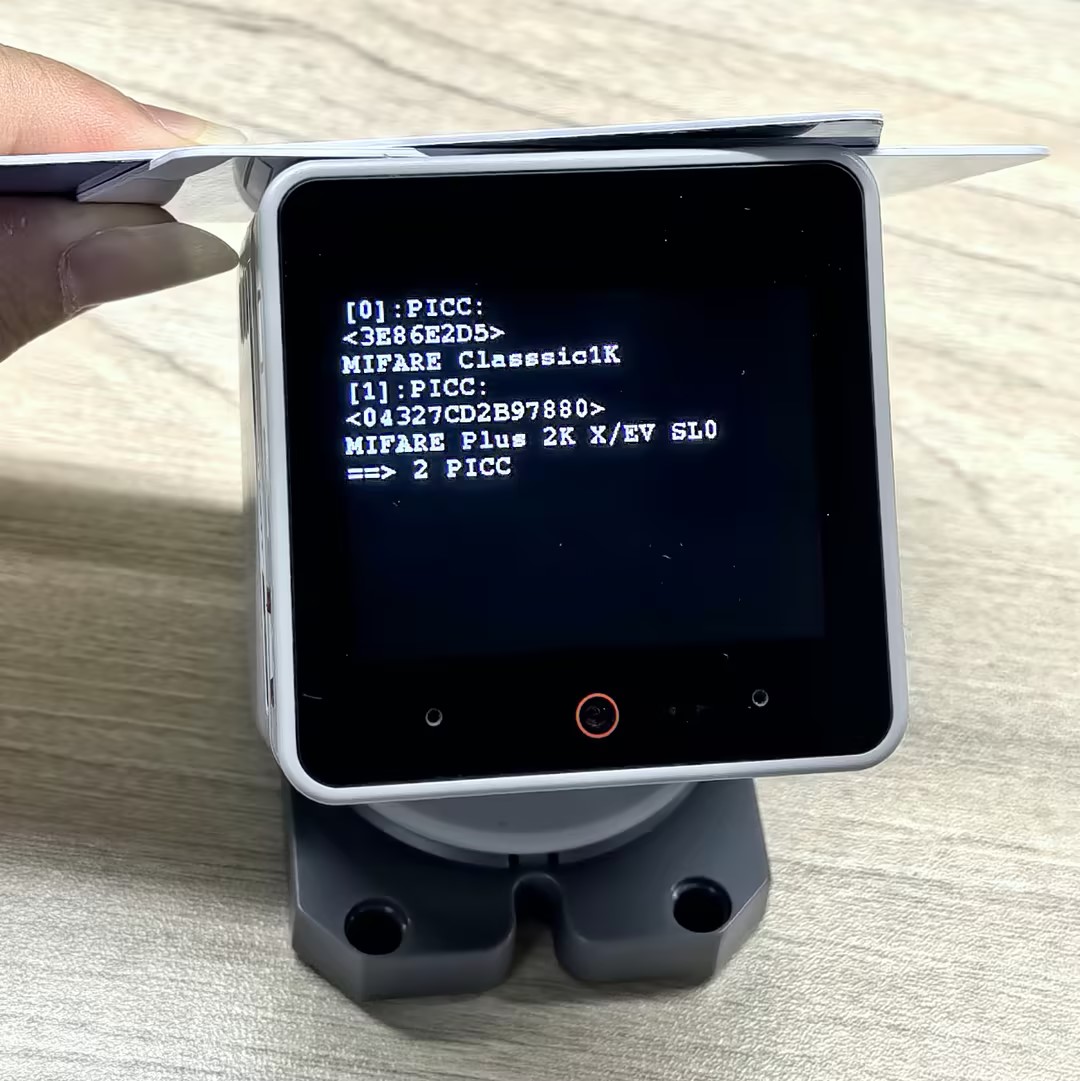
Serial monitor output example:
PICC:3E86E2D5 MIFARE Classsic1K 0004/08 752/1024
PICC:04327CD2B97880 MIFARE Plus 2K X/EV SL0 0044/20 1520/2048
==> 2 PICCComplete Data Reading
This process requires placing the card near the top sensing surface of StackChan when touching the screen. After the program detects the card, it automatically executes reading and prints data to both the screen and serial port. During the reading process, the program performs complete card identification and activation.
#include <M5Unified.h>
#include <M5UnitUnified.h>
#include <M5UnitUnifiedNFC.h>
#include <M5Utility.h>
#include <Wire.h>
#include <vector>

using namespace m5::nfc::a; // NFC-A protocol layer
using namespace m5::nfc::a::mifare; // MIFARE card common operations
using namespace m5::nfc::a::mifare::classic; // MIFARE Classic card specific operations

namespace {
auto& lcd = M5.Display;
m5::unit::UnitUnified Units; // Unit unified manager instance
m5::unit::UnitNFC unit{};  // NFC Unit instance (I2C interface)
m5::nfc::NFCLayerA nfc_a{unit}; // NFC-A protocol layer instance for ISO 14443-3A cards

// KeyA that can authenticate all blocks
// If it's a different key value, change it
constexpr Key keyA = DEFAULT_KEY;  // Default as 0xFFFFFFFFFFFF
}  // namespace

void setup()
{
    M5.begin();

    // The screen shall be in landscape mode
    if (lcd.height() > lcd.width()) {
        lcd.setRotation(1);
    }

    bool unit_ready{};// Unit initialization status flag

    // Add NFC Unit to manager and initialize
    unit_ready = Units.add(unit, M5.In_I2C) && Units.begin();
    if (!unit_ready) {
        M5_LOGE("Failed to begin");
        lcd.fillScreen(TFT_RED);
        while (true) {
            m5::utility::delay(10000);
        }
    }

    M5_LOGI("M5UnitUnified initialized");
    M5_LOGI("%s", Units.debugInfo().c_str());

    lcd.setFont(&fonts::FreeMono9pt7b);
    lcd.fillScreen(0);
    lcd.setCursor(0, 0);
    lcd.printf("Please put the PICC\nand click\nBtnA");
    M5.Log.printf("Please put the PICC and click BtnA\n");
}

void loop()
{
    M5.update();
    Units.update();// Update all registered Units

    if (M5.BtnA.wasClicked()) {
        lcd.fillScreen(0);
        lcd.setCursor(0, 0);
        PICC picc{}; // Create card object
        if (nfc_a.detect(picc)) { // Detect a single card
            // Identify card type and reactivate (get full communication parameters)
            if (nfc_a.identify(picc) && nfc_a.reactivate(picc)) {
                lcd.printf("%s\n%s", picc.uidAsString().c_str(), picc.typeAsString().c_str());
                // Print detailed info: UID, type, user area size, total size
                M5.Log.printf("==== Dump %s %s %u/%u ====\n", picc.uidAsString().c_str(), picc.typeAsString().c_str(),
                              picc.userAreaSize(), picc.totalSize());
                // Dump all card data (needs key for MIFARE Classic, key parameter ignored for other types)
                nfc_a.dump(keyA);  // Need key if MIFARE classic, Ignore key if not MIFARE classic
                nfc_a.deactivate();
            } else {
                lcd.printf("Failed to identify");
                M5_LOGE("Failed to identify/activate %s", picc.uidAsString().c_str());
            }
        } else {
            lcd.printf("PICC NOT exists");
            M5.Log.printf("PICC NOT exists\n");
        }
    }
}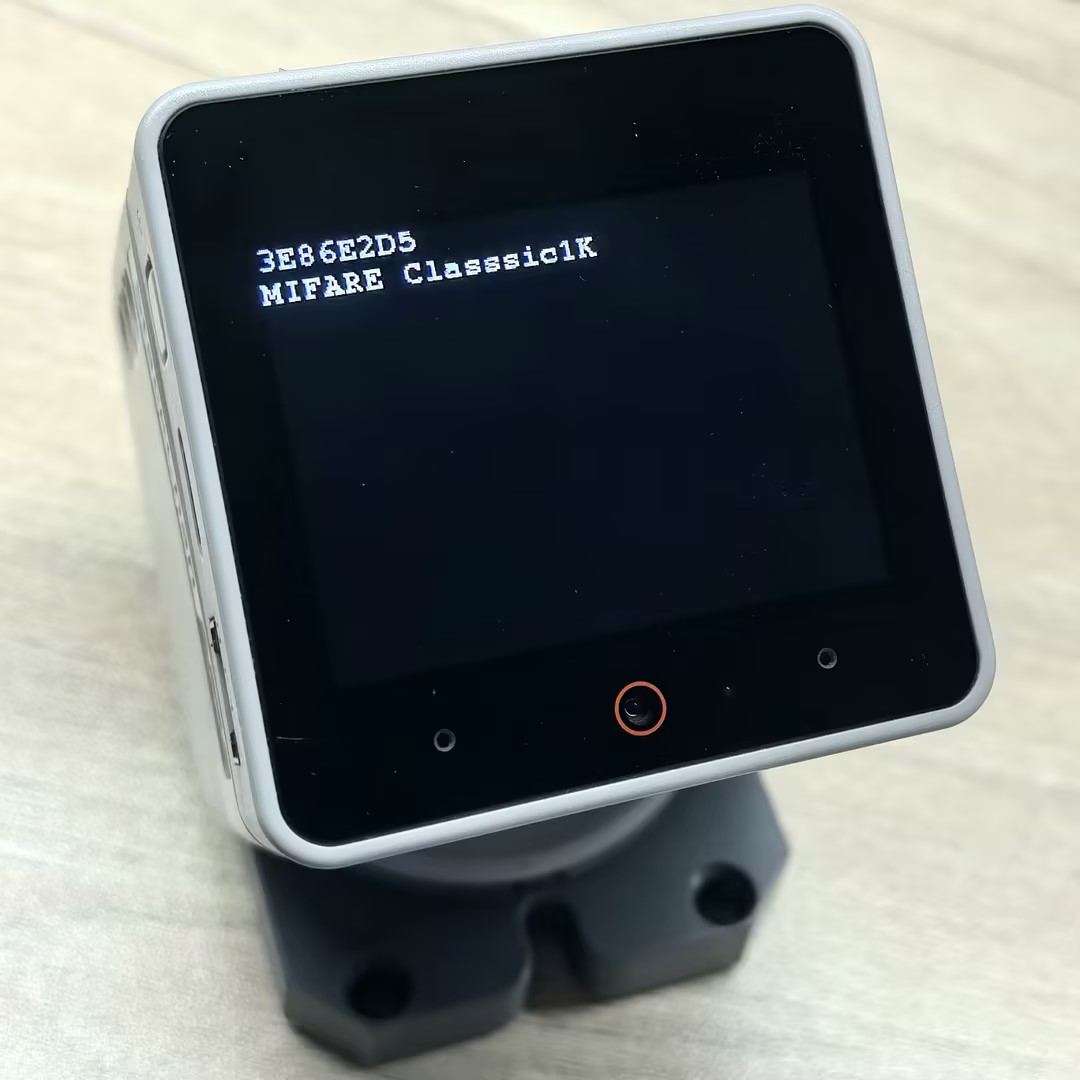
Serial monitor output example:
==== Dump 3E86E2D5 MIFARE Classsic1K 752/1024 ====
Sec[Blk]:00 01 02 03 04 05 06 07 08 09 0A 0B 0C 0D 0E 0F [Access]
-----------------------------------------------------------------
00)[000]:3E 86 E2 D5 8F 08 04 00 62 63 64 65 66 67 68 69 [0 0 0]
   [001]:00 00 00 00 00 00 00 00 00 00 00 00 00 00 00 00 [0 0 0]
   [002]:00 00 00 00 00 00 00 00 00 00 00 00 00 00 00 00 [0 0 0]
   [003]:00 00 00 00 00 00 FF 07 80 69 FF FF FF FF FF FF [0 0 1]
01)[004]:00 00 00 00 00 00 00 00 00 00 00 00 00 00 00 00 [0 0 0]
   [005]:00 00 00 00 00 00 00 00 00 00 00 00 00 00 00 00 [0 0 0]
   [006]:00 00 00 00 00 00 00 00 00 00 00 00 00 00 00 00 [0 0 0]
   [007]:00 00 00 00 00 00 FF 07 80 69 FF FF FF FF FF FF [0 0 1]
02)[008]:00 00 00 00 00 00 00 00 00 00 00 00 00 00 00 00 [0 0 0]
   [009]:00 00 00 00 00 00 00 00 00 00 00 00 00 00 00 00 [0 0 0]
   [010]:00 00 00 00 00 00 00 00 00 00 00 00 00 00 00 00 [0 0 0]
   [011]:00 00 00 00 00 00 FF 07 80 69 FF FF FF FF FF FF [0 0 1]
03)[012]:00 00 00 00 00 00 00 00 00 00 00 00 00 00 00 00 [0 0 0]
   [013]:00 00 00 00 00 00 00 00 00 00 00 00 00 00 00 00 [0 0 0]
   [014]:00 00 00 00 00 00 00 00 00 00 00 00 00 00 00 00 [0 0 0]
   [015]:00 00 00 00 00 00 FF 07 80 69 FF FF FF FF FF FF [0 0 1]
04)[016]:00 00 00 00 00 00 00 00 00 00 00 00 00 00 00 00 [0 0 0]
   [017]:00 00 00 00 00 00 00 00 00 00 00 00 00 00 00 00 [0 0 0]
   [018]:00 00 00 00 00 00 00 00 00 00 00 00 00 00 00 00 [0 0 0]
   [019]:00 00 00 00 00 00 FF 07 80 69 FF FF FF FF FF FF [0 0 1]
05)[020]:00 00 00 00 00 00 00 00 00 00 00 00 00 00 00 00 [0 0 0]
   [021]:00 00 00 00 00 00 00 00 00 00 00 00 00 00 00 00 [0 0 0]
   [022]:00 00 00 00 00 00 00 00 00 00 00 00 00 00 00 00 [0 0 0]
   [023]:00 00 00 00 00 00 FF 07 80 69 FF FF FF FF FF FF [0 0 1]
06)[024]:00 00 00 00 00 00 00 00 00 00 00 00 00 00 00 00 [0 0 0]
   [025]:00 00 00 00 00 00 00 00 00 00 00 00 00 00 00 00 [0 0 0]
   [026]:00 00 00 00 00 00 00 00 00 00 00 00 00 00 00 00 [0 0 0]
   [027]:00 00 00 00 00 00 FF 07 80 69 FF FF FF FF FF FF [0 0 1]
07)[028]:00 00 00 00 00 00 00 00 00 00 00 00 00 00 00 00 [0 0 0]
   [029]:00 00 00 00 00 00 00 00 00 00 00 00 00 00 00 00 [0 0 0]
   [030]:00 00 00 00 00 00 00 00 00 00 00 00 00 00 00 00 [0 0 0]
   [031]:00 00 00 00 00 00 FF 07 80 69 FF FF FF FF FF FF [0 0 1]
08)[032]:00 00 00 00 00 00 00 00 00 00 00 00 00 00 00 00 [0 0 0]
   [033]:00 00 00 00 00 00 00 00 00 00 00 00 00 00 00 00 [0 0 0]
   [034]:00 00 00 00 00 00 00 00 00 00 00 00 00 00 00 00 [0 0 0]
   [035]:00 00 00 00 00 00 FF 07 80 69 FF FF FF FF FF FF [0 0 1]
09)[036]:00 00 00 00 00 00 00 00 00 00 00 00 00 00 00 00 [0 0 0]
   [037]:00 00 00 00 00 00 00 00 00 00 00 00 00 00 00 00 [0 0 0]
   [038]:00 00 00 00 00 00 00 00 00 00 00 00 00 00 00 00 [0 0 0]
   [039]:00 00 00 00 00 00 FF 07 80 69 FF FF FF FF FF FF [0 0 1]
10)[040]:00 00 00 00 00 00 00 00 00 00 00 00 00 00 00 00 [0 0 0]
   [041]:00 00 00 00 00 00 00 00 00 00 00 00 00 00 00 00 [0 0 0]
   [042]:00 00 00 00 00 00 00 00 00 00 00 00 00 00 00 00 [0 0 0]
   [043]:00 00 00 00 00 00 FF 07 80 69 FF FF FF FF FF FF [0 0 1]
11)[044]:00 00 00 00 00 00 00 00 00 00 00 00 00 00 00 00 [0 0 0]
   [045]:00 00 00 00 00 00 00 00 00 00 00 00 00 00 00 00 [0 0 0]
   [046]:00 00 00 00 00 00 00 00 00 00 00 00 00 00 00 00 [0 0 0]
   [047]:00 00 00 00 00 00 FF 07 80 69 FF FF FF FF FF FF [0 0 1]
12)[048]:00 00 00 00 00 00 00 00 00 00 00 00 00 00 00 00 [0 0 0]
   [049]:00 00 00 00 00 00 00 00 00 00 00 00 00 00 00 00 [0 0 0]
   [050]:00 00 00 00 00 00 00 00 00 00 00 00 00 00 00 00 [0 0 0]
   [051]:00 00 00 00 00 00 FF 07 80 69 FF FF FF FF FF FF [0 0 1]
13)[052]:00 00 00 00 00 00 00 00 00 00 00 00 00 00 00 00 [0 0 0]
   [053]:00 00 00 00 00 00 00 00 00 00 00 00 00 00 00 00 [0 0 0]
   [054]:00 00 00 00 00 00 00 00 00 00 00 00 00 00 00 00 [0 0 0]
   [055]:00 00 00 00 00 00 FF 07 80 69 FF FF FF FF FF FF [0 0 1]
14)[056]:00 00 00 00 00 00 00 00 00 00 00 00 00 00 00 00 [0 0 0]
   [057]:00 00 00 00 00 00 00 00 00 00 00 00 00 00 00 00 [0 0 0]
   [058]:00 00 00 00 00 00 00 00 00 00 00 00 00 00 00 00 [0 0 0]
   [059]:00 00 00 00 00 00 FF 07 80 69 FF FF FF FF FF FF [0 0 1]
15)[060]:00 00 00 00 00 00 00 00 00 00 00 00 00 00 00 00 [0 0 0]
   [061]:00 00 00 00 00 00 00 00 00 00 00 00 00 00 00 00 [0 0 0]
   [062]:00 00 00 00 00 00 00 00 00 00 00 00 00 00 00 00 [0 0 0]
[063]:00 00 00 00 00 00 FF 07 80 69 FF FF FF FF FF FF [0 0 1]Tag Emulation
This example demonstrates NFC tag emulation functionality. When other NFC readers (such as a smartphone) approach the top of StackChan, they can detect and read the emulated NFC tag. The program supports emulation of two common tag card types: MIFARE Ultralight and NTAG 213, each with corresponding UID and memory data (including NDEF messages).
Key points:
- During emulation,
update()must be called continuously in the main loop to update state - State changes (Off→Idle→Ready→Active→Halt) are displayed in real-time via screen indicator
- Card data can include NDEF messages supporting multiple content types (URI, text, images, etc.)
#include <M5StackChan.h>
#include <M5UnitUnified.h>
#include <M5UnitUnifiedNFC.h>
#include <M5Utility.h>
#include <vector>

using namespace m5::nfc; // NFC common namespace
using namespace m5::nfc::a; // Use NFC-A protocol namespace (ISO 14443-3A)
using namespace m5::nfc::a::mifare; // MIFARE card common operations
using namespace m5::nfc::a::mifare::classic; // MIFARE Classic card specific operations

namespace {
auto& lcd = M5StackChan.Display();
m5::unit::UnitUnified Units; // Unit unified manager instance
m5::unit::UnitNFC unit{};  // NFC Unit instance (I2C interface)
m5::nfc::EmulationLayerA emu_a{unit}; // Create NFC-A emulation layer instance to emulate the device as an NFC tag

PICC picc{}; // Card object to emulate

// ===== Select the tag type to emulate =====
#define EMU_MIFARE_ULTRALIGHT // MIFARE Ultralight tag
// #define EMU_NTAG213  // NTAG213 tag

// ===== MIFARE Ultralight emulation data =====
#if defined(EMU_MIFARE_ULTRALIGHT)
constexpr Type type{Type::MIFARE_Ultralight};
constexpr uint8_t uid[] = {0x04, 0x34, 0x56, 0x78, 0x9A, 0xBC, 0xDE};// 7-byte UID (Ultralight/NTAG series uses 7-byte UID)
// Emulated tag memory data (contains NDEF message: URL https://m5stack.com/ and text "Hello M5Stack")
uint8_t picc_memory[]   = {
    0x00, 0x00, 0x00, 0x00,  // Page 0: UID bytes (to be filled by embed_uid)
    0x00, 0x00, 0x00, 0x00,  // Page 1: UID bytes (continued)
    0x00, 0xA3, 0x00, 0x00,  // Page 2: Internal data, lock bits
    0xE1, 0x10, 0x06, 0x00,  // Page 3: CC (Capability Container) - NDEF format identifier
    0x03, 0x25, 0x91, 0x01,  // Page 4: NDEF TLV start
    0x0D, 0x55, 0x04, 0x6D,  // Page 5: URI record (https://)
    0x35, 0x73, 0x74, 0x61,  // Page 6: "5sta"
    0x63, 0x6B, 0x2E, 0x63,  // Page 7: "ck.c"
    0x6F, 0x6D, 0x2F, 0x51,  // Page 8: "om/" + text record start
    0x01, 0x10, 0x54, 0x02,  // Page 9: Text record header
    0x65, 0x6E, 0x48, 0x65,  // Page 10: "enHe" (language code "en" + "He")
    0x6C, 0x6C, 0x6F, 0x20,  // Page 11: "llo "
    0x4D, 0x35, 0x53, 0x74,  // Page 12: "M5St"
    0x61, 0x63, 0x6B, 0xFE,  // Page 13: "ack" + NDEF terminator 0xFE
    0x44, 0x45, 0x46, 0x00,  // Page 14: Padding data
    0x44, 0x45, 0x46, 0x00,  // Page 15: Padding data
};
// ===== NTAG213 emulation data =====
#elif defined(EMU_NTAG213)
constexpr Type type{Type::NTAG_213};
constexpr uint8_t uid[] = {0x99, 0x88, 0x77, 0x66, 0x55, 0x44, 0x33};// 7-byte UID
// Emulated tag memory data (contains multilingual NDEF message: URL + Chinese/English/Japanese text)
uint8_t picc_memory[]   = {
    0x00, 0x00, 0x00, 0x00,  // Page 0: UID bytes
    0x00, 0x00, 0x00, 0x00,  // Page 1: UID bytes (continued)
    0x00, 0x48, 0x00, 0x00,  // Page 2: Internal data, lock bits
    0xE1, 0x10, 0x12, 0x00,  // Page 3: CC (Capability Container)
    0x01, 0x03, 0xA0, 0x0C,  // Page 4: NDEF capability data
    0x34, 0x03, 0x58, 0x91,  // Page 5: NDEF TLV + message start
    0x01, 0x0D, 0x55, 0x04,  // Page 6: URI record header (https://)
    0x6D, 0x35, 0x73, 0x74,  // Page 7: "m5st"
    0x61, 0x63, 0x6B, 0x2E,  // Page 8: "ack."
    0x63, 0x6F, 0x6D, 0x2F,  // Page 9: "com/"
    0x11, 0x01, 0x11, 0x54,  // Page 10: Chinese text record header
    0x02, 0x7A, 0x68, 0xE4,  // Page 11: Language code "zh" + UTF-8 Chinese start
    0xBD, 0xA0, 0xE5, 0xA5,  // Page 12: UTF-8 encoding of "你好"
    0xBD, 0x20, 0x4D, 0x35,  // Page 13: " M5"
    0x53, 0x74, 0x61, 0x63,  // Page 14: "Stac"
    0x6B, 0x11, 0x01, 0x10,  // Page 15: "k" + English text record header
    0x54, 0x02, 0x65, 0x6E,  // Page 16: Language code "en"
    0x48, 0x65, 0x6C, 0x6C,  // Page 17: "Hell"
    0x6F, 0x20, 0x4D, 0x35,  // Page 18: "o M5"
    0x53, 0x74, 0x61, 0x63,  // Page 19: "Stac"
    0x6B, 0x51, 0x01, 0x1A,  // Page 20: "k" + Japanese text record header
    0x54, 0x02, 0x6A, 0x61,  // Page 21: Language code "ja"
    0xE3, 0x81, 0x93, 0xE3,  // Page 22: "こ" UTF-8
    0x82, 0x93, 0xE3, 0x81,  // Page 23: "ん" + start of "に"
    0xAB, 0xE3, 0x81, 0xA1,  // Page 24: "に" + "ち"
    0xE3, 0x81, 0xAF, 0x20,  // Page 25: "は "
    0x4D, 0x35, 0x53, 0x74,  // Page 26: "M5St"
    0x61, 0x63, 0x6B, 0xFE,  // Page 27: "ack" + NDEF terminator
    0x00, 0x00, 0x00, 0x00,  // Pages 28-39: Free user data area
    0x00, 0x00, 0x00, 0x00,  //
    0x00, 0x00, 0x00, 0x00,  //
    0x00, 0x00, 0x00, 0x00,  //
    0x00, 0x00, 0x00, 0x00,  //
    0x00, 0x00, 0x00, 0x00,  //
    0x00, 0x00, 0x00, 0x00,  //
    0x00, 0x00, 0x00, 0x00,  //
    0x00, 0x00, 0x00, 0x00,  //
    0x00, 0x00, 0x00, 0x00,  //
    0x00, 0x00, 0x00, 0x00,  //
    0x00, 0x00, 0x00, 0x00,  //
    0x00, 0x00, 0x00, 0xBD,  // Page 40: NTAG213 configuration page
    0x02, 0x00, 0x00, 0xFF,  // Page 41: Configuration page (continued)
    0x00, 0x00, 0x00, 0x00,  // Page 42: Password protection
    0x00, 0x00, 0x00, 0x00,  // Page 43: Password acknowledgment
    0x00, 0x00, 0x00, 0x00,  // Page 44: Reserved area
};
#else
#error "Choose the target to emulate"
#endif

/**
 * @brief Calculate BCC (Block Check Character) - XOR operation on byte sequence
 * @param p    Pointer to input data
 * @param len  Data length
 * @param init Initial value (default: 0)
 * @return     BCC check value
 */
uint8_t bcc8(const uint8_t* p, const uint8_t len, const uint8_t init = 0)
{
    uint8_t v = init;
    for (uint_fast8_t i = 0; i < len; ++i) {
        v ^= p[i];
    }
    return v;
}

/**
 * @brief Correctly embed 7-byte UID into Ultralight/NTAG memory layout
 *
 * UID storage format in Ultralight/NTAG memory:
 *   Page 0: [UID0, UID1, UID2, BCC0]  BCC0 = CT ^ UID0 ^ UID1 ^ UID2
 *   Page 1: [UID3, UID4, UID5, UID6]
 *   Page 2 prefix: [BCC1]  BCC1 = UID3 ^ UID4 ^ UID5 ^ UID6
 *
 * @param mem  Target memory buffer (at least 9 bytes)
 * @param uid  7-byte UID data
 */
void embed_uid(uint8_t mem[9], const uint8_t uid[7])
{
    memcpy(mem, uid, 3);
    mem[3] = bcc8(uid, 3, 0x88 /* CT */);
    memcpy(mem + 4, uid + 3, 4);
    mem[8] = bcc8(uid + 3, 4);
}

// Color table corresponding to emulation states
constexpr uint16_t color_table[] = {
    //  None,      Off,     Idle,     Ready,   Active,      Halt };
    TFT_BLACK, TFT_RED, TFT_BLUE, TFT_YELLOW, TFT_GREEN, TFT_MAGENTA};
// Character identifiers for emulation states
//                                 None,  Off,  Idle, Ready, Active, Halt
constexpr const char* state_table[] = {"-", "O", "I", "R", "A", "H"};
}  // namespace

void setup()
{
    M5StackChan.begin();
    Serial.begin(115200);
    // The screen shall be in landscape mode
    if (lcd.height() > lcd.width()) {
        lcd.setRotation(1);
    }

    // Emulation settings
    auto cfg      = unit.config();
    cfg.emulation = true;
    cfg.mode      = NFC::A;
    unit.config(cfg);

    bool unit_ready{};// Unit initialization status flag

    // Add NFC Unit to manager and initialize
    unit_ready = Units.add(unit, M5.In_I2C) && Units.begin();
    if (!unit_ready) {
        // Initialization failed: turn screen red and enter infinite loop
        M5_LOGE("Failed to begin");
        lcd.fillScreen(TFT_RED);
        while (true) {
            m5::utility::delay(10000);
        }
    }
    M5_LOGI("M5UnitUnified initialized");
    M5_LOGI("%s", Units.debugInfo().c_str());

    lcd.setFont(&fonts::FreeMonoBold9pt7b);
    lcd.startWrite();
    lcd.fillScreen(TFT_RED);
    // Initialize emulation
    if (picc.emulate(type, uid, sizeof(uid))) {// Set card type and UID to emulate
        embed_uid(picc_memory, uid);// Embed UID into emulation memory
        // Start emulation layer with card object and memory data
        if (emu_a.begin(picc, picc_memory, sizeof(picc_memory))) {
            lcd.fillScreen(TFT_DARKGREEN);
            lcd.setTextColor(TFT_WHITE, TFT_DARKGREEN);
            lcd.setCursor(0, 16);
            // Get and display the emulated PICC info
            const auto& e_picc = emu_a.emulatePICC();
            Serial.printf("Emulation:%s %s ATQA:%04X SAK:%u\n", e_picc.typeAsString().c_str(),
                          e_picc.uidAsString().c_str(), e_picc.atqa, e_picc.sak);
            lcd.printf("%s\n%s\nATQA:%04X\nSAK:%u ", e_picc.typeAsString().c_str(), e_picc.uidAsString().c_str(),
                       e_picc.atqa, e_picc.sak);
        }
    }
    lcd.fillRect(0, 0, 32, 16, color_table[0]);
    lcd.drawString(state_table[0], 0, 0);
    lcd.endWrite();
}

void loop()
{
    M5StackChan.update();
    Units.update();// Update all registered Units
    emu_a.update();  // Update emulation layer state (MUST be called in loop)

    // Monitor emulation state changes and update screen indicator
    static EmulationLayerA::State latest{}; // Record previous state
    auto state = emu_a.state(); // Get current emulation state
    if (latest != state) {
        latest = state;
        lcd.startWrite();
        // Update top-left color block and text based on state
        lcd.fillRect(0, 0, 32, 16, color_table[m5::stl::to_underlying(state)]);
        lcd.drawString(state_table[m5::stl::to_underlying(state)], 0, 0);
        Serial.println(state_table[m5::stl::to_underlying(state)]);
        lcd.endWrite();
    }
}After uploading the above code to the main controller, the top of StackChan will emulate as an NFC tag. When a smartphone or other NFC reader approaches it, they can detect the NFC tag and read the stored NDEF message content (URL + Text). The serial monitor will output the emulated tag's type, UID, ATQA, and SAK information. Meanwhile, the top-left corner of the main controller screen will display state indicators (Idle/Ready/Active, etc.).
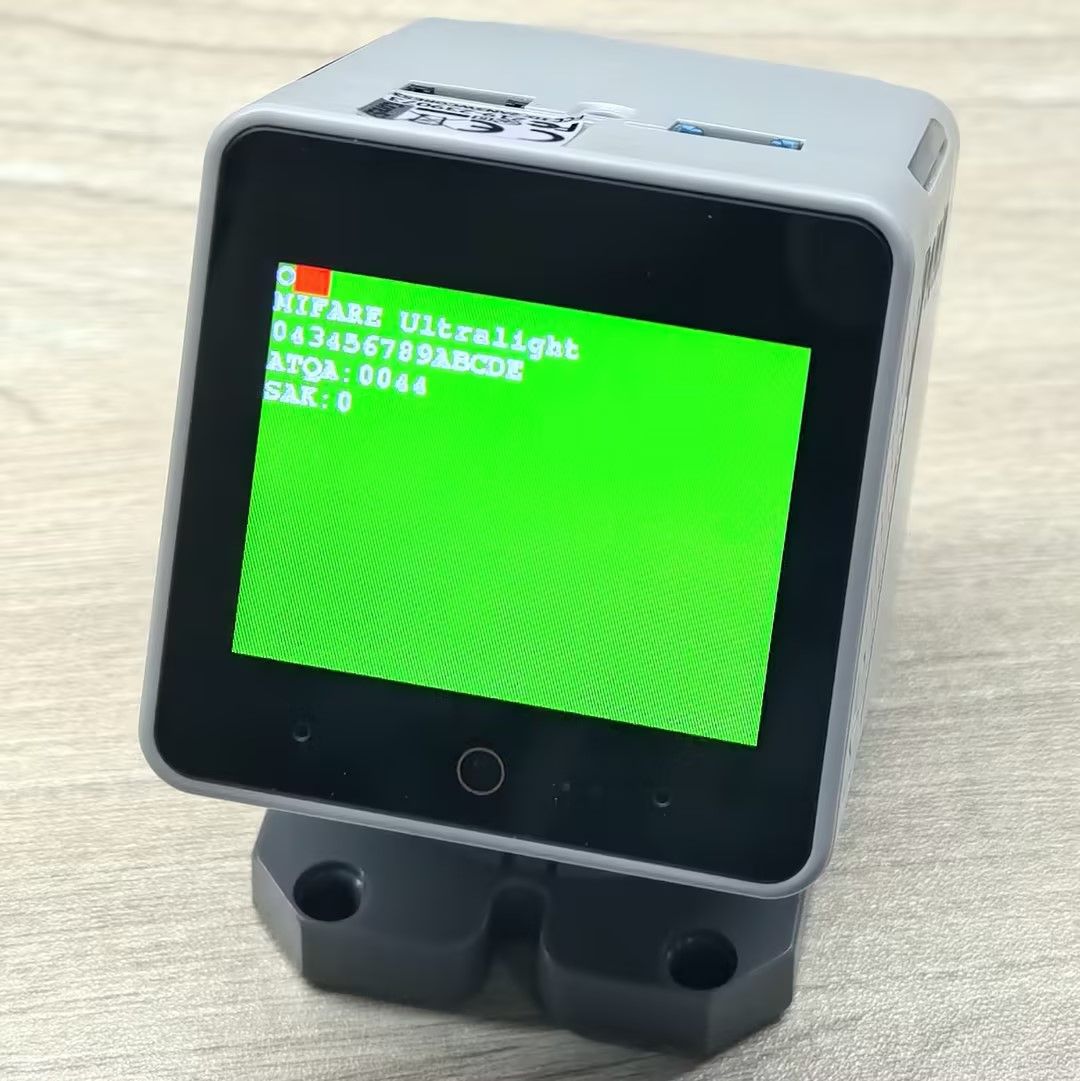
Example of tag information read by smartphone:

Serial monitor output examples:
- MIFARE Ultralight
Emulation:MIFARE Ultralight 043456789ABCDE ATQA:0044 SAK:0
O
I
R
A
H
R
A
H
R
A
O- NTAG 213
Emulation:NTAG 213 99887766554433 ATQA:0044 SAK:0
O
I
R
A
H
R
A
H
R
A
ODirect Card Reading and Writing
This example demonstrates how to directly read and write NFC cards, including both cross-block continuous read/write and single-block read/write methods.
#include <M5StackChan.h>
#include <M5UnitUnified.h>
#include <M5UnitUnifiedNFC.h>
#include <M5Utility.h>
#include <vector>

using namespace m5::nfc; // NFC common namespace
using namespace m5::nfc::a; // Use NFC-A protocol namespace (ISO 14443-3A)
using namespace m5::nfc::a::mifare; // MIFARE card common operations

namespace {
auto& lcd = M5StackChan.Display();
m5::unit::UnitUnified Units; // Unit unified manager instance
m5::unit::UnitNFC unit{};  // NFC Unit instance (I2C interface)
m5::nfc::NFCLayerA nfc_a{unit};// NFC-A protocol layer instance

// Classic default KeyA (0xFFFFFFFFFFFF)
// If your card uses a different key, change it here
constexpr classic::Key keyA = classic::DEFAULT_KEY;

// Test message strings (selected based on card capacity)
constexpr char long_msg[]  = "This is a sample message buffer used for testing NFC page writes and data integrity verification purposes.";// For large-capacity cards (user area >= 120 bytes)
constexpr char short_msg[] = "0123456789ABCDEFGHIJ";// For small-capacity cards (user area < 120 bytes)

/**
 * @brief Cross-block continuous read/write test (triggered by click)
 *
 * Write test message to card starting from specified block, read back and verify data integrity,
 * then clear by writing all zeros.
 * Uses high-level read()/write() API which handles cross-block/cross-sector operations automatically.
 *
 * Flow: Write -> Dump -> Read back & Verify -> Clear -> Dump
 *
 * @param sblock  Starting block number to write
 * @param msg     Test message string to write
 * @return true if all operations (write, verify, clear) succeeded
 */
bool read_write(const uint8_t sblock, const char* msg)
{
    auto len = strlen(msg);
    uint8_t buf[(strlen(msg) + 15) / 16 * 16]{};  // Round up to 16-byte alignment (Classic block size)
    uint16_t rx_len = sizeof(buf);

    // Write test message to card
    M5.Log.printf("================================ WRITE block:%u len:%zu\n", sblock, sizeof(buf));
    if (!nfc_a.write(sblock, (const uint8_t*)msg, len, keyA)) {
        M5_LOGE("Failed to write block %u", sblock);
        return false;
    }
    lcd.fillScreen(TFT_ORANGE);

    // Dump written data for visual confirmation
    nfc_a.mifareClassicAuthenticateA(classic::get_sector_trailer_block(sblock), keyA);// Authenticate sector before dump
    nfc_a.dump(sblock);

    // Read back and verify data integrity
    if (!nfc_a.read(buf, rx_len, sblock, keyA)) {
        M5_LOGE("Failed to read");
        return false;
    }
    lcd.fillScreen(TFT_BLUE);

    bool verify_ok = (memcmp(buf, msg, len) == 0);// Compare read data with original message
    M5.Log.printf("================================ VERIFY:%s\n", verify_ok ? "OK" : "NG");
    if (!verify_ok) {
        M5_LOGE("VERIFY NG!!");
        m5::utility::log::dump(buf, rx_len, false);// Dump read data for debugging
    }

    // Clear by writing all zeros
    memset(buf, 0, sizeof(buf));
    lcd.fillScreen(TFT_MAGENTA);
    if (!nfc_a.write(sblock, buf, sizeof(buf), keyA)) {
        M5_LOGE("Failed to clear");
        return false;
    }
    M5.Log.printf("================================ CLEAR\n");

    // Dump cleared data for visual confirmation
    nfc_a.mifareClassicAuthenticateA(classic::get_sector_trailer_block(sblock), keyA);
    nfc_a.dump(sblock);

    return true;
}

/**
 * @brief Single block read/write test
 *
 * Write a fixed test string to a single 16-byte block using low-level read16()/write16() API,
 * read back and verify, then clear.
 * Unlike read_write(), this operates on exactly one block without cross-sector handling.
 *
 * Flow: Authenticate -> Dump before -> Write -> Dump after -> Read & Verify -> Clear -> Dump
 *
 * @param block  Block number to read/write (must NOT be a sector trailer block)
 */
void read_write_single_block(const uint8_t block)
{
    constexpr char msg[] = "M5Unit-RFID";// Fixed test message (fits within 16-byte block)

    // Authenticate with KeyA before any read/write operation
    if (!nfc_a.mifareClassicAuthenticateA(block, keyA)) {
        M5_LOGE("Failed to AuthA");
        return;
    }

    // Dump block content before write
    M5.Log.printf("Before[%u] ----\n", block);
    nfc_a.dump(block);

    // Write test message to the block
    M5.Log.printf("Write\n");
    if (!nfc_a.write16(block, (const uint8_t*)msg, sizeof(msg))) {
        M5_LOGE("Failed to write");
        return;
    }

    // Dump block content after write
    M5.Log.printf("After[%u] ----\n", block);
    nfc_a.dump(block);

    // Read back and verify data integrity
    uint8_t rbuf[16]{};
    if (!nfc_a.read16(rbuf, block)) {
        M5_LOGE("Failed to read");
        return;
    }
    bool verify = (std::memcmp(rbuf, (const uint8_t*)msg, sizeof(msg)) == 0);// Compare read data with original
    M5.Log.printf("Verify %s\n", verify ? "OK" : "NG");

    // Clear block by writing minimal zero data (library pads to 16 bytes)
    M5.Log.printf("Clear\n");
    uint8_t c[1]{};
    if (!nfc_a.write16(block, c, sizeof(c))) {
        M5_LOGE("Failed to write");
        return;
    }

    // Dump block content after clear
    nfc_a.dump(block);
}

}  // namespace

void setup()
{
    M5StackChan.begin();
    Serial.begin(115200);
    // The screen shall be in landscape mode
    if (lcd.height() > lcd.width()) {
        lcd.setRotation(1);
    }

    bool unit_ready{};// Unit initialization status flag

    // Add NFC Unit to manager and initialize
    unit_ready = Units.add(unit, M5.In_I2C) && Units.begin();
    if (!unit_ready) {
        // Initialization failed: turn screen red and enter infinite loop
        M5_LOGE("Failed to begin");
        lcd.fillScreen(TFT_RED);
        while (true) {
            m5::utility::delay(10000);
        }
    }
    M5_LOGI("M5UnitUnified initialized");
    M5_LOGI("%s", Units.debugInfo().c_str());

    lcd.setFont(&fonts::FreeMonoBold9pt7b);
    lcd.setCursor(0, 0);
    lcd.printf("Put Classic card\nand touch/hold screen");
    M5.Log.printf("Put Classic card and touch/hold screen\n");
}

void loop()
{
    M5StackChan.update();
    Units.update();// Update all registered Units

    bool clicked = M5.Touch.getDetail().wasClicked();  // For cross-block read/write test
    bool held    = M5.Touch.getDetail().wasHold();     // For single block read/write test

    if (clicked || held) {
        PICC picc;
        if (nfc_a.detect(picc)) {
            lcd.fillScreen(TFT_DARKGREEN);

            if (nfc_a.identify(picc) && nfc_a.reactivate(picc)) {
                // Print card information: UID, type, user area size, total size
                M5.Log.printf("PICC:%s %s %u/%u\n",
                              picc.uidAsString().c_str(),
                              picc.typeAsString().c_str(),
                              picc.userAreaSize(),
                              picc.totalSize());

                // Only process MIFARE Classic cards, skip all other types
                if (!picc.isMifareClassic()) {
                    M5.Log.printf("Not a MIFARE Classic card, skipped\n");
                } else if (clicked) {
                    // Cross-block continuous read/write test
                    M5.Speaker.tone(2000, 30);
                    // Select message based on card capacity
                    const char* msg = (picc.userAreaSize() >= 120) ? long_msg : short_msg;
                    bool ret = read_write(picc.firstUserBlock(), msg);// Start from first user block
                    lcd.fillScreen(ret ? TFT_BLACK : TFT_RED);// Black = success, Red = failure

                } else if (held) {
                    // Single block read/write test
                    M5.Speaker.tone(4000, 30);
                    // Use second-to-last block (avoid sector trailer which contains keys and access bits)
                    read_write_single_block(picc.blocks - 2);
                }

                nfc_a.deactivate();// Release card communication
            } else {
                M5_LOGE("Failed to identify/activate");
            }
        } else {
            M5.Log.printf("PICC NOT detected\n");
        }

        lcd.setCursor(0, 0);
        lcd.printf("Put Classic card\nand touch/hold screen");
        M5.Log.printf("Put Classic card and touch/hold screen\n");
    }
}Serial monitor output examples:
- Click (cross-block read/write test):
PICC:3E86E2D5 MIFARE Classsic1K 752/1024
================================ WRITE block:1 len:112
00)[000]:3E 86 E2 D5 8F 08 04 00 62 63 64 65 66 67 68 69 [0 0 0]
   [001]:54 68 69 73 20 69 73 20 61 20 73 61 6D 70 6C 65 [0 0 0]
   [002]:20 6D 65 73 73 61 67 65 20 62 75 66 66 65 72 20 [0 0 0]
   [003]:00 00 00 00 00 00 FF 07 80 69 FF FF FF FF FF FF [0 0 1]
================================ VERIFY:OK
================================ CLEAR
00)[000]:3E 86 E2 D5 8F 08 04 00 62 63 64 65 66 67 68 69 [0 0 0]
   [001]:00 00 00 00 00 00 00 00 00 00 00 00 00 00 00 00 [0 0 0]
   [002]:00 00 00 00 00 00 00 00 00 00 00 00 00 00 00 00 [0 0 0]
[003]:00 00 00 00 00 00 FF 07 80 69 FF FF FF FF FF FF [0 0 1]- Hold (single block read/write test):
PICC:3E86E2D5 MIFARE Classsic1K 752/1024
Before[62] ----
15)[060]:00 00 00 00 00 00 00 00 00 00 00 00 00 00 00 00 [0 0 0]
   [061]:00 00 00 00 00 00 00 00 00 00 00 00 00 00 00 00 [0 0 0]
   [062]:00 00 00 00 00 00 00 00 00 00 00 00 00 00 00 00 [0 0 0]
   [063]:00 00 00 00 00 00 FF 07 80 69 FF FF FF FF FF FF [0 0 1]
Write
After[62] ----
15)[060]:00 00 00 00 00 00 00 00 00 00 00 00 00 00 00 00 [0 0 0]
   [061]:00 00 00 00 00 00 00 00 00 00 00 00 00 00 00 00 [0 0 0]
   [062]:4D 35 55 6E 69 74 2D 52 46 49 44 00 00 00 00 00 [0 0 0]
   [063]:00 00 00 00 00 00 FF 07 80 69 FF FF FF FF FF FF [0 0 1]
Verify OK
Clear
15)[060]:00 00 00 00 00 00 00 00 00 00 00 00 00 00 00 00 [0 0 0]
   [061]:00 00 00 00 00 00 00 00 00 00 00 00 00 00 00 00 [0 0 0]
   [062]:00 00 00 00 00 00 00 00 00 00 00 00 00 00 00 00 [0 0 0]
[063]:00 00 00 00 00 00 FF 07 80 69 FF FF FF FF FF FF [0 0 1]NDEF Format Card Reading and Writing
This example demonstrates how to use StackChan to read and write NFC tags in NDEF format, including the following functions:
- Write multi-record messages containing URL and text in NDEF format
- Read NDEF messages from tags and parse displayed content
- Write NDEF media records using built-in PNG image data
- Adapt message content for different capacity tags (select text length based on user area size)
#include <M5StackChan.h>
#include <M5UnitUnified.h>
#include <M5UnitUnifiedNFC.h>
#include <M5Utility.h>
#include <algorithm>
#include <vector>

using namespace m5::nfc; // NFC common namespace
using namespace m5::nfc::a; // Use NFC-A protocol namespace (ISO 14443-3A)
using namespace m5::nfc::a::mifare; // MIFARE card common operations
using namespace m5::nfc::ndef; // NDEF (NFC Data Exchange Format)

namespace {
auto& lcd = M5StackChan.Display();
m5::unit::UnitUnified Units; // Unit unified manager instance
m5::unit::UnitNFC unit{};  // NFC Unit instance (I2C interface)
m5::nfc::NFCLayerA nfc_a{unit};// NFC-A protocol layer instance

// PNG image binary data (64x64 pixels, used for writing to NDEF record)
constexpr uint8_t poji_64_png[] = {
    0x89, 0x50, 0x4e, 0x47, 0x0d, 0x0a, 0x1a, 0x0a, 0x00, 0x00, 0x00, 0x0d, 0x49, 0x48, 0x44, 0x52, 0x00, 0x00, 0x00,
    0x40, 0x00, 0x00, 0x00, 0x40, 0x01, 0x00, 0x00, 0x00, 0x00, 0x82, 0x12, 0x4c, 0x73, 0x00, 0x00, 0x00, 0x02, 0x62,
    0x4b, 0x47, 0x44, 0x00, 0x01, 0xdd, 0x8a, 0x13, 0xa4, 0x00, 0x00, 0x00, 0x09, 0x70, 0x48, 0x59, 0x73, 0x00, 0x00,
    0x00, 0x48, 0x00, 0x00, 0x00, 0x48, 0x00, 0x46, 0xc9, 0x6b, 0x3e, 0x00, 0x00, 0x00, 0x07, 0x74, 0x49, 0x4d, 0x45,
    0x07, 0xe8, 0x0b, 0x16, 0x08, 0x12, 0x36, 0x8d, 0x3c, 0xbe, 0xef, 0x00, 0x00, 0x00, 0x77, 0x74, 0x45, 0x58, 0x74,
    0x52, 0x61, 0x77, 0x20, 0x70, 0x72, 0x6f, 0x66, 0x69, 0x6c, 0x65, 0x20, 0x74, 0x79, 0x70, 0x65, 0x20, 0x38, 0x62,
    0x69, 0x6d, 0x00, 0x0a, 0x38, 0x62, 0x69, 0x6d, 0x0a, 0x20, 0x20, 0x20, 0x20, 0x20, 0x20, 0x34, 0x30, 0x0a, 0x33,
    0x38, 0x34, 0x32, 0x34, 0x39, 0x34, 0x64, 0x30, 0x34, 0x30, 0x34, 0x30, 0x30, 0x30, 0x30, 0x30, 0x30, 0x30, 0x30,
    0x30, 0x30, 0x30, 0x30, 0x33, 0x38, 0x34, 0x32, 0x34, 0x39, 0x34, 0x64, 0x30, 0x34, 0x32, 0x35, 0x30, 0x30, 0x30,
    0x30, 0x30, 0x30, 0x30, 0x30, 0x30, 0x30, 0x31, 0x30, 0x64, 0x34, 0x31, 0x64, 0x38, 0x63, 0x64, 0x39, 0x38, 0x66,
    0x30, 0x30, 0x62, 0x32, 0x30, 0x34, 0x65, 0x39, 0x38, 0x30, 0x30, 0x39, 0x39, 0x38, 0x0a, 0x65, 0x63, 0x66, 0x38,
    0x34, 0x32, 0x37, 0x65, 0x0a, 0xa6, 0x53, 0xc3, 0x8e, 0x00, 0x00, 0x00, 0x01, 0x6f, 0x72, 0x4e, 0x54, 0x01, 0xcf,
    0xa2, 0x77, 0x9a, 0x00, 0x00, 0x00, 0x6e, 0x49, 0x44, 0x41, 0x54, 0x28, 0xcf, 0x63, 0xf8, 0x0f, 0x05, 0x0c, 0xc3,
    0x98, 0xf1, 0x43, 0x1e, 0xcc, 0xf8, 0xbc, 0xf7, 0xf3, 0xf9, 0xbd, 0xe7, 0x81, 0x8c, 0xef, 0x36, 0xef, 0x81, 0x08,
    0xc8, 0x78, 0xc2, 0x71, 0xfe, 0xb3, 0x80, 0x3a, 0x90, 0xf1, 0x4e, 0x22, 0xfe, 0x97, 0x44, 0x39, 0x90, 0xf1, 0x5e,
    0x28, 0xfe, 0x97, 0xc7, 0x67, 0x20, 0xe3, 0x5c, 0xfc, 0xfc, 0x9f, 0xbf, 0x8a, 0x81, 0x8c, 0xf3, 0xff, 0xef, 0xff,
    0xfe, 0xff, 0x19, 0x99, 0xf1, 0xfe, 0xff, 0xfb, 0xef, 0xff, 0xbf, 0x03, 0x19, 0xcf, 0xff, 0x7f, 0x7f, 0x0f, 0x24,
    0x40, 0x0c, 0xa0, 0x15, 0x20, 0xc6, 0x67, 0x90, 0x95, 0x20, 0x2b, 0x7e, 0x83, 0x18, 0xf7, 0x07, 0x81, 0xdf, 0x69,
    0xcc, 0x00, 0x00, 0x17, 0xc5, 0xed, 0x7a, 0x25, 0x80, 0xdc, 0xb3, 0x00, 0x00, 0x00, 0x50, 0x65, 0x58, 0x49, 0x66,
    0x4d, 0x4d, 0x00, 0x2a, 0x00, 0x00, 0x00, 0x08, 0x00, 0x02, 0x01, 0x12, 0x00, 0x03, 0x00, 0x00, 0x00, 0x01, 0x00,
    0x01, 0x00, 0x00, 0x87, 0x69, 0x00, 0x04, 0x00, 0x00, 0x00, 0x01, 0x00, 0x00, 0x00, 0x26, 0x00, 0x00, 0x00, 0x00,
    0x00, 0x03, 0xa0, 0x01, 0x00, 0x03, 0x00, 0x00, 0x00, 0x01, 0x00, 0x01, 0x00, 0x00, 0xa0, 0x02, 0x00, 0x04, 0x00,
    0x00, 0x00, 0x01, 0x00, 0x00, 0x02, 0x00, 0xa0, 0x03, 0x00, 0x04, 0x00, 0x00, 0x00, 0x01, 0x00, 0x00, 0x02, 0x00,
    0x00, 0x00, 0x00, 0x00, 0x19, 0x25, 0x9b, 0x9b, 0x00, 0x00, 0x00, 0x25, 0x74, 0x45, 0x58, 0x74, 0x64, 0x61, 0x74,
    0x65, 0x3a, 0x63, 0x72, 0x65, 0x61, 0x74, 0x65, 0x00, 0x32, 0x30, 0x32, 0x34, 0x2d, 0x31, 0x31, 0x2d, 0x32, 0x32,
    0x54, 0x30, 0x38, 0x3a, 0x31, 0x35, 0x3a, 0x32, 0x31, 0x2b, 0x30, 0x30, 0x3a, 0x30, 0x30, 0x28, 0xd2, 0x30, 0x68,
    0x00, 0x00, 0x00, 0x25, 0x74, 0x45, 0x58, 0x74, 0x64, 0x61, 0x74, 0x65, 0x3a, 0x6d, 0x6f, 0x64, 0x69, 0x66, 0x79,
    0x00, 0x32, 0x30, 0x32, 0x33, 0x2d, 0x30, 0x34, 0x2d, 0x32, 0x38, 0x54, 0x30, 0x36, 0x3a, 0x35, 0x32, 0x3a, 0x32,
    0x35, 0x2b, 0x30, 0x30, 0x3a, 0x30, 0x30, 0xcf, 0xa4, 0xfa, 0x1c, 0x00, 0x00, 0x00, 0x28, 0x74, 0x45, 0x58, 0x74,
    0x64, 0x61, 0x74, 0x65, 0x3a, 0x74, 0x69, 0x6d, 0x65, 0x73, 0x74, 0x61, 0x6d, 0x70, 0x00, 0x32, 0x30, 0x32, 0x34,
    0x2d, 0x31, 0x31, 0x2d, 0x32, 0x32, 0x54, 0x30, 0x38, 0x3a, 0x31, 0x38, 0x3a, 0x35, 0x34, 0x2b, 0x30, 0x30, 0x3a,
    0x30, 0x30, 0xa3, 0x99, 0x04, 0x05, 0x00, 0x00, 0x00, 0x11, 0x74, 0x45, 0x58, 0x74, 0x65, 0x78, 0x69, 0x66, 0x3a,
    0x43, 0x6f, 0x6c, 0x6f, 0x72, 0x53, 0x70, 0x61, 0x63, 0x65, 0x00, 0x31, 0x0f, 0x9b, 0x02, 0x49, 0x00, 0x00, 0x00,
    0x12, 0x74, 0x45, 0x58, 0x74, 0x65, 0x78, 0x69, 0x66, 0x3a, 0x45, 0x78, 0x69, 0x66, 0x4f, 0x66, 0x66, 0x73, 0x65,
    0x74, 0x00, 0x33, 0x38, 0xad, 0xb8, 0xbe, 0x23, 0x00, 0x00, 0x00, 0x18, 0x74, 0x45, 0x58, 0x74, 0x65, 0x78, 0x69,
    0x66, 0x3a, 0x50, 0x69, 0x78, 0x65, 0x6c, 0x58, 0x44, 0x69, 0x6d, 0x65, 0x6e, 0x73, 0x69, 0x6f, 0x6e, 0x00, 0x35,
    0x31, 0x32, 0xb6, 0x2e, 0xb8, 0xdc, 0x00, 0x00, 0x00, 0x18, 0x74, 0x45, 0x58, 0x74, 0x65, 0x78, 0x69, 0x66, 0x3a,
    0x50, 0x69, 0x78, 0x65, 0x6c, 0x59, 0x44, 0x69, 0x6d, 0x65, 0x6e, 0x73, 0x69, 0x6f, 0x6e, 0x00, 0x35, 0x31, 0x32,
    0x2b, 0x21, 0x59, 0xaa, 0x00, 0x00, 0x00, 0x00, 0x49, 0x45, 0x4e, 0x44, 0xae, 0x42, 0x60, 0x82};

constexpr uint32_t poji_64_png_len = 738;// PNG image data length (bytes)

/**
 * @brief Format DESFire card (delete all applications and files)
 *
 * Note: DESFire Light does NOT support format operation
 */
void format_desfire()
{
    auto& picc = nfc_a.activatedPICC();

    if (picc.isMifareDESFire()) {
        desfire::DESFireFileSystem dfs(nfc_a);
        if (picc.type == Type::MIFARE_DESFire_Light) {
            M5_LOGW("DESFire light can NOT format");
            return;
        } else {
            if (!dfs.formatPICC(desfire::DESFIRE_DEFAULT_KEY)) {
                M5_LOGE("Failed to formatPICC");
                return;
            }
            uint32_t free_size{};
            if (dfs.selectApplication() && dfs.getFreeMemory(free_size)) {
                M5_LOGI("free(picc):%u", free_size);
            }
        }
    }
}

/**
 * @brief Read NDEF data and display
 *
 * Read NDEF message from activated card, parse and display each record on screen/serial.
 * Supports Well-known types (URI, text, etc.) and MIME types (such as PNG images).
 */
void read_ndef()
{
    // Disable non-test NDEF read path; keep only the current debug logging.
    bool valid{};
    if (!nfc_a.ndefIsValidFormat(valid)) {// Check if the data on the card is valid NDEF format
        M5_LOGE("Failed to ndefIsValidFormat");
        lcd.fillScreen(TFT_RED);
        return;
    }
    if (!valid) {
        M5.Log.printf("Data format is NOT NDEF\n");
        return;
    }

    TLV msg;
    // Read NDEF message TLV
    if (!nfc_a.ndefRead(msg)) {
        M5_LOGE("Failed to read");
        lcd.fillScreen(TFT_RED);
        return;
    }

    // If it does not exist, a Null TLV is returned
    if (msg.isMessageTLV()) {
        lcd.setCursor(0, lcd.fontHeight());
        // Iterate through all records in the NDEF message
        for (auto&& r : msg.records()) {
            switch (r.tnf()) {
                case TNF::Wellknown: {// Well-known type records (e.g., URI "U", Text "T")
                    auto s = r.payloadAsString().c_str();
                    M5.Log.printf("SZ:%3u TNF:%u T:%s [%s]\n", r.payloadSize(), r.tnf(), r.type(), s);
                    lcd.printf("T:%s [%s]\n", r.type(), s);
                } break;
                default:
                    // Other type records (e.g., MIME media type)
                    M5.Log.printf("SZ:%3u TNF:%u T:%s\n", r.payloadSize(), r.tnf(), r.type());
                    lcd.printf("T:%s\n", r.type());
                    // If it's a PNG image, draw it directly on screen
                    if (strcmp(r.type(), "image/png") == 0) {
                        lcd.drawPng(r.payload(), r.payloadSize(), lcd.width() >> 1, lcd.height() >> 1);
                    }
                    break;
            }
        }
    } else {
        M5.Log.printf("NDEF Message TLV is NOT exists\n");
    }
}

/**
 * @brief Write NDEF data to tag
 *
 * Build an NDEF message containing URI, multilingual text, and PNG image, and write it to the tag.
 * Automatically adjusts the number of records based on tag capacity.
 */
void write_ndef()
{
    auto& picc = nfc_a.activatedPICC();// Get currently activated card

    /*
      **** MIFARE Ultralight NOTICE ***************************
      Change the Ultralight series to NDEF format
      Note: This change cannot be undone
      *********************************************************
    */
    if (picc.isMifareUltralight()) {
        // Convert Ultralight card format to NDEF format (irreversible operation)
        if (!nfc_a.mifareUltralightChangeFormatToNDEF()) {
            M5_LOGE("Failed to mifareUltralightChangeFormatToNDEF");
            lcd.fillScreen(TFT_RED);
            return;
        }
        M5_LOGI("Changed NDEF format");
    }

    /*
      **** MIFARE DESFire NOTICE ******************************
      If the DESFire card is not in NDEF format, the PICC will be formatted
      This means all existing files and applications will be deleted!
      For DESFire light, the file structure is changed to comply with the NDEF specification,
      and the data is overwritten.
      *********************************************************
    */
    if (picc.isMifareDESFire() && picc.type != Type::MIFARE_DESFire_Light) {
        bool valid{};
        if (!nfc_a.ndefIsValidFormat(valid)) {
            lcd.fillScreen(TFT_RED);
            return;
        }
        M5_LOGI("NDEF format valid?:%u", valid);
        if (!valid) {
            format_desfire();// NDEF format invalid, format DESFire card first
            // Prepare NDEF file structure
            if (!nfc_a.ndefPrepareDesfire(picc.userAreaSize())) {
                M5_LOGE("Failed to prepare NDEF files");
                lcd.fillScreen(TFT_RED);
                return;
            }
            M5_LOGI("Prepare for NDEF OK");
        }
    }

    // Build NDEF message and write
    TLV msg{Tag::Message};
    Record r[5] = {};  // Wellknown as default

    // URI record
    r[0].setURIPayload("m5stack.com/", URIProtocol::HTTPS);
    // Text record with language type
    const char* en_data = "Hello M5Stack";
    r[1].setTextPayload(en_data, "en");
    const char* zh_data = "你好 M5Stack";
    r[2].setTextPayload(zh_data, "zh");
    const char* ja_data = "こんにちは M5Stack";
    r[3].setTextPayload(ja_data, "ja");

    // MIME record
    Record png{TNF::MIMEMedia};// Create MIME type record
    png.setType("image/png");// Set MIME type to PNG
    png.setPayload(poji_64_png, poji_64_png_len);// Set PNG image data as payload
    r[4] = png;

    // Calculate maximum available space (user area size minus 1 byte for terminator TLV)
    uint32_t max_user_size = nfc_a.activatedPICC().userAreaSize() - 1 /* terminator TLV */;
    for (auto&& rr : r) {
        msg.push_back(rr);
        if (msg.required() > max_user_size) {
            msg.pop_back(); // Exceeds capacity, remove the last added record
            break;
        }
    }

    // Write NDEF message to tag
    if (!nfc_a.ndefWrite(msg)) {
        M5_LOGE("Failed to write");
        lcd.fillScreen(TFT_RED);
        return;
    }
    M5.Log.printf("Write NDEF OK!\n");
}

}  // namespace

void setup()
{
    M5StackChan.begin();
    Serial.begin(115200);
    // The screen shall be in landscape mode
    if (lcd.height() > lcd.width()) {
        lcd.setRotation(1);
    }

    bool unit_ready{};// Unit initialization status flag

    // Add NFC Unit to manager and initialize
    unit_ready = Units.add(unit, M5.In_I2C) && Units.begin();
    if (!unit_ready) {
        // Initialization failed: turn screen red and enter infinite loop
        M5_LOGE("Failed to begin");
        lcd.fillScreen(TFT_RED);
        while (true) {
            m5::utility::delay(10000);
        }
    }
    M5_LOGI("M5UnitUnified initialized");
    M5_LOGI("%s", Units.debugInfo().c_str());

    lcd.setFont(&fonts::FreeMonoBold9pt7b);
    lcd.setCursor(0, 0);
    lcd.printf("Put the tag and\ntouch/hold screen");
    M5.Log.printf("Put the tag and touch/hold screen\n");
}

void loop()
{
    M5StackChan.update();
    Units.update();// Update all registered Units

    bool clicked = M5.Touch.getDetail().wasClicked();  // For cross-block read/write test
    bool held    = M5.Touch.getDetail().wasHold();     // For single block read/write test

    if (clicked || held) {
        PICC picc{};
        if (nfc_a.detect(picc)) {
            if (nfc_a.identify(picc) && nfc_a.reactivate(picc)) {
                M5.Log.printf("PICC:%s %s %u/%u\n", picc.uidAsString().c_str(), picc.typeAsString().c_str(),
                              picc.userAreaSize(), picc.totalSize());
                // Check if card supports NDEF
                if (picc.supportsNDEF()) {
                    if (clicked) {
                        lcd.fillScreen(TFT_BLUE);
                        // nfc_a.dump();
                        read_ndef();
                    } else if (held) {
                        lcd.fillScreen(TFT_YELLOW);
                        write_ndef();
                        lcd.fillScreen(0);
                    }
                    M5.Log.printf("Please remove the PICC from the reader\n");
                } else {
                    M5.Log.printf("Not support the NDEF\n");
                }
            } else {
                M5_LOGE("Failed to identify/activate %s", picc.uidAsString().c_str());
            }
            nfc_a.deactivate();
            lcd.setCursor(0, 0);
            lcd.printf("Put the tag and\ntouch/hold screen");
            M5.Log.printf("Put the tag and touch/hold screen\n");
        } else {
            M5.Log.printf("PICC NOT exists\n");
        }
    }
}Serial Monitor Output Examples:
- Click (Reading NDEF):
PICC:047D9D82752291 MIFARE Ultralight EV1 11 48/80
SZ: 13 TNF:1 T:U [https://m5stack.com/]
SZ: 16 TNF:1 T:T [Hello M5Stack]- Hold (Writing NDEF):
PICC:047D9D82752291 MIFARE Ultralight EV1 11 48/80
Write NDEF OK!
Please remove the PICC from the readerE-Wallet
This example demonstrates how to use StackChan to implement e-wallet functionality, supporting two modes:
Non-rechargeable E-Wallet (Click): Supports only deduction operations, preventing illegal recharging, suitable for one-time consumption scenarios. This mode disables recharging through specific permission settings, ensuring that consumption amounts can only decrease and never increase.
Rechargeable E-Wallet (Hold): Supports both deduction and recharge operations, suitable for scenarios requiring repeated recharging. Through reasonable permission configuration, both operations are allowed, providing a more flexible user experience.
The core principle of NFC e-wallet is to use MIFARE Classic card's Value Block to store and manage amount information. Value Blocks use a special internal format including data backup and anti-tampering mechanisms. Each value block occupies one block space on the card (16 bytes), containing: amount value (4 bytes), amount complement backup (4 bytes), amount backup (4 bytes), complement backup (4 bytes). This redundant design prevents data from being maliciously tampered with.
Related APIs
Authentication Operations
| Method | Function |
|---|---|
mifareClassicAuthenticateA(block, key) | Authenticate sector with KeyA |
mifareClassicAuthenticateB(block, key) | Authenticate sector with KeyB |
mifareClassicWriteAccessCondition(block, mode, keyA, keyB) | Modify block access permissions |
Value Block Operations
| Method | Function |
|---|---|
mifareClassicWriteValueBlock(block, value) | Initialize value block, write amount |
mifareClassicDecrementValueBlock(block, amount) | Deduction operation |
mifareClassicIncrementValueBlock(block, amount) | Recharge operation |
mifareClassicRestoreValueBlock(block) | Restore value block to buffer |
mifareClassicTransferValueBlock(block) | Transfer buffer data to card |
Status Query
| Method | Function |
|---|---|
activatedPICC() | Get currently activated card |
picc.isUserBlock(block) | Check if block is user-available |
dump(block) | Print block hex content for debugging |
Workflow Comparison
| Stage | Non-rechargeable Wallet | Rechargeable Wallet |
|---|---|---|
| 1. Authenticate | KeyA Authentication | KeyA Auth, then KeyB Auth |
| 2. Initialize | Set READ_WRITE_BLOCK mode | Set READ_WRITE_BLOCK mode |
| 3. Set Amount | Write initial amount | Write initial amount |
| 4. Set Permissions | VALUE_BLOCK_NON_RECHARGEABLE | VALUE_BLOCK_RECHARGEABLE |
| 5. Deduct | Supported ✓ | Supported ✓ |
| 6. Recharge | Not supported ✗ | Supported ✓ |
| 7. Data Reuse | Copy to adjacent block for backup | Copy to adjacent block |
| 8. Restore | Restore to normal block | Restore permissions and clear |
Core Difference: The key difference between the two modes is the permission bit setting. Non-rechargeable mode disables the Increment command through permission bit configuration, while rechargeable mode allows both operations.
Code
#include <M5StackChan.h>
#include <M5UnitUnified.h>
#include <M5UnitUnifiedNFC.h>
#include <M5Utility.h>
#include <vector>
using namespace m5::nfc::a;// NFC-A protocol layer
using namespace m5::nfc::a::mifare;// MIFARE card common operations
using namespace m5::nfc::a::mifare::classic;// MIFARE Classic card specific operations
namespace {
auto& lcd = M5StackChan.Display();
m5::unit::UnitUnified Units; // Unit unified manager instance
m5::unit::UnitNFC unit{};  // NFC Unit instance (I2C interface)
m5::nfc::NFCLayerA nfc_a{unit};// NFC-A protocol layer instance
// KeyA,B that can authenticate all blocks
// If it's a different key value, change it
constexpr Key keyA = DEFAULT_KEY;  // Default as 0xFFFFFFFFFFFF
constexpr Key keyB = DEFAULT_KEY;  // Default as 0xFFFFFFFFFFFF
/* @brief Non-rechargeable e-wallet demonstration: create and use value block
*
* This function demonstrates how to create a non-rechargeable value block on a MIFARE Classic card and perform decrement operations.
* Main steps include:
*   1. Authenticate sector
*   2. Set block access to read/write
*   3. Initialize value block with initial amount
*   4. Change access to non-rechargeable mode
*   5. Demonstrate decrementing the amount
*   6. Attempt to recharge (should fail)
*   7. Demonstrate copying value block
*   8. Finally restore block to normal read/write
*
* @param block Block number, must be user block and not sector trailer
* @param akey  KeyA for authentication
* @param bkey  KeyB for modifying access conditions
*/
void non_rechargeable_value_block(const uint8_t block, const Key& akey, const Key& bkey)
{
    auto& picc = nfc_a.activatedPICC();// Get the currently activated PICC object
    // Verify that block and block-1 are both user blocks (not config or sector trailer)
    if (!picc.isUserBlock(block) || !picc.isUserBlock(block - 1)) {
        M5_LOGE("block and block - 1 must be user block %u %u", block, block - 1);
        return;
    }
    // Step 1: Authenticate sector with KeyA
    if (!nfc_a.mifareClassicAuthenticateA(block, akey)) {
        M5_LOGE("Failed to AUTH A %u/%u", block, block);
        return;
    }
    // Change read/write block
    if (!nfc_a.mifareClassicWriteAccessCondition(block, READ_WRITE_BLOCK, akey, bkey)) {
        M5_LOGE("Failed to WriteAccessCondition %u", block);
        return;
    }
    // Write initial value
    if (!nfc_a.mifareClassicWriteValueBlock(block, 1234567)) {
        M5_LOGE("Failed to WriteValue %u", block);
        return;
    }
    // After writing the value, change it to the value block (Non rechargeable)
    if (!nfc_a.mifareClassicWriteAccessCondition(block, VALUE_BLOCK_NON_RECHARGEABLE, akey, bkey)) {
        M5_LOGE("Failed to WriteAccessCondition %u", block);
        return;
    }
    M5.Log.printf("==== Initial value\n");
    nfc_a.dump(block);
    // Decrement and transfer value
    if (!nfc_a.mifareClassicDecrementValueBlock(block, 4567u)) {
        M5_LOGE("Failed to decrement %u", block);
        return;
    }
    M5.Log.printf("==== Decrement done\n");
    nfc_a.dump(block);
    // Incremental operations cannot be performed because charging is not possible
    if (nfc_a.mifareClassicIncrementValueBlock(block, 9876543)) {
        M5_LOGE("Oops!?!?");
        return;
    } else {
        // Passing through this block is normal
        M5.Log.printf("Incremental operations cannot be performed because charging is not possible\n");
        // The Increment command failed, causing a HALT, so need reactivate and auth
        if (!nfc_a.reactivate()) {
            M5_LOGE("Failed to reactivate");
            return;
        }
        if (!nfc_a.mifareClassicAuthenticateA(block, akey)) {
            M5_LOGE("Failed to AUTH %u/%u", block, block);
            return;
        }
        M5.Log.printf("==== Can NOT increment\n");
        nfc_a.dump(block);
    }
    // Copy value block
    if (!nfc_a.mifareClassicRestoreValueBlock(block)) {
        M5_LOGE("Failed to restore %u", block);
        return;
    }
    if (!nfc_a.mifareClassicTransferValueBlock(block - 1)) {
        M5_LOGE("Failed to transfer %u", block);
        return;
    }
    M5.Log.printf("==== Copy from %u to %u\n", block, block - 1);
    nfc_a.dump(block);
    // Change read/write block and clear
    if (!nfc_a.mifareClassicWriteAccessCondition(block, READ_WRITE_BLOCK, akey, bkey)) {
        M5_LOGE("Failed to WriteAccessCondition%u", block);
        return;
    }
    uint8_t c[1]{};
    if (!nfc_a.write16(block, c, sizeof(c)) || !nfc_a.write16(block - 1, c, sizeof(c))) {
        M5_LOGE("Failed to Write %u/%u", block, block - 1);
        return;
    }
    M5.Log.printf("==== To be normal block\n");
    nfc_a.dump(block);
}
/**
* @brief Rechargeable e-wallet demonstration: create, decrement, and recharge value block
*
* Rechargeable e-wallet characteristics:
*   - Set amount on initialization
*   - Supports both decrement and recharge
*   - Sector trailer access: KeyB must be read-only
*   - Supports transfer to adjacent block
*
* Workflow:
*   1. Set sector trailer so KeyB is read-only
*   2. Authenticate sector with KeyB
*   3. Set block access to readable/writable
*   4. Initialize value block with initial amount
*   5. Change access condition to rechargeable mode
*   6. Demonstrate decrement operation
*   7. Demonstrate recharge (increment) operation
*   8. Demonstrate transfer operation
*   9. Restore access permissions to default
*   10. Restore block to normal
*
* @param block Block number to operate
* @param akey  MIFARE Classic KeyA (for authentication)
* @param bkey  MIFARE Classic KeyB (for authentication)
*/
void rechargeable_value_block(const uint8_t block, const Key& akey, const Key& bkey)
{
    auto& picc = nfc_a.activatedPICC();
    // Verify both blocks are user blocks
    if (!picc.isUserBlock(block) || !picc.isUserBlock(block - 1)) {
        M5_LOGE("block and block - 1 must be user block %u %u", block, block - 1);
        return;
    }
    // Auth A
    uint8_t stb = get_sector_trailer_block(block);
    if (!nfc_a.mifareClassicAuthenticateA(stb, akey)) {
        M5_LOGE("Failed to AUTH A %u/%u", block, stb);
        return;
    }
    // KeyB authentication is required for Increment operations
    // Additionally, KeyB must be read-only
    // Some cards may function even if the sector trailer access bit is 001, but strictly speaking, 110 or similar is
    // preferable
    // Change Sector trailer access bits
    //       RkeyA  WkeyA    RAb       WAb     ***RkeyB***   WkeyB
    // 011 | never | key B | key A|B | key B | ***never*** | key B |
    if (!nfc_a.mifareClassicWriteAccessCondition(stb, 0x03 /*011*/, akey, bkey)) {
        M5_LOGE("Failed to WriteAccessCondition %u", stb);
        return;
    }
    // Auth B
    if (!nfc_a.mifareClassicAuthenticateB(block, bkey)) {
        M5_LOGE("Failed to AUTH B %u/%u", block, stb);
        return;
    }
    // Change read/write block
    if (!nfc_a.mifareClassicWriteAccessCondition(block, READ_WRITE_BLOCK, akey, bkey)) {
        M5_LOGE("Failed to WriteAccessCondition %u", block);
        return;
    }
    // Write initial value
    if (!nfc_a.mifareClassicWriteValueBlock(block, 1234567)) {
        M5_LOGE("Failed to WriteValue %u", block);
        return;
    }
    // After writing the value, change it to the value block (rechargeable)
    if (!nfc_a.mifareClassicWriteAccessCondition(block, VALUE_BLOCK_RECHARGEABLE, akey, bkey)) {
        M5_LOGE("Failed to WriteAccessCondition %u", block);
        return;
    }
    M5.Log.printf("==== Initial value\n");
    nfc_a.dump(block);
    // Decrement and transfer value
    if (!nfc_a.mifareClassicDecrementValueBlock(block, 4567u)) {
        M5_LOGE("Failed to decrement %u", block);
        return;
    }
    M5.Log.printf("==== Decrement done\n");
    nfc_a.dump(block);
    // Increment and transfer value
    if (!nfc_a.mifareClassicIncrementValueBlock(block, 99u)) {
        M5_LOGE("Failed to increment %u", block);
        return;
    }
    M5.Log.printf("==== Increment done\n");
    nfc_a.dump(block);
    // Copy value block
    if (!nfc_a.mifareClassicRestoreValueBlock(block)) {
        M5_LOGE("Failed to restore %u", block);
        return;
    }
    if (!nfc_a.mifareClassicTransferValueBlock(block - 1)) {
        M5_LOGE("Failed to transfer %u", block);
        return;
    }
    M5.Log.printf("==== Copy from %u to %u\n", block, block - 1);
    nfc_a.dump(block);
    // Change read/write block and clear
    if (!nfc_a.mifareClassicWriteAccessCondition(block, READ_WRITE_BLOCK, akey, bkey)) {
        M5_LOGE("Failed to WriteAccessCondition%u", block);
        return;
    }
    // Clear both blocks
    uint8_t c[1]{};
    if (!nfc_a.write16(block, c, sizeof(c)) || !nfc_a.write16(block - 1, c, sizeof(c))) {
        M5_LOGE("Failed to Write %u/%u", block, block - 1);
        return;
    }
    // Restore access bits
    if (!nfc_a.mifareClassicWriteAccessCondition(stb, 0x01 /*001*/, akey, bkey)) {
        M5_LOGE("Failed to WriteAccessCondition %u", stb);
        return;
    }
    // Finally authenticate with KeyA once more
    if (!nfc_a.mifareClassicAuthenticateA(stb, akey)) {
        M5_LOGE("Failed to AUTH A %u/%u", block, stb);
        return;
    }
    M5.Log.printf("==== To be normal block\n");
    nfc_a.dump(block);
}
// Scan all sectors and restore any value blocks to normal read/write blocks
// Also restores sector trailer access bits to default (001)
// Tries multiple key combinations: KeyA/KeyB may have been changed by previous operations
void restore_all_value_blocks(const Key& akey, const Key& bkey)
{
    auto& picc = nfc_a.activatedPICC();
    uint8_t st_block{};
    uint32_t restored{};
    constexpr Key zero_key = {0x00, 0x00, 0x00, 0x00, 0x00, 0x00};
    // Try to authenticate with multiple keys
    // Note: After a failed auth, PICC goes to HALT state. Need reactivate before retry.
    auto try_auth = [&](uint8_t stb) -> bool {
        if (nfc_a.mifareClassicAuthenticateA(stb, akey)) {
            M5_LOGI("Auth KeyA(default) OK for trailer %u", stb);
            return true;
        }
        nfc_a.reactivate();
        if (nfc_a.mifareClassicAuthenticateA(stb, zero_key)) {
            M5_LOGI("Auth KeyA(zero) OK for trailer %u", stb);
            return true;
        }
        nfc_a.reactivate();
        if (nfc_a.mifareClassicAuthenticateB(stb, bkey)) {
            M5_LOGI("Auth KeyB(default) OK for trailer %u", stb);
            return true;
        }
        nfc_a.reactivate();
        if (nfc_a.mifareClassicAuthenticateB(stb, zero_key)) {
            M5_LOGI("Auth KeyB(zero) OK for trailer %u", stb);
            return true;
        }
        nfc_a.reactivate();
        return false;
    };
    // Pass 1: Restore sector trailer access bits first
    // Some access conditions require KeyB for trailer writes
    for (uint_fast16_t stb = 3; stb < picc.blocks; stb = get_sector_trailer_block(stb + 1)) {
        if (!try_auth(stb)) {
            M5_LOGW("Cannot auth sector trailer %u, skip", stb);
            continue;
        }
        // Try with current auth (KeyA)
        if (nfc_a.mifareClassicWriteAccessCondition(stb, 0x01 /*001*/, akey, bkey)) {
            M5_LOGI("Restored trailer %u with KeyA", stb);
            continue;
        }
        M5_LOGW("KeyA write failed for trailer %u, trying KeyB...", stb);
        // KeyA write failed -> need KeyB auth for this trailer
        nfc_a.reactivate();
        if (nfc_a.mifareClassicAuthenticateB(stb, bkey)) {
            if (nfc_a.mifareClassicWriteAccessCondition(stb, 0x01, akey, bkey)) {
                M5_LOGI("Restored trailer %u with KeyB(default)", stb);
                continue;
            }
        }
        nfc_a.reactivate();
        if (nfc_a.mifareClassicAuthenticateB(stb, zero_key)) {
            if (nfc_a.mifareClassicWriteAccessCondition(stb, 0x01, akey, bkey)) {
                M5_LOGI("Restored trailer %u with KeyB(zero)", stb);
                continue;
            }
        }
        M5_LOGE("Cannot restore trailer %u", stb);
        nfc_a.reactivate();
    }
    // Pass 2: Find and restore value blocks
    st_block = 0;
    for (uint_fast16_t block = 0; block < picc.blocks; ++block) {
        uint8_t stb = get_sector_trailer_block(block);
        if (stb != st_block) {
            st_block = stb;
            if (!try_auth(stb)) {
                block = stb;
                continue;
            }
        }
        if (block == stb || !picc.isUserBlock(block)) {
            continue;
        }
        bool vb{};
        if (!nfc_a.mifareClassicIsValueBlock(vb, block)) {
            continue;
        }
        if (!vb) {
            continue;
        }
        M5.Log.printf("Found value block [%u], restoring...\n", block);
        // Change to read/write block
        if (!nfc_a.mifareClassicWriteAccessCondition(block, READ_WRITE_BLOCK, akey, bkey)) {
            M5_LOGE("Failed to change access condition %u", block);
            continue;
        }
        // Clear block data
        uint8_t c[1]{};
        if (!nfc_a.write16(block, c, sizeof(c))) {
            M5_LOGE("Failed to clear %u", block);
            continue;
        }
        ++restored;
    }
    M5.Log.printf("Restored %u value blocks\n", restored);
}
}  // namespace
void setup()
{
    M5StackChan.begin();
    Serial.begin(115200);
    // The screen shall be in landscape mode
    if (lcd.height() > lcd.width()) {
        lcd.setRotation(1);
    }
    bool unit_ready{};// Unit initialization status flag
    // Add NFC Unit to manager and initialize
    unit_ready = Units.add(unit, M5.In_I2C) && Units.begin();
    if (!unit_ready) {
        // Initialization failed: turn screen red and enter infinite loop
        M5_LOGE("Failed to begin");
        lcd.fillScreen(TFT_RED);
        while (true) {
            m5::utility::delay(10000);
        }
    }
    M5_LOGI("M5UnitUnified initialized");
    M5_LOGI("%s", Units.debugInfo().c_str());
    lcd.setFont(&fonts::FreeMonoBold9pt7b);
    lcd.setCursor(0, 0);
    lcd.printf("Put the tag and\ntouch/hold screen");
    M5.Log.printf("Put the tag and touch/hold screen\n");
}
void loop()
{
    M5StackChan.update();
    Units.update();// Update all registered Units
    bool clicked = M5.Touch.getDetail().wasClicked();  // For cross-block read/write test
    bool held    = M5.Touch.getDetail().wasHold();     // For single block read/write test
    if (clicked || held) {
        PICC picc{};
        if (nfc_a.detect(picc)) {// Detect a single card
            if (nfc_a.identify(picc) && nfc_a.reactivate(picc)) {// Identify card and reactivate for full parameters
                // Print card info: UID, type, user area size, total size
                M5.Log.printf("PICC:%s %s %u/%u\n", picc.uidAsString().c_str(), picc.typeAsString().c_str(),
                              picc.userAreaSize(), picc.totalSize());
                // Check if card is MIFARE Classic (supports e-wallet)
                if (picc.isMifareClassic()) {
                    if (clicked) {
                        lcd.fillScreen(TFT_BLUE);
                        M5.Log.print("Non rechargeable\n");
                        // Demonstrate non-rechargeable e-wallet: amount can only decrease, cannot recharge
                        non_rechargeable_value_block(picc.blocks - 2, keyA, keyB);
                        // nfc_a.dump(DEFAULT_KEY);
                    } else if (held) {
                        M5.Speaker.tone(4000, 30);
                        lcd.fillScreen(TFT_YELLOW);
                        M5.Log.print("Rechargeable\n");
                        // Demonstrate rechargeable e-wallet: amount can both decrease and recharge
                        rechargeable_value_block(picc.blocks - 2, keyA, keyB);
                        // restore_all_value_blocks(DEFAULT_KEY, DEFAULT_KEY);
                    }
                    M5.Log.printf("Please remove the PICC from the reader\n");
                } else {
                    M5.Log.printf("Not support the value block\n");
                }
                nfc_a.deactivate();
            } else {
                M5_LOGE("Failed to identify/activate %s", picc.uidAsString().c_str());
            }
        } else {
            M5.Log.printf("PICC NOT exists\n");
        }
        lcd.setCursor(0, 0);
        lcd.printf("Put the tag and\ntouch/hold screen");
        M5.Log.printf("Put the tag and touch/hold screen\n");
    }
}Execution Result Description
After running through the code flow, setup() initializes the device and displays a prompt message. In loop():
- Click: Executes the non-rechargeable e-wallet demonstration
- Hold: Executes the rechargeable e-wallet demonstration
Each operation follows this workflow:
- Detect and identify a MIFARE Classic card
- Execute the corresponding e-wallet function
- Print block contents via
dump()to verify data changes - Restore the block to its normal state
Output field descriptions:
- The content after
PICC:is the card UID, type, and capacity information - The
[062]:format indicates the data of block 62 in sector 15 V:1234567indicates the amount stored in the value block[0 0 1]represents the access bits (C1 C2 C3), which determine read/write and increment permissions
Output Example
Non-Rechargeable Wallet Execution:
- Initialized to 1234567; after a deduction of 4567, the value becomes 1230000
- Recharge attempt fails (expected behavior)
- The value block is copied to an adjacent block via the transfer command
- Finally restored to a normal read/write block
Rechargeable Wallet Execution:
- Initialized to 1234567; after a deduction of 4567, the value becomes 1230000
- After recharging by 99, the value becomes 1230099 (the key difference from the non-rechargeable mode)
- The access bits change from
[0 0 1]to[1 1 0], indicating support for both operations
Serial monitor output examples:
- Click (Non-Rechargeable Wallet):
PICC:3E86E2D5 MIFARE Classsic1K 752/1024
Non rechargeable
==== Initial value
15)[060]:00 00 00 00 00 00 00 00 00 00 00 00 00 00 00 00 [0 0 0]
   [061]:00 00 00 00 00 00 00 00 00 00 00 00 00 00 00 00 [0 0 0]
   [062]:87 D6 12 00 78 29 ED FF 87 D6 12 00 3E C1 3E C1 [0 0 1] V:1234567 A: 62
   [063]:00 00 00 00 00 00 FF 03 C0 69 FF FF FF FF FF FF [0 0 1]
==== Decrement done
15)[060]:00 00 00 00 00 00 00 00 00 00 00 00 00 00 00 00 [0 0 0]
   [061]:00 00 00 00 00 00 00 00 00 00 00 00 00 00 00 00 [0 0 0]
   [062]:B0 C4 12 00 4F 3B ED FF B0 C4 12 00 3E C1 3E C1 [0 0 1] V:1230000 A: 62
   [063]:00 00 00 00 00 00 FF 03 C0 69 FF FF FF FF FF FF [0 0 1]
Incremental operations cannot be performed because charging is not possible
==== Can NOT increment
15)[060]:00 00 00 00 00 00 00 00 00 00 00 00 00 00 00 00 [0 0 0]
   [061]:00 00 00 00 00 00 00 00 00 00 00 00 00 00 00 00 [0 0 0]
   [062]:B0 C4 12 00 4F 3B ED FF B0 C4 12 00 3E C1 3E C1 [0 0 1] V:1230000 A: 62
   [063]:00 00 00 00 00 00 FF 03 C0 69 FF FF FF FF FF FF [0 0 1]
==== Copy from 62 to 61
15)[060]:00 00 00 00 00 00 00 00 00 00 00 00 00 00 00 00 [0 0 0]
   [061]:B0 C4 12 00 4F 3B ED FF B0 C4 12 00 3E C1 3E C1 [0 0 0] V:1230000 A: 62
   [062]:B0 C4 12 00 4F 3B ED FF B0 C4 12 00 3E C1 3E C1 [0 0 1] V:1230000 A: 62
   [063]:00 00 00 00 00 00 FF 03 C0 69 FF FF FF FF FF FF [0 0 1]
==== To be normal block
15)[060]:00 00 00 00 00 00 00 00 00 00 00 00 00 00 00 00 [0 0 0]
   [061]:00 00 00 00 00 00 00 00 00 00 00 00 00 00 00 00 [0 0 0]
   [062]:00 00 00 00 00 00 00 00 00 00 00 00 00 00 00 00 [0 0 0]
   [063]:00 00 00 00 00 00 FF 07 80 69 FF FF FF FF FF FF [0 0 1]
Please remove the PICC from the reader- Hold (Rechargeable Wallet):
PICC:3E86E2D5 MIFARE Classsic1K 752/1024
Rechargeable
==== Initial value
15)[060]:00 00 00 00 00 00 00 00 00 00 00 00 00 00 00 00 [0 0 0]
   [061]:00 00 00 00 00 00 00 00 00 00 00 00 00 00 00 00 [0 0 0]
   [062]:87 D6 12 00 78 29 ED FF 87 D6 12 00 3E C1 3E C1 [1 1 0] V:1234567 A: 62
   [063]:00 00 00 00 00 00 3B 47 8C 69 00 00 00 00 00 00 [0 1 1]
==== Decrement done
15)[060]:00 00 00 00 00 00 00 00 00 00 00 00 00 00 00 00 [0 0 0]
   [061]:00 00 00 00 00 00 00 00 00 00 00 00 00 00 00 00 [0 0 0]
   [062]:B0 C4 12 00 4F 3B ED FF B0 C4 12 00 3E C1 3E C1 [1 1 0] V:1230000 A: 62
   [063]:00 00 00 00 00 00 3B 47 8C 69 00 00 00 00 00 00 [0 1 1]
==== Increment done
15)[060]:00 00 00 00 00 00 00 00 00 00 00 00 00 00 00 00 [0 0 0]
   [061]:00 00 00 00 00 00 00 00 00 00 00 00 00 00 00 00 [0 0 0]
   [062]:13 C5 12 00 EC 3A ED FF 13 C5 12 00 3E C1 3E C1 [1 1 0] V:1230099 A: 62
   [063]:00 00 00 00 00 00 3B 47 8C 69 00 00 00 00 00 00 [0 1 1]
==== Copy from 62 to 61
15)[060]:00 00 00 00 00 00 00 00 00 00 00 00 00 00 00 00 [0 0 0]
   [061]:13 C5 12 00 EC 3A ED FF 13 C5 12 00 3E C1 3E C1 [0 0 0] V:1230099 A: 62
   [062]:13 C5 12 00 EC 3A ED FF 13 C5 12 00 3E C1 3E C1 [1 1 0] V:1230099 A: 62
   [063]:00 00 00 00 00 00 3B 47 8C 69 00 00 00 00 00 00 [0 1 1]
==== To be normal block
15)[060]:00 00 00 00 00 00 00 00 00 00 00 00 00 00 00 00 [0 0 0]
   [061]:00 00 00 00 00 00 00 00 00 00 00 00 00 00 00 00 [0 0 0]
   [062]:00 00 00 00 00 00 00 00 00 00 00 00 00 00 00 00 [0 0 0]
   [063]:00 00 00 00 00 00 FF 07 80 69 FF FF FF FF FF FF [0 0 1]
Please remove the PICC from the reader