

Arduino 上手教程
2. 设备开发 & 案例程序
3. M5Unified
4. M5GFX
5. 扩展模块
Unit
Module
Atomic
Tab5
IoT
Stamp UWB F Arduino 使用教程
1. 准备工作
环境配置:参考 Arduino IDE 上手教程完成 IDE 安装,并安装 Stamp C5 对应的板管理和驱动库。
使用到的驱动库:
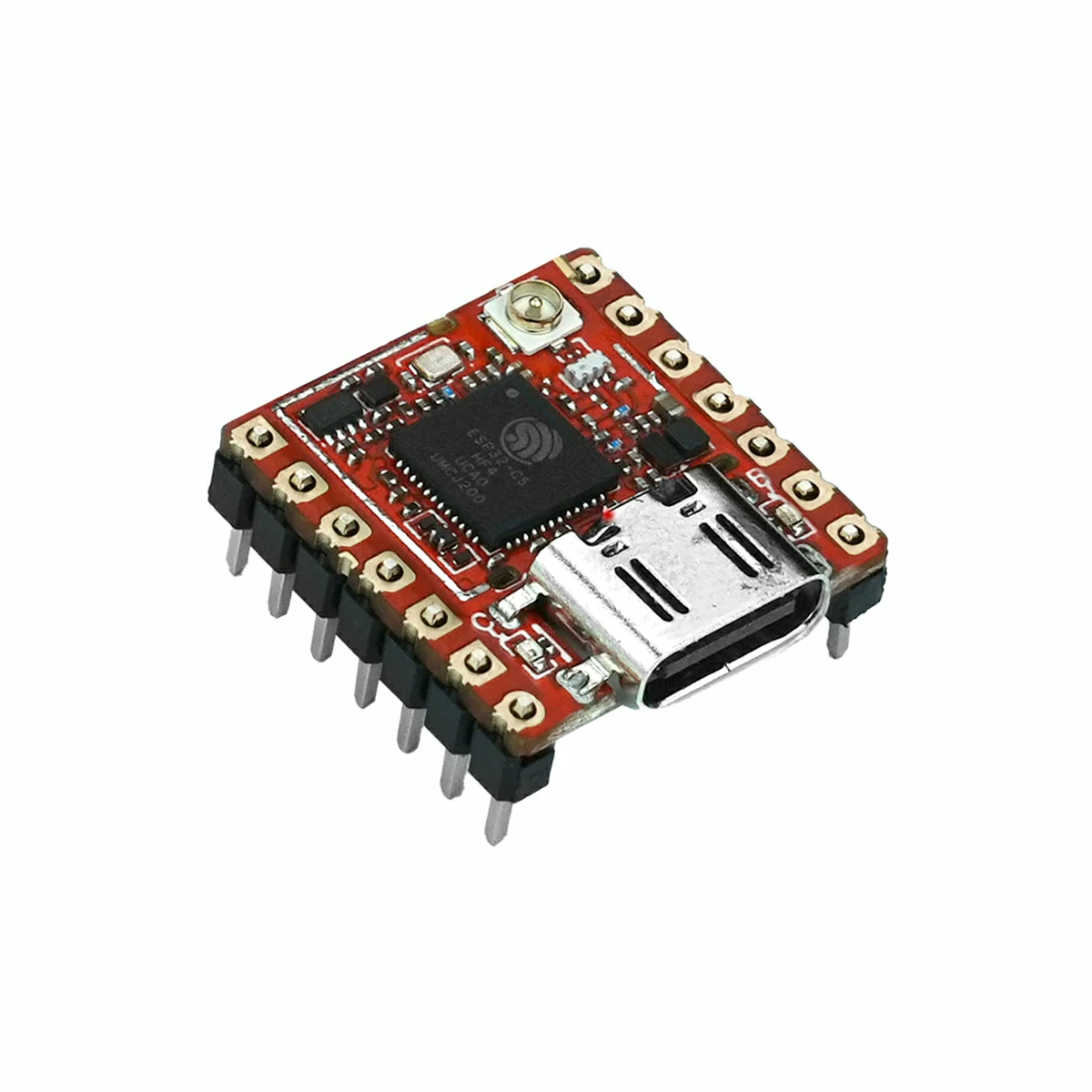
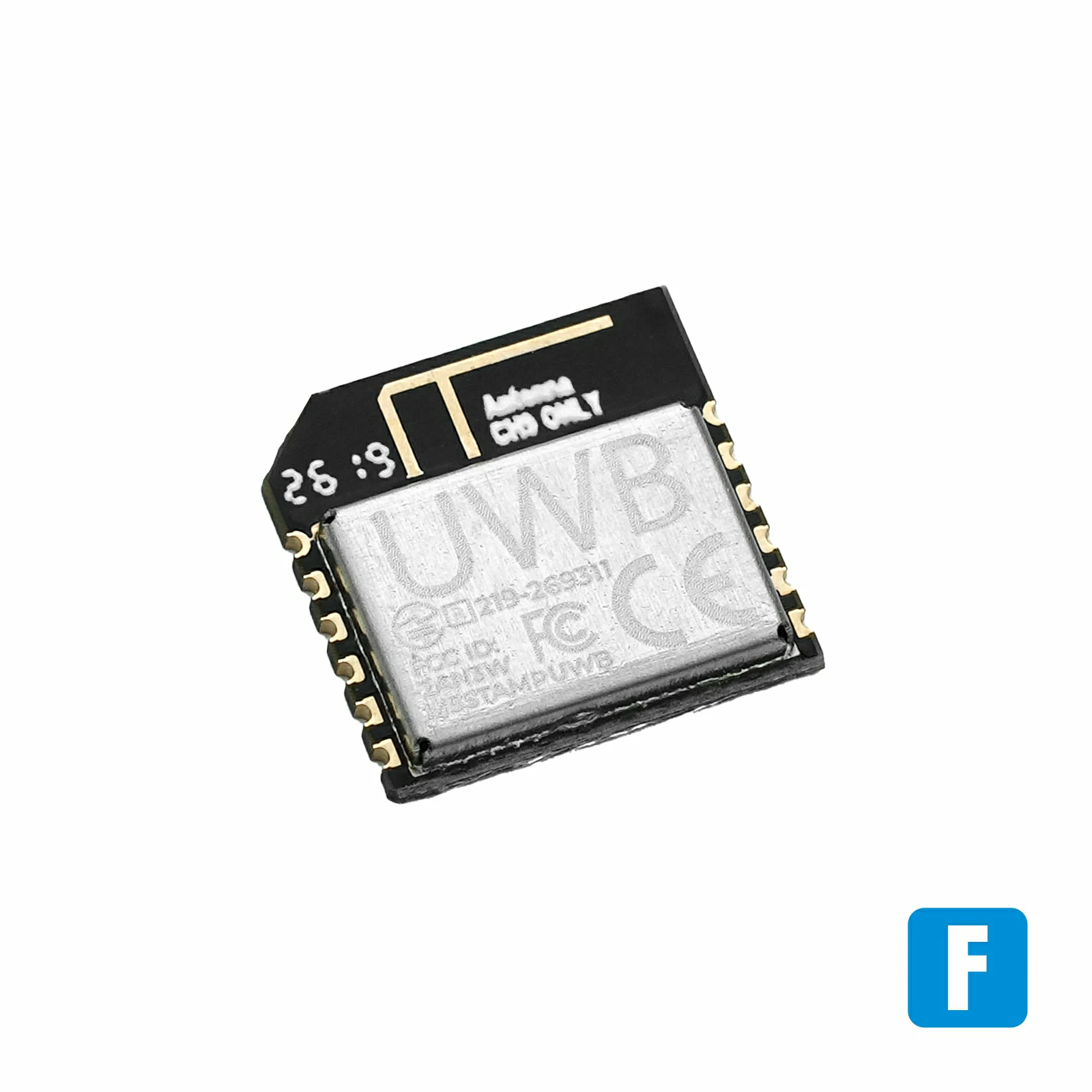
使用到的硬件产品:
2. 注意事项
注意
1. 为保证通信质量,请使用高 PSRR LDO 或电源纹波在 12mVpp 以内的电源给 Stamp UWB 供电。
2. UWB 测距至少需要 2 个设备,其中一个设备作为 Tag,另一个设备作为 Anchor。
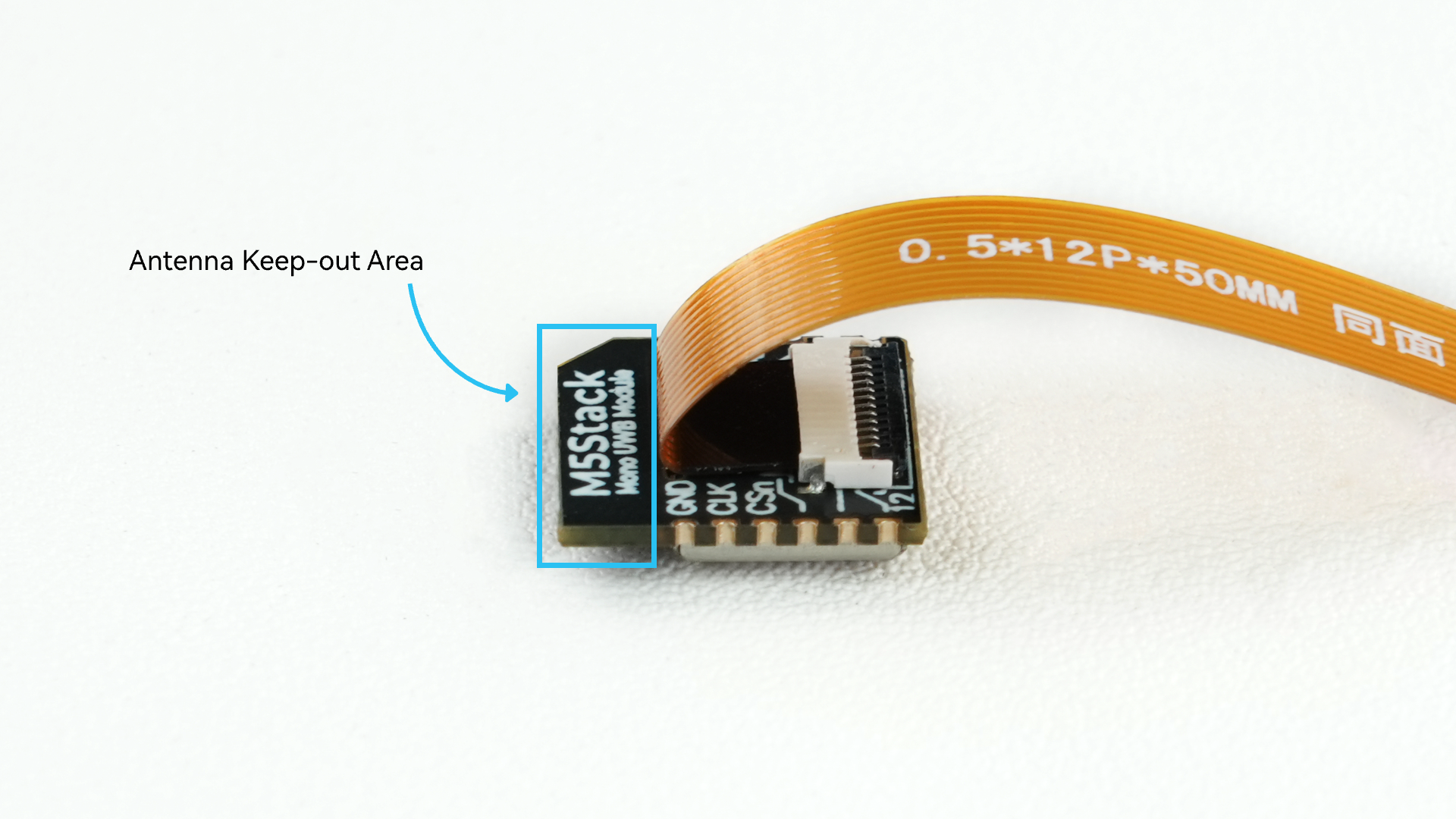
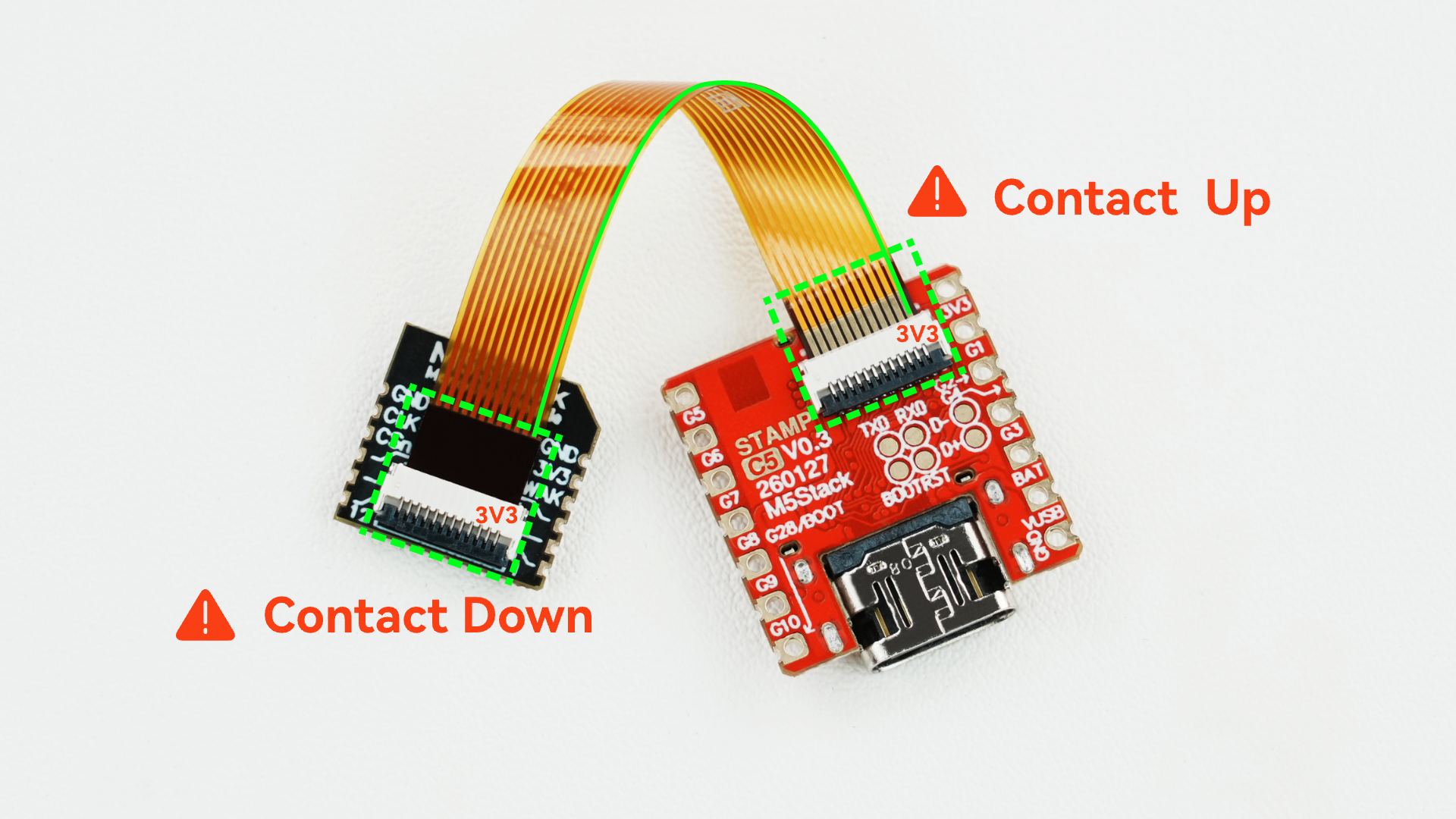
3. 在进行整机设计时,请注意 FPC 排线及其连接器对模组天线性能的影响。FPC 排线不得经过模组 PCB 天线下方或天线净空区域,否则可能改变天线阻抗和辐射特性,降低射频性能并引入测距误差。建议将 FPC 排线布置在天线区域之外,并在整机装配完成后进行实际测试,以确保产品的通信距离和测距精度满足设计要求。
2. UWB 测距至少需要 2 个设备,其中一个设备作为 Tag,另一个设备作为 Anchor。
3. 在进行整机设计时,请注意 FPC 排线及其连接器对模组天线性能的影响。FPC 排线不得经过模组 PCB 天线下方或天线净空区域,否则可能改变天线阻抗和辐射特性,降低射频性能并引入测距误差。建议将 FPC 排线布置在天线区域之外,并在整机装配完成后进行实际测试,以确保产品的通信距离和测距精度满足设计要求。
引脚兼容性
Stamp UWB 通过 SPI 接口通信。下方例程使用 Stamp C5 作为主控,使用其他主控或载板时,需要根据实际接线修改程序中的引脚定义。
Stamp C5 与 Stamp UWB F 的引脚连接如下:
| Stamp UWB F 引脚 | Stamp C5 GPIO |
|---|---|
| GP7 | G23 |
| IRQ | G0 |
| WAKEUP | G24 |
| RST | G25 |
| MISO | G26 |
| MOSI | G27 |
| CS | G11 |
| SCK | G12 |
3. 双边测距(DS-TWR)
3.1 Tag 端
cpp
1 2 3 4 5 6 7 8 9 10 11 12 13 14 15 16 17 18 19 20 21 22 23 24 25 26 27 28 29 30 31 32 33 34 35 36 37 38 39 40 41 42 43 44 45 46 47 48 49 50 51 52 53 54 55 56 57 58 59 60 61 62 63 64 65 66 67 68 69 70 71 72 73 74 75 76 77 78 79 80 81 82 83 84 85 86 87 88 89 90 91 92 93 94 95 96 97 98 99 100 101 102 103 104
#include <Arduino.h>
#include <M5Stamp_UWB.h>

static constexpr uint32_t RANGE_INTERVAL_MS = 200;
static constexpr uint32_t LOG_INTERVAL      = 10;

M5Stamp_UWB uwb;
M5Stamp_UWBDSRangeConfig rangeConfig;
bool uwbReady        = false;
uint32_t lastRangeMs = 0;
uint32_t rangeCount  = 0;
uint32_t okCount     = 0;

static bool initUwb()
{
    // Stamp-C5 connections to the onboard QM33120 UWB transceiver.
    M5Stamp_UWBConfig config;
    config.pin_gp7    = 23;
    config.pin_irq    = 0;
    config.pin_wakeup = 24;
    config.pin_rst    = 25;
    config.pin_miso   = 26;
    config.pin_mosi   = 27;
    config.pin_cs     = 11;
    config.pin_sck    = 12;

    M5Stamp_UWBPHYConfig phy;
    phy.channel = M5Stamp_UWBChannel::Channel5;

    // Both devices must use the same network addresses and DS-TWR timing.
    rangeConfig.panId                          = 0xDECA;
    rangeConfig.initiatorAddress               = 0x0001;
    rangeConfig.responderAddress               = 0x0002;
    rangeConfig.responseRxAfterTxDelayUus      = 1500;
    rangeConfig.responseTxDelayUus             = 3000;
    rangeConfig.finalTxDelayUus                = 1800;
    rangeConfig.finalRxAfterResponseTxDelayUus = 500;
    rangeConfig.resultRxAfterFinalTxDelayUus   = 500;
    rangeConfig.rxTimeoutUus                   = 3000;
    rangeConfig.hostTimeoutMs                  = 100;
    rangeConfig.resultRepeatCount              = 3;
    rangeConfig.resultRepeatGapMs              = 3;

    if (!uwb.begin(config, phy)) {
        Serial.printf("UWB_BEGIN,result=FAIL,error=%s\n", uwb.lastErrorName());
        Serial.printf("UWB_RAW_ID,dev_id=0x%08lX\n", static_cast<unsigned long>(uwb.readRawDeviceId()));
        return false;
    }

    const uint32_t devId = uwb.deviceId();
    Serial.printf("UWB_ID,dev_id=0x%08lX,chip=%s\n", static_cast<unsigned long>(devId), uwb.chipName());
    if (devId != M5STAMP_UWB_QM33120_DEVICE_ID) {
        Serial.printf("UWB_ID,result=FAIL,expected=0xDECA0314\n");
        return false;
    }

    Serial.printf("UWB_CONFIG,result=OK,ch=%u,plen=%u,rate=6M8,tx_power=0x%08lX\n", static_cast<unsigned>(phy.channel),
                  static_cast<unsigned>(phy.preambleLength), static_cast<unsigned long>(phy.txPower));
    return true;
}

static void runRanging()
{
    // Start one DS-TWR exchange at the configured interval.
    if (millis() - lastRangeMs < RANGE_INTERVAL_MS) return;
    lastRangeMs = millis();

    const M5Stamp_UWBDSRangeResult result = uwb.requestDSRange(rangeConfig);
    rangeCount++;
    okCount += result.success;

    // Print accumulated statistics every LOG_INTERVAL attempts.
    if (rangeCount % LOG_INTERVAL) return;

    const uint32_t failCount = rangeCount - okCount;
    if (result.success) {
        Serial.printf(
            "DS_RANGE_STAT,count=%lu,ok=%lu,fail=%lu,last=OK,seq=%u,distance_mm=%ld,distance_m=%.3f,elapsed_ms=%lu\n",
            static_cast<unsigned long>(rangeCount), static_cast<unsigned long>(okCount),
            static_cast<unsigned long>(failCount), result.sequence, static_cast<long>(result.distanceMm),
            result.distanceM, static_cast<unsigned long>(result.elapsedMs));
    } else {
        Serial.printf("DS_RANGE_STAT,count=%lu,ok=%lu,fail=%lu,last=FAIL,seq=%u,error=%s\n",
                      static_cast<unsigned long>(rangeCount), static_cast<unsigned long>(okCount),
                      static_cast<unsigned long>(failCount), result.sequence, uwb.lastErrorName());
    }
}

void setup()
{
    Serial.begin(115200);
    delay(1000);
    Serial.printf("M5Stamp UWB DS-TWR TAG\n");
    Serial.printf("ROLE,mode=TAG\n");
    Serial.printf("TWR_MODE,mode=DS-TWR\n");
    uwbReady = initUwb();
    Serial.printf("TEST_START,result=%s\n", uwbReady ? "OK" : "FAIL");
}

void loop()
{
    if (uwbReady) runRanging();
    else delay(1000);
}串口输出示例:
M5Stamp UWB DS-TWR TAG
ROLE,mode=TAG
TWR_MODE,mode=DS-TWR
UWB_ID,dev_id=0xDECA0314,chip=QM33120/DW3720
UWB_CONFIG,result=OK,ch=5,plen=128,rate=6M8,tx_power=0xFEFEFEFE
TEST_START,result=OK
DS_RANGE_STAT,count=10,ok=10,fail=0,last=OK,seq=10,distance_mm=164,distance_m=0.164,elapsed_ms=7
DS_RANGE_STAT,count=20,ok=20,fail=0,last=OK,seq=20,distance_mm=166,distance_m=0.166,elapsed_ms=7
DS_RANGE_STAT,count=30,ok=30,fail=0,last=OK,seq=30,distance_mm=171,distance_m=0.171,elapsed_ms=7
DS_RANGE_STAT,count=40,ok=40,fail=0,last=OK,seq=40,distance_mm=168,distance_m=0.168,elapsed_ms=7
DS_RANGE_STAT,count=50,ok=50,fail=0,last=OK,seq=50,distance_mm=153,distance_m=0.153,elapsed_ms=7
DS_RANGE_STAT,count=60,ok=60,fail=0,last=OK,seq=60,distance_mm=196,distance_m=0.196,elapsed_ms=7
DS_RANGE_STAT,count=70,ok=70,fail=0,last=OK,seq=70,distance_mm=172,distance_m=0.172,elapsed_ms=7
DS_RANGE_STAT,count=80,ok=80,fail=0,last=OK,seq=80,distance_mm=182,distance_m=0.182,elapsed_ms=7
DS_RANGE_STAT,count=90,ok=90,fail=0,last=OK,seq=90,distance_mm=160,distance_m=0.160,elapsed_ms=7
DS_RANGE_STAT,count=100,ok=100,fail=0,last=OK,seq=100,distance_mm=157,distance_m=0.157,elapsed_ms=7
DS_RANGE_STAT,count=110,ok=110,fail=0,last=OK,seq=110,distance_mm=210,distance_m=0.210,elapsed_ms=7
DS_RANGE_STAT,count=120,ok=120,fail=0,last=OK,seq=120,distance_mm=164,distance_m=0.164,elapsed_ms=7
DS_RANGE_STAT,count=130,ok=130,fail=0,last=OK,seq=130,distance_mm=174,distance_m=0.174,elapsed_ms=73.2 Anchor 端
cpp
1 2 3 4 5 6 7 8 9 10 11 12 13 14 15 16 17 18 19 20 21 22 23 24 25 26 27 28 29 30 31 32 33 34 35 36 37 38 39 40 41 42 43 44 45 46 47 48 49 50 51 52 53 54 55 56 57 58 59 60 61 62 63 64 65 66 67 68 69 70 71 72 73 74 75 76 77 78 79 80 81 82 83 84 85 86 87 88 89 90 91 92 93 94 95 96 97 98 99 100
#include <Arduino.h>
#include <M5Stamp_UWB.h>

static constexpr uint32_t LOG_INTERVAL = 20;

M5Stamp_UWB uwb;
M5Stamp_UWBDSRangeConfig rangeConfig;
bool uwbReady          = false;
uint32_t responseCount = 0;
uint32_t failCount     = 0;

static bool initUwb()
{
    // Stamp-C5 connections to the onboard QM33120 UWB transceiver.
    M5Stamp_UWBConfig config;
    config.pin_gp7    = 23;
    config.pin_irq    = 0;
    config.pin_wakeup = 24;
    config.pin_rst    = 25;
    config.pin_miso   = 26;
    config.pin_mosi   = 27;
    config.pin_cs     = 11;
    config.pin_sck    = 12;

    M5Stamp_UWBPHYConfig phy;
    phy.channel = M5Stamp_UWBChannel::Channel5;

    // Both devices must use the same network addresses and DS-TWR timing.
    rangeConfig.panId                          = 0xDECA;
    rangeConfig.initiatorAddress               = 0x0001;
    rangeConfig.responderAddress               = 0x0002;
    rangeConfig.responseRxAfterTxDelayUus      = 1500;
    rangeConfig.responseTxDelayUus             = 3000;
    rangeConfig.finalTxDelayUus                = 1800;
    rangeConfig.finalRxAfterResponseTxDelayUus = 500;
    rangeConfig.resultRxAfterFinalTxDelayUus   = 500;
    rangeConfig.rxTimeoutUus                   = 3000;
    rangeConfig.hostTimeoutMs                  = 100;
    rangeConfig.resultRepeatCount              = 3;
    rangeConfig.resultRepeatGapMs              = 3;

    if (!uwb.begin(config, phy)) {
        Serial.printf("UWB_BEGIN,result=FAIL,error=%s\n", uwb.lastErrorName());
        Serial.printf("UWB_RAW_ID,dev_id=0x%08lX\n", static_cast<unsigned long>(uwb.readRawDeviceId()));
        return false;
    }

    const uint32_t devId = uwb.deviceId();
    Serial.printf("UWB_ID,dev_id=0x%08lX,chip=%s\n", static_cast<unsigned long>(devId), uwb.chipName());
    if (devId != M5STAMP_UWB_QM33120_DEVICE_ID) {
        Serial.printf("UWB_ID,result=FAIL,expected=0xDECA0314\n");
        return false;
    }

    Serial.printf("UWB_CONFIG,result=OK,ch=%u,plen=%u,rate=6M8,tx_power=0x%08lX\n", static_cast<unsigned>(phy.channel),
                  static_cast<unsigned>(phy.preambleLength), static_cast<unsigned long>(phy.txPower));
    return true;
}

static void runResponder()
{
    // Wait for a Poll/Final exchange and return the DS-TWR distance result.
    const M5Stamp_UWBDSResponderResult result = uwb.respondDSRange(rangeConfig);
    if (!result.success) {
        // Idle receive timeouts are expected and are not counted as failures.
        if (result.error == M5Stamp_UWBError::RxTimeout) return;
        if (++failCount % LOG_INTERVAL == 0) {
            Serial.printf("DS_RESP_STAT,count=%lu,fail=%lu,last=FAIL,error=%s\n",
                          static_cast<unsigned long>(responseCount), static_cast<unsigned long>(failCount),
                          uwb.lastErrorName());
        }
        return;
    }

    // Print accumulated statistics every LOG_INTERVAL responses.
    if (++responseCount % LOG_INTERVAL == 0) {
        Serial.printf(
            "DS_RESP_STAT,count=%lu,fail=%lu,last=OK,seq=%u,requester=0x%X,distance_mm=%ld,distance_m=%.3f,elapsed_ms=%lu\n",
            static_cast<unsigned long>(responseCount), static_cast<unsigned long>(failCount), result.sequence,
            result.requester, static_cast<long>(result.distanceMm), result.distanceM,
            static_cast<unsigned long>(result.elapsedMs));
    }
}

void setup()
{
    Serial.begin(115200);
    delay(1000);
    Serial.printf("M5Stamp UWB DS-TWR ANCHOR\n");
    Serial.printf("ROLE,mode=ANCHOR\n");
    Serial.printf("TWR_MODE,mode=DS-TWR\n");
    uwbReady = initUwb();
    Serial.printf("TEST_START,result=%s\n", uwbReady ? "OK" : "FAIL");
}

void loop()
{
    if (uwbReady) runResponder();
    else delay(1000);
}串口输出示例:
M5Stamp UWB DS-TWR ANCHOR
ROLE,mode=ANCHOR
TWR_MODE,mode=DS-TWR
UWB_ID,dev_id=0xDECA0314,chip=QM33120/DW3720
UWB_CONFIG,result=OK,ch=5,plen=128,rate=6M8,tx_power=0xFEFEFEFE
TEST_START,result=OK
DS_RESP_STAT,count=9500,fail=0,last=OK,seq=7,requester=0x1,distance_mm=162,distance_m=0.162,elapsed_ms=98
DS_RESP_STAT,count=9520,fail=0,last=OK,seq=27,requester=0x1,distance_mm=185,distance_m=0.185,elapsed_ms=93
DS_RESP_STAT,count=9540,fail=0,last=OK,seq=47,requester=0x1,distance_mm=181,distance_m=0.181,elapsed_ms=98
DS_RESP_STAT,count=9560,fail=0,last=OK,seq=67,requester=0x1,distance_mm=167,distance_m=0.167,elapsed_ms=98
DS_RESP_STAT,count=9580,fail=0,last=OK,seq=87,requester=0x1,distance_mm=193,distance_m=0.193,elapsed_ms=98
DS_RESP_STAT,count=9600,fail=0,last=OK,seq=107,requester=0x1,distance_mm=166,distance_m=0.166,elapsed_ms=98
DS_RESP_STAT,count=9620,fail=0,last=OK,seq=127,requester=0x1,distance_mm=164,distance_m=0.164,elapsed_ms=984. 单边测距(SS-TWR)
注意
此测距方式最终计算距离时只使用了 Tag 端的时间戳,因此测距精度受 Tag 端的时钟影响较大,误差较大,不推荐使用此方式。若需要更高精度的测距结果,请使用双边测距(DS-TWR)方式。
4.1 Tag 端
cpp
1 2 3 4 5 6 7 8 9 10 11 12 13 14 15 16 17 18 19 20 21 22 23 24 25 26 27 28 29 30 31 32 33 34 35 36 37 38 39 40 41 42 43 44 45 46 47 48 49 50 51 52 53 54 55 56 57 58 59 60 61 62 63 64 65 66 67 68 69 70 71 72 73 74 75 76 77 78 79 80 81 82 83 84 85 86 87 88 89 90 91 92 93 94 95 96 97 98 99
#include <Arduino.h>
#include <M5Stamp_UWB.h>

static constexpr uint32_t RANGE_INTERVAL_MS = 200;
static constexpr uint32_t LOG_INTERVAL      = 10;

M5Stamp_UWB uwb;
M5Stamp_UWBRangeConfig rangeConfig;
bool uwbReady        = false;
uint32_t lastRangeMs = 0;
uint32_t rangeCount  = 0;
uint32_t okCount     = 0;

static bool initUwb()
{
    // Stamp-C5 connections to the onboard QM33120 UWB transceiver.
    M5Stamp_UWBConfig config;
    config.pin_gp7    = 23;
    config.pin_irq    = 0;
    config.pin_wakeup = 24;
    config.pin_rst    = 25;
    config.pin_miso   = 26;
    config.pin_mosi   = 27;
    config.pin_cs     = 11;
    config.pin_sck    = 12;

    M5Stamp_UWBPHYConfig phy;
    phy.channel = M5Stamp_UWBChannel::Channel5;

    // Both devices must use the same PAN ID, addresses, and response timing.
    rangeConfig.panId                     = 0xDECA;
    rangeConfig.initiatorAddress          = 0x0001;
    rangeConfig.responderAddress          = 0x0002;
    rangeConfig.responseRxAfterTxDelayUus = 500;
    rangeConfig.responseTxDelayUus        = 3000;
    rangeConfig.rxTimeoutUus              = 6000;
    rangeConfig.hostTimeoutMs             = 100;

    if (!uwb.begin(config, phy)) {
        Serial.printf("UWB_BEGIN,result=FAIL,error=%s\n", uwb.lastErrorName());
        Serial.printf("UWB_RAW_ID,dev_id=0x%08lX\n", static_cast<unsigned long>(uwb.readRawDeviceId()));
        return false;
    }

    const uint32_t devId = uwb.deviceId();
    Serial.printf("UWB_ID,dev_id=0x%08lX,chip=%s\n", static_cast<unsigned long>(devId), uwb.chipName());
    if (devId != M5STAMP_UWB_QM33120_DEVICE_ID) {
        Serial.printf("UWB_ID,result=FAIL,expected=0xDECA0314\n");
        return false;
    }

    Serial.printf("UWB_CONFIG,result=OK,ch=%u,plen=%u,rate=6M8,tx_power=0x%08lX\n", static_cast<unsigned>(phy.channel),
                  static_cast<unsigned>(phy.preambleLength), static_cast<unsigned long>(phy.txPower));
    return true;
}

static void runRanging()
{
    // Start one SS-TWR exchange at the configured interval.
    if (millis() - lastRangeMs < RANGE_INTERVAL_MS) return;
    lastRangeMs = millis();

    const M5Stamp_UWBRangeResult result = uwb.requestRange(rangeConfig);
    rangeCount++;
    okCount += result.success;

    // Print accumulated statistics every LOG_INTERVAL attempts.
    if (rangeCount % LOG_INTERVAL) return;

    const uint32_t failCount = rangeCount - okCount;
    if (result.success) {
        Serial.printf(
            "SS_RANGE_STAT,count=%lu,ok=%lu,fail=%lu,last=OK,seq=%u,distance_mm=%ld,distance_m=%.3f,elapsed_ms=%lu\n",
            static_cast<unsigned long>(rangeCount), static_cast<unsigned long>(okCount),
            static_cast<unsigned long>(failCount), result.sequence, static_cast<long>(result.distanceMm),
            result.distanceM, static_cast<unsigned long>(result.elapsedMs));
    } else {
        Serial.printf("SS_RANGE_STAT,count=%lu,ok=%lu,fail=%lu,last=FAIL,seq=%u,error=%s\n",
                      static_cast<unsigned long>(rangeCount), static_cast<unsigned long>(okCount),
                      static_cast<unsigned long>(failCount), result.sequence, uwb.lastErrorName());
    }
}

void setup()
{
    Serial.begin(115200);
    delay(1000);
    Serial.printf("M5Stamp UWB SS-TWR TAG\n");
    Serial.printf("ROLE,mode=TAG\n");
    Serial.printf("TWR_MODE,mode=SS-TWR\n");
    uwbReady = initUwb();
    Serial.printf("TEST_START,result=%s\n", uwbReady ? "OK" : "FAIL");
}

void loop()
{
    if (uwbReady) runRanging();
    else delay(1000);
}串口输出示例:
M5Stamp UWB SS-TWR TAG
ROLE,mode=TAG
TWR_MODE,mode=SS-TWR
UWB_ID,dev_id=0xDECA0314,chip=QM33120/DW3720
UWB_CONFIG,result=OK,ch=5,plen=128,rate=6M8,tx_power=0xFEFEFEFE
TEST_START,result=OK
SS_RANGE_STAT,count=10,ok=10,fail=0,last=OK,seq=10,distance_mm=2270,distance_m=2.270,elapsed_ms=4
SS_RANGE_STAT,count=20,ok=20,fail=0,last=OK,seq=20,distance_mm=2282,distance_m=2.282,elapsed_ms=4
SS_RANGE_STAT,count=30,ok=30,fail=0,last=OK,seq=30,distance_mm=2275,distance_m=2.275,elapsed_ms=4
SS_RANGE_STAT,count=40,ok=40,fail=0,last=OK,seq=40,distance_mm=2251,distance_m=2.251,elapsed_ms=4
SS_RANGE_STAT,count=50,ok=50,fail=0,last=OK,seq=50,distance_mm=2265,distance_m=2.265,elapsed_ms=4
SS_RANGE_STAT,count=60,ok=60,fail=0,last=OK,seq=60,distance_mm=2301,distance_m=2.301,elapsed_ms=4
SS_RANGE_STAT,count=70,ok=70,fail=0,last=OK,seq=70,distance_mm=2301,distance_m=2.301,elapsed_ms=4
SS_RANGE_STAT,count=80,ok=80,fail=0,last=OK,seq=80,distance_mm=2291,distance_m=2.291,elapsed_ms=4
SS_RANGE_STAT,count=90,ok=90,fail=0,last=OK,seq=90,distance_mm=2282,distance_m=2.282,elapsed_ms=4
SS_RANGE_STAT,count=100,ok=100,fail=0,last=OK,seq=100,distance_mm=2312,distance_m=2.312,elapsed_ms=44.2 Anchor 端
cpp
1 2 3 4 5 6 7 8 9 10 11 12 13 14 15 16 17 18 19 20 21 22 23 24 25 26 27 28 29 30 31 32 33 34 35 36 37 38 39 40 41 42 43 44 45 46 47 48 49 50 51 52 53 54 55 56 57 58 59 60 61 62 63 64 65 66 67 68 69 70 71 72 73 74 75 76 77 78 79 80 81 82 83 84 85 86 87 88 89 90 91 92 93
#include <Arduino.h>
#include <M5Stamp_UWB.h>

static constexpr uint32_t LOG_INTERVAL = 20;

M5Stamp_UWB uwb;
M5Stamp_UWBRangeConfig rangeConfig;
bool uwbReady         = false;
uint32_t responseCount = 0;
uint32_t failCount     = 0;

static bool initUwb()
{
    // Stamp-C5 connections to the onboard QM33120 UWB transceiver.
    M5Stamp_UWBConfig config;
    config.pin_gp7    = 23;
    config.pin_irq    = 0;
    config.pin_wakeup = 24;
    config.pin_rst    = 25;
    config.pin_miso   = 26;
    config.pin_mosi   = 27;
    config.pin_cs     = 11;
    config.pin_sck    = 12;

    M5Stamp_UWBPHYConfig phy;
    phy.channel = M5Stamp_UWBChannel::Channel5;

    // Both devices must use the same PAN ID, addresses, and response timing.
    rangeConfig.panId                     = 0xDECA;
    rangeConfig.initiatorAddress          = 0x0001;
    rangeConfig.responderAddress          = 0x0002;
    rangeConfig.responseRxAfterTxDelayUus = 500;
    rangeConfig.responseTxDelayUus        = 3000;
    rangeConfig.rxTimeoutUus              = 6000;
    rangeConfig.hostTimeoutMs             = 100;

    if (!uwb.begin(config, phy)) {
        Serial.printf("UWB_BEGIN,result=FAIL,error=%s\n", uwb.lastErrorName());
        Serial.printf("UWB_RAW_ID,dev_id=0x%08lX\n", static_cast<unsigned long>(uwb.readRawDeviceId()));
        return false;
    }

    const uint32_t devId = uwb.deviceId();
    Serial.printf("UWB_ID,dev_id=0x%08lX,chip=%s\n", static_cast<unsigned long>(devId), uwb.chipName());
    if (devId != M5STAMP_UWB_QM33120_DEVICE_ID) {
        Serial.printf("UWB_ID,result=FAIL,expected=0xDECA0314\n");
        return false;
    }

    Serial.printf("UWB_CONFIG,result=OK,ch=%u,plen=%u,rate=6M8,tx_power=0x%08lX\n", static_cast<unsigned>(phy.channel),
                  static_cast<unsigned>(phy.preambleLength), static_cast<unsigned long>(phy.txPower));
    return true;
}

static void runResponder()
{
    // Wait for a Poll frame and send the delayed SS-TWR Response frame.
    const M5Stamp_UWBResponderResult result = uwb.respondRange(rangeConfig);
    if (!result.success) {
        // Idle receive timeouts are expected and are not counted as failures.
        if (result.error == M5Stamp_UWBError::RxTimeout) return;
        if (++failCount % LOG_INTERVAL == 0) {
            Serial.printf("SS_RESP_STAT,count=%lu,fail=%lu,last=FAIL,error=%s\n",
                          static_cast<unsigned long>(responseCount), static_cast<unsigned long>(failCount),
                          uwb.lastErrorName());
        }
        return;
    }

    // Print accumulated statistics every LOG_INTERVAL responses.
    if (++responseCount % LOG_INTERVAL == 0) {
        Serial.printf("SS_RESP_STAT,count=%lu,fail=%lu,last=OK,seq=%u,requester=0x%X,elapsed_ms=%lu\n",
                      static_cast<unsigned long>(responseCount), static_cast<unsigned long>(failCount), result.sequence,
                      result.requester, static_cast<unsigned long>(result.elapsedMs));
    }
}

void setup()
{
    Serial.begin(115200);
    delay(1000);
    Serial.printf("M5Stamp UWB SS-TWR ANCHOR\n");
    Serial.printf("ROLE,mode=ANCHOR\n");
    Serial.printf("TWR_MODE,mode=SS-TWR\n");
    uwbReady = initUwb();
    Serial.printf("TEST_START,result=%s\n", uwbReady ? "OK" : "FAIL");
}

void loop()
{
    if (uwbReady) runResponder();
    else delay(1000);
}串口输出示例:
M5Stamp UWB SS-TWR ANCHOR
ROLE,mode=ANCHOR
TWR_MODE,mode=SS-TWR
UWB_ID,dev_id=0xDECA0314,chip=QM33120/DW3720
UWB_CONFIG,result=OK,ch=5,plen=128,rate=6M8,tx_power=0xFEFEFEFE
TEST_START,result=OK
SS_RESP_STAT,count=1260,fail=0,last=OK,seq=12,requester=0x1,elapsed_ms=98
SS_RESP_STAT,count=1280,fail=0,last=OK,seq=32,requester=0x1,elapsed_ms=98
SS_RESP_STAT,count=1300,fail=0,last=OK,seq=52,requester=0x1,elapsed_ms=93
SS_RESP_STAT,count=1320,fail=0,last=OK,seq=72,requester=0x1,elapsed_ms=98
SS_RESP_STAT,count=1340,fail=0,last=OK,seq=92,requester=0x1,elapsed_ms=985. 多 Anchor 测距(1 个 Tag 与多个 Anchor)
下方例程适用于 1 个 Tag 与多个 Anchor 的测距场景。Tag 会按照 ANCHOR_SHORT_ADDRS 中的地址依次发起 DS-TWR 测距,Anchor 只响应发往自身 ANCHOR_SHORT_ADDR 的请求,Tag 最终输出与各 Anchor 之间的距离,不进行二维或三维坐标解算。请为每个 Anchor 设置唯一的短地址,并将所有 Anchor 地址填写到 Tag 端的地址列表中;Tag 与所有 Anchor 必须使用相同的 PAN ID、UWB 信道、Tag 地址和 DS-TWR 时序参数。Tag 在切换 Anchor 前会等待一段时间,测距失败时会对当前 Anchor 重试,以降低残留帧或帧冲突的影响。若要实现二维或三维定位,还需要预先确定各 Anchor 的坐标,并在上层程序中增加多边测量定位算法。
5.1 Tag 端
cpp
1 2 3 4 5 6 7 8 9 10 11 12 13 14 15 16 17 18 19 20 21 22 23 24 25 26 27 28 29 30 31 32 33 34 35 36 37 38 39 40 41 42 43 44 45 46 47 48 49 50 51 52 53 54 55 56 57 58 59 60 61 62 63 64 65 66 67 68 69 70 71 72 73 74 75 76 77 78 79 80 81 82 83 84 85 86 87 88 89 90 91 92 93 94 95 96 97 98 99 100 101 102 103 104 105 106 107 108 109 110 111 112 113 114 115 116 117 118 119 120 121 122 123 124 125 126 127 128 129 130 131 132 133 134 135 136 137 138 139 140 141 142 143 144 145 146 147 148 149 150 151 152 153 154 155 156 157 158 159 160 161
#include <Arduino.h>
#include <M5Stamp_UWB.h>

static constexpr uint32_t RANGE_INTERVAL_MS    = 1000;
static constexpr uint32_t ANCHOR_SWITCH_GAP_MS = 30;
static constexpr uint8_t ANCHOR_RETRY_COUNT    = 3;

static constexpr uint16_t PAN_ID = 0xDECA;
static constexpr uint16_t TAG_SHORT_ADDR = 0x0001;
static constexpr M5Stamp_UWBChannel UWB_CHANNEL = M5Stamp_UWBChannel::Channel5;

// Add or remove Anchor addresses as needed. Every Anchor must be unique.
static constexpr uint16_t ANCHOR_SHORT_ADDRS[] = {0x0002, 0x0003, 0x0004};
static constexpr size_t ANCHOR_COUNT = sizeof(ANCHOR_SHORT_ADDRS) / sizeof(ANCHOR_SHORT_ADDRS[0]);

M5Stamp_UWB uwb;
M5Stamp_UWBDSRangeConfig rangeConfig;
bool uwbReady        = false;
uint32_t lastRangeMs = 0;
uint32_t rangeCount  = 0;
uint32_t okCount     = 0;

static void setRangeConfig(uint16_t anchorAddress)
{
    // Both devices must use the same network addresses and DS-TWR timing.
    rangeConfig.panId                          = PAN_ID;
    rangeConfig.initiatorAddress               = TAG_SHORT_ADDR;
    rangeConfig.responderAddress               = anchorAddress;
    rangeConfig.responseRxAfterTxDelayUus      = 1500;
    rangeConfig.responseTxDelayUus             = 3000;
    rangeConfig.finalTxDelayUus                = 1800;
    rangeConfig.finalRxAfterResponseTxDelayUus = 500;
    rangeConfig.resultRxAfterFinalTxDelayUus   = 500;
    rangeConfig.rxTimeoutUus                   = 3000;
    rangeConfig.hostTimeoutMs                  = 100;
    rangeConfig.resultRepeatCount              = 3;
    rangeConfig.resultRepeatGapMs              = 3;
}

static bool initUwb()
{
    M5Stamp_UWBConfig config;
    config.pin_gp7    = 23;
    config.pin_irq    = 0;
    config.pin_wakeup = 24;
    config.pin_rst    = 25;
    config.pin_miso   = 26;
    config.pin_mosi   = 27;
    config.pin_cs     = 11;
    config.pin_sck    = 12;

    M5Stamp_UWBPHYConfig phy;
    phy.channel = UWB_CHANNEL;

    if (!uwb.begin(config, phy)) {
        Serial.printf("UWB_BEGIN,result=FAIL,error=%s\n", uwb.lastErrorName());
        Serial.printf("UWB_RAW_ID,dev_id=0x%08lX\n",
                      static_cast<unsigned long>(uwb.readRawDeviceId()));
        return false;
    }

    const uint32_t devId = uwb.deviceId();
    Serial.printf("UWB_ID,dev_id=0x%08lX,chip=%s\n",
                  static_cast<unsigned long>(devId), uwb.chipName());

    if (devId != M5STAMP_UWB_QM33120_DEVICE_ID) {
        Serial.printf("UWB_ID,result=FAIL,expected=0xDECA0314\n");
        return false;
    }

    Serial.printf("UWB_CONFIG,result=OK,ch=%u,plen=%u,rate=6M8,tx_power=0x%08lX\n",
                  static_cast<unsigned>(phy.channel),
                  static_cast<unsigned>(phy.preambleLength),
                  static_cast<unsigned long>(phy.txPower));
    return true;
}

static M5Stamp_UWBDSRangeResult rangeAnchor(uint16_t anchorAddress)
{
    M5Stamp_UWBDSRangeResult result;

    for (uint8_t attempt = 0; attempt < ANCHOR_RETRY_COUNT; ++attempt) {
        setRangeConfig(anchorAddress);
        result = uwb.requestDSRange(rangeConfig);

        if (result.success) return result;

        if (attempt + 1 < ANCHOR_RETRY_COUNT) {
            // Clear stale frames before retrying the same Anchor.
            delay(ANCHOR_SWITCH_GAP_MS);
        }
    }

    return result;
}

static void runRanging()
{
    if (millis() - lastRangeMs < RANGE_INTERVAL_MS) return;
    lastRangeMs = millis();

    // Range each Anchor in sequence so their responses do not collide.
    for (size_t i = 0; i < ANCHOR_COUNT; ++i) {
        const uint16_t anchorAddress = ANCHOR_SHORT_ADDRS[i];
        const M5Stamp_UWBDSRangeResult result = rangeAnchor(anchorAddress);

        rangeCount++;
        okCount += result.success;

        const uint32_t failCount = rangeCount - okCount;

        if (result.success) {
            Serial.printf(
                "MULTI_ANCHOR_RANGE,count=%lu,ok=%lu,fail=%lu,anchor=0x%04X,last=OK,seq=%u,distance_mm=%ld,distance_m=%.3f,elapsed_ms=%lu\n",
                static_cast<unsigned long>(rangeCount),
                static_cast<unsigned long>(okCount),
                static_cast<unsigned long>(failCount),
                static_cast<unsigned>(anchorAddress),
                result.sequence,
                static_cast<long>(result.distanceMm),
                result.distanceM,
                static_cast<unsigned long>(result.elapsedMs));
        } else {
            Serial.printf(
                "MULTI_ANCHOR_RANGE,count=%lu,ok=%lu,fail=%lu,anchor=0x%04X,last=FAIL,seq=%u,error=%s\n",
                static_cast<unsigned long>(rangeCount),
                static_cast<unsigned long>(okCount),
                static_cast<unsigned long>(failCount),
                static_cast<unsigned>(anchorAddress),
                result.sequence,
                uwb.lastErrorName());
        }

        if (i + 1 < ANCHOR_COUNT) {
            // Wait for the current Anchor to finish repeated Result frames.
            delay(ANCHOR_SWITCH_GAP_MS);
        }
    }
}

void setup()
{
    Serial.begin(115200);
    delay(1000);

    Serial.printf("M5Stamp UWB DS-TWR MULTI-ANCHOR TAG\n");
    Serial.printf("ROLE,mode=TAG\n");
    Serial.printf("TWR_MODE,mode=DS-TWR\n");

    uwbReady = initUwb();

    Serial.printf("TEST_START,result=%s,anchors=%u\n",
                  uwbReady ? "OK" : "FAIL",
                  static_cast<unsigned>(ANCHOR_COUNT));
}

void loop()
{
    if (uwbReady) runRanging();
    else delay(1000);
}串口输出示例:
M5Stamp UWB DS-TWR MULTI-ANCHOR TAG
ROLE,mode=TAG
TWR_MODE,mode=DS-TWR
UWB_ID,dev_id=0xDECA0314,chip=QM33120/DW3720
UWB_CONFIG,result=OK,ch=5,plen=128,rate=6M8,tx_power=0xFEFEFEFE
TEST_START,result=OK,anchors=3
MULTI_ANCHOR_RANGE,count=1,ok=1,fail=0,anchor=0x0002,last=OK,seq=1,distance_mm=1014,distance_m=1.014,elapsed_ms=7
MULTI_ANCHOR_RANGE,count=2,ok=2,fail=0,anchor=0x0003,last=OK,seq=2,distance_mm=478,distance_m=0.478,elapsed_ms=7
MULTI_ANCHOR_RANGE,count=3,ok=3,fail=0,anchor=0x0004,last=OK,seq=3,distance_mm=703,distance_m=0.703,elapsed_ms=7
MULTI_ANCHOR_RANGE,count=4,ok=4,fail=0,anchor=0x0002,last=OK,seq=4,distance_mm=977,distance_m=0.977,elapsed_ms=7
MULTI_ANCHOR_RANGE,count=5,ok=5,fail=0,anchor=0x0003,last=OK,seq=5,distance_mm=233,distance_m=0.233,elapsed_ms=7
MULTI_ANCHOR_RANGE,count=6,ok=6,fail=0,anchor=0x0004,last=OK,seq=6,distance_mm=758,distance_m=0.758,elapsed_ms=7
MULTI_ANCHOR_RANGE,count=7,ok=7,fail=0,anchor=0x0002,last=OK,seq=7,distance_mm=1009,distance_m=1.009,elapsed_ms=7
MULTI_ANCHOR_RANGE,count=8,ok=8,fail=0,anchor=0x0003,last=OK,seq=8,distance_mm=55,distance_m=0.055,elapsed_ms=7
MULTI_ANCHOR_RANGE,count=9,ok=9,fail=0,anchor=0x0004,last=OK,seq=9,distance_mm=679,distance_m=0.679,elapsed_ms=75.2 Anchor 端
cpp
1 2 3 4 5 6 7 8 9 10 11 12 13 14 15 16 17 18 19 20 21 22 23 24 25 26 27 28 29 30 31 32 33 34 35 36 37 38 39 40 41 42 43 44 45 46 47 48 49 50 51 52 53 54 55 56 57 58 59 60 61 62 63 64 65 66 67 68 69 70 71 72 73 74 75 76 77 78 79 80 81 82 83 84 85 86 87 88 89 90 91 92 93 94 95 96 97 98 99 100 101 102 103 104 105 106 107 108 109 110 111 112 113 114 115 116 117 118 119 120 121 122 123 124 125 126 127 128 129 130 131 132 133 134
#include <Arduino.h>
#include <M5Stamp_UWB.h>

static constexpr uint32_t LOG_INTERVAL = 20;

static constexpr uint16_t PAN_ID = 0xDECA;
static constexpr uint16_t TAG_SHORT_ADDR = 0x0001;

// Change this value on every Anchor. Do not reuse an address.
static constexpr uint16_t ANCHOR_SHORT_ADDR = 0x0002;

static constexpr M5Stamp_UWBChannel UWB_CHANNEL = M5Stamp_UWBChannel::Channel5;

M5Stamp_UWB uwb;
M5Stamp_UWBDSRangeConfig rangeConfig;
bool uwbReady      = false;
uint32_t responseCount = 0;
uint32_t failCount     = 0;

static void setRangeConfig()
{
    // Both devices must use the same network addresses and DS-TWR timing.
    rangeConfig.panId                          = PAN_ID;
    rangeConfig.initiatorAddress               = TAG_SHORT_ADDR;
    rangeConfig.responderAddress               = ANCHOR_SHORT_ADDR;
    rangeConfig.responseRxAfterTxDelayUus      = 1500;
    rangeConfig.responseTxDelayUus             = 3000;
    rangeConfig.finalTxDelayUus                = 1800;
    rangeConfig.finalRxAfterResponseTxDelayUus = 500;
    rangeConfig.resultRxAfterFinalTxDelayUus   = 500;
    rangeConfig.rxTimeoutUus                   = 3000;
    rangeConfig.hostTimeoutMs                  = 100;
    rangeConfig.resultRepeatCount              = 3;
    rangeConfig.resultRepeatGapMs              = 3;
}

static bool initUwb()
{
    M5Stamp_UWBConfig config;
    config.pin_gp7    = 23;
    config.pin_irq    = 0;
    config.pin_wakeup = 24;
    config.pin_rst    = 25;
    config.pin_miso   = 26;
    config.pin_mosi   = 27;
    config.pin_cs     = 11;
    config.pin_sck    = 12;

    M5Stamp_UWBPHYConfig phy;
    phy.channel = UWB_CHANNEL;

    if (!uwb.begin(config, phy)) {
        Serial.printf("UWB_BEGIN,result=FAIL,error=%s\n", uwb.lastErrorName());
        Serial.printf("UWB_RAW_ID,dev_id=0x%08lX\n",
                      static_cast<unsigned long>(uwb.readRawDeviceId()));
        return false;
    }

    const uint32_t devId = uwb.deviceId();
    Serial.printf("UWB_ID,dev_id=0x%08lX,chip=%s\n",
                  static_cast<unsigned long>(devId), uwb.chipName());

    if (devId != M5STAMP_UWB_QM33120_DEVICE_ID) {
        Serial.printf("UWB_ID,result=FAIL,expected=0xDECA0314\n");
        return false;
    }

    Serial.printf("UWB_CONFIG,result=OK,ch=%u,plen=%u,rate=6M8,tx_power=0x%08lX\n",
                  static_cast<unsigned>(phy.channel),
                  static_cast<unsigned>(phy.preambleLength),
                  static_cast<unsigned long>(phy.txPower));
    return true;
}

static void runResponder()
{
    setRangeConfig();

    const M5Stamp_UWBDSResponderResult result = uwb.respondDSRange(rangeConfig);

    if (!result.success) {
        // Other Anchors also hear Polls addressed to them; ignore those frames.
        if (result.error == M5Stamp_UWBError::RxTimeout ||
            result.error == M5Stamp_UWBError::RangeFrameMismatch) {
            return;
        }

        if (++failCount % LOG_INTERVAL == 0) {
            Serial.printf(
                "MULTI_ANCHOR_RESP,count=%lu,fail=%lu,last=FAIL,anchor=0x%X,error=%s\n",
                static_cast<unsigned long>(responseCount),
                static_cast<unsigned long>(failCount),
                static_cast<unsigned>(ANCHOR_SHORT_ADDR),
                uwb.lastErrorName());
        }
        return;
    }

    if (++responseCount % LOG_INTERVAL == 0) {
        Serial.printf(
            "MULTI_ANCHOR_RESP,count=%lu,fail=%lu,last=OK,anchor=0x%X,seq=%u,requester=0x%X,distance_mm=%ld,distance_m=%.3f,elapsed_ms=%lu\n",
            static_cast<unsigned long>(responseCount),
            static_cast<unsigned long>(failCount),
            static_cast<unsigned>(ANCHOR_SHORT_ADDR),
            result.sequence,
            result.requester,
            static_cast<long>(result.distanceMm),
            result.distanceM,
            static_cast<unsigned long>(result.elapsedMs));
    }
}

void setup()
{
    Serial.begin(115200);
    delay(1000);

    Serial.printf("M5Stamp UWB DS-TWR ANCHOR\n");
    Serial.printf("ROLE,mode=ANCHOR\n");
    Serial.printf("TWR_MODE,mode=DS-TWR\n");
    Serial.printf("ANCHOR_ADDR,addr=0x%04X\n",
                  static_cast<unsigned>(ANCHOR_SHORT_ADDR));

    uwbReady = initUwb();

    Serial.printf("TEST_START,result=%s\n",
                  uwbReady ? "OK" : "FAIL");
}

void loop()
{
    if (uwbReady) runResponder();
    else delay(1000);
}串口输出示例:
M5Stamp UWB DS-TWR ANCHOR
ROLE,mode=ANCHOR
TWR_MODE,mode=DS-TWR
ANCHOR_ADDR,addr=0x0002
UWB_ID,dev_id=0xDECA0314,chip=QM33120/DW3720
UWB_CONFIG,result=OK,ch=5,plen=128,rate=6M8,tx_power=0xFEFEFEFE
TEST_START,result=OK6. 编译上传
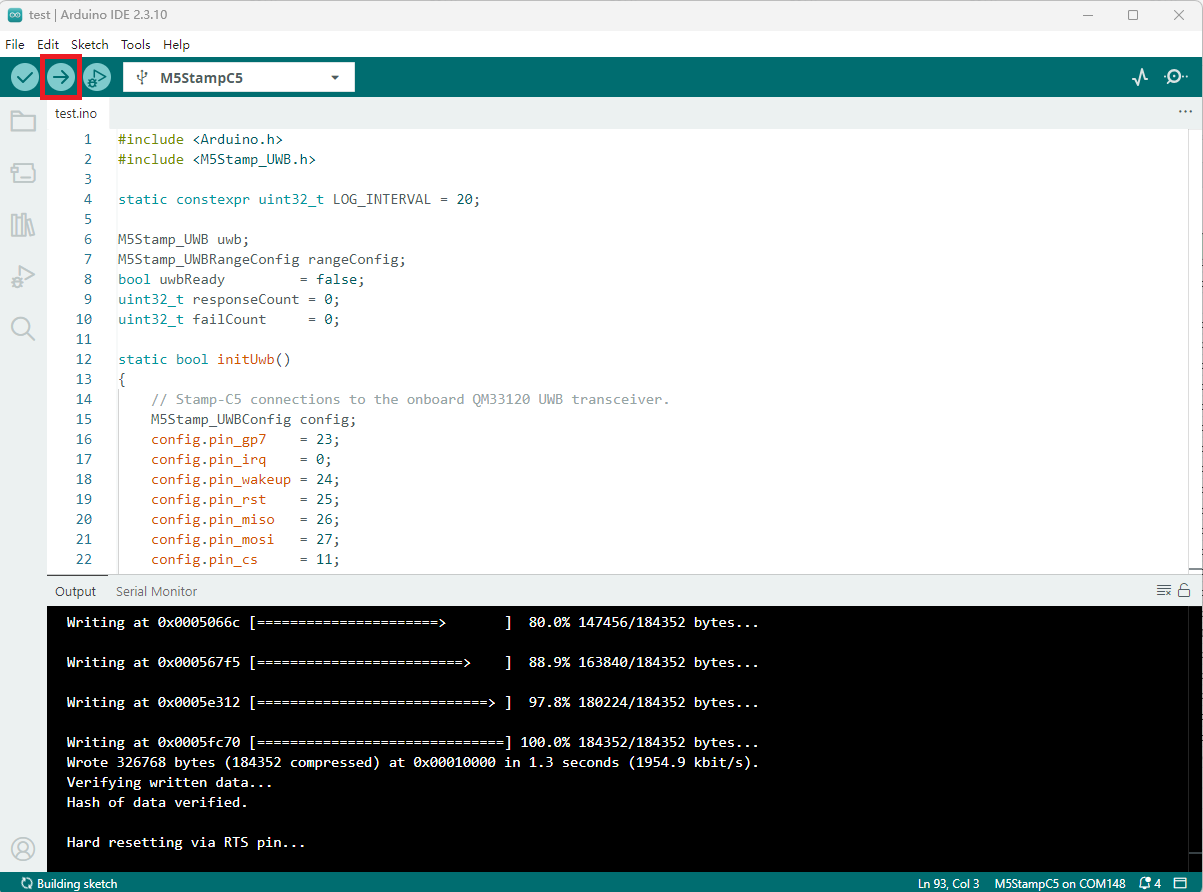
- 选中设备端口,选择上述案例程序粘贴,点击 Arduino IDE 左上角编译上传按钮,等待程序完成编译并上传至设备。
Page Tools