
Arduino Quick Start
2. Devices & Examples
3. M5Unified
4. M5GFX
5. Extensions
Unit
Module
Atomic
Tab5
IoT
Accessories
PaperMono Microphone
APIs and example programs for the PaperMono microphone.
Example Programs
Build Requirements
- M5Stack Board Manager version >= 3.3.9
- Board option =
M5PaperMono - M5Unified library version >= 0.2.20
- M5GFX library version >= 0.2.27
- M5IOE1 library version >= 1.0.9
cpp
1 2 3 4 5 6 7 8 9 10 11 12 13 14 15 16 17 18 19 20 21 22 23 24 25 26 27 28 29 30 31 32 33 34 35 36 37 38 39 40 41 42 43 44 45 46 47 48 49 50 51 52 53 54 55 56 57 58 59 60 61 62 63 64 65 66 67 68 69 70 71 72 73 74 75 76 77 78 79 80 81 82 83 84 85 86 87 88 89 90 91 92 93 94 95 96 97 98 99 100 101 102 103 104 105 106 107 108 109 110 111 112 113 114 115 116 117 118 119 120 121 122 123 124 125 126 127 128 129 130 131 132 133 134 135 136 137 138 139 140 141 142 143 144 145 146 147 148 149 150 151 152 153 154 155 156 157 158 159 160 161 162 163 164 165 166 167 168 169 170 171 172 173 174 175 176 177 178 179 180 181 182 183 184 185 186 187 188 189 190 191 192 193 194 195 196 197 198 199 200 201 202 203 204 205 206 207 208 209 210 211 212 213 214 215 216 217 218 219 220 221 222 223 224 225 226 227 228 229 230 231 232 233 234 235 236 237 238 239 240 241 242 243 244 245 246 247 248 249 250 251 252 253 254 255 256 257 258 259 260 261 262 263 264 265 266 267 268 269
#include <Arduino.h>
#include <M5IOE1.h>
#include <M5Unified.h>
#include <driver/gpio.h>
#include <math.h>

namespace {

constexpr uint32_t kSampleRateHz = 16000;
constexpr size_t kSampleCount = 1600;
constexpr uint32_t kUpdateIntervalMs = 1000;
constexpr size_t kHistoryLength = 60;

constexpr int kPdmClockPin = 45;
constexpr int kPdmDataPin = 46;
constexpr auto kPdmPowerPin = M5IOE1_PIN_12;

constexpr int kGraphLeft = 42;
constexpr int kGraphTop = 245;
constexpr int kGraphWidth = 396;
constexpr int kGraphHeight = 430;

M5IOE1 ioe1;
M5Canvas canvas(&M5.Display);
int16_t samples[kSampleCount];
float levelHistory[kHistoryLength] = {};
size_t historyCount = 0;
uint32_t nextUpdateMs = 0;

struct VolumeReading {
    float rms;
    float peak;
    float dbfs;
    float percent;
};

[[noreturn]] void stopWithError(const char* message)
{
    Serial.println(message);
    canvas.fillSprite(TFT_WHITE);
    canvas.setTextColor(TFT_BLACK, TFT_WHITE);
    canvas.setTextDatum(middle_center);
    canvas.setFont(&fonts::FreeSansBold18pt7b);
    canvas.drawString("MIC ERROR", 240, 330);
    canvas.setFont(&fonts::FreeSans12pt7b);
    canvas.drawString(message, 240, 410);
    M5.Display.setEpdMode(epd_mode_t::epd_fastest);
    canvas.pushSprite(0, 0);
    while (true) {
        delay(1000);
    }
}

bool waitForRecording(uint32_t timeoutMs)
{
    const uint32_t startedAt = millis();
    while (M5.Mic.isRecording()) {
        if (millis() - startedAt >= timeoutMs) {
            return false;
        }
        delay(1);
    }
    return true;
}

VolumeReading analyzeSamples()
{
    int64_t sum = 0;
    for (size_t i = 0; i < kSampleCount; ++i) {
        sum += samples[i];
    }
    const double mean = static_cast<double>(sum) / kSampleCount;

    double squareSum = 0.0;
    double peak = 0.0;
    for (size_t i = 0; i < kSampleCount; ++i) {
        const double centered = static_cast<double>(samples[i]) - mean;
        squareSum += centered * centered;
        peak = max(peak, fabs(centered));
    }

    const float rms = sqrt(squareSum / kSampleCount);
    const float dbfs = rms > 0.0f ? 20.0f * log10f(rms / 32768.0f) : -96.0f;
    const float percent = constrain((dbfs + 60.0f) * (100.0f / 60.0f), 0.0f, 100.0f);
    return {rms, static_cast<float>(peak), dbfs, percent};
}

void appendHistory(float value)
{
    if (historyCount < kHistoryLength) {
        levelHistory[historyCount++] = value;
        return;
    }

    memmove(levelHistory, levelHistory + 1,
            (kHistoryLength - 1) * sizeof(levelHistory[0]));
    levelHistory[kHistoryLength - 1] = value;
}

void drawGrid()
{
    canvas.drawRect(kGraphLeft, kGraphTop, kGraphWidth, kGraphHeight, TFT_BLACK);
    canvas.setFont(&fonts::FreeSans9pt7b);
    canvas.setTextDatum(middle_right);

    for (int percent = 0; percent <= 100; percent += 25) {
        const int y = kGraphTop + kGraphHeight -
                      (percent * kGraphHeight / 100);
        const uint16_t color = percent == 0 ? TFT_BLACK : TFT_LIGHTGREY;
        canvas.drawFastHLine(kGraphLeft, y, kGraphWidth, color);
        canvas.drawString(String(percent), kGraphLeft - 7, y);
    }

    canvas.setTextDatum(top_center);
    canvas.drawString("60 seconds", kGraphLeft + kGraphWidth / 2,
                      kGraphTop + kGraphHeight + 18);
}

void drawScreen(const VolumeReading& reading)
{
    canvas.fillSprite(TFT_WHITE);
    canvas.setTextColor(TFT_BLACK, TFT_WHITE);
    canvas.setTextDatum(top_center);

    canvas.setFont(&fonts::FreeSansBold24pt7b);
    canvas.drawString("PaperMono MIC", 240, 24);
    canvas.setFont(&fonts::FreeSans12pt7b);
    canvas.drawString("Volume amplitude", 240, 92);

    canvas.setFont(&fonts::FreeSansBold18pt7b);
    canvas.setTextDatum(middle_center);
    canvas.drawString(String(reading.percent, 1) + "%", 110, 180);
    canvas.drawString(String(reading.dbfs, 1) + " dBFS", 350, 180);

    canvas.setFont(&fonts::FreeSans9pt7b);
    canvas.drawString("RMS " + String(reading.rms, 0), 110, 220);
    canvas.drawString("PEAK " + String(reading.peak, 0), 350, 220);

    drawGrid();

    if (historyCount > 0) {
        const int plotLeft = kGraphLeft + 1;
        const int plotRight = kGraphLeft + kGraphWidth - 2;
        const int plotBottom = kGraphTop + kGraphHeight - 1;
        const int plotHeight = kGraphHeight - 2;
        int previousX = plotRight -
                        static_cast<int>((historyCount - 1) *
                                         (plotRight - plotLeft) /
                                         (kHistoryLength - 1));
        int previousY = plotBottom -
                        static_cast<int>(levelHistory[0] * plotHeight / 100.0f);

        for (size_t i = 1; i < historyCount; ++i) {
            const int x = plotRight -
                          static_cast<int>((historyCount - 1 - i) *
                                           (plotRight - plotLeft) /
                                           (kHistoryLength - 1));
            const int y = plotBottom -
                          static_cast<int>(levelHistory[i] * plotHeight / 100.0f);
            canvas.drawLine(previousX, previousY, x, y, TFT_BLACK);
            canvas.fillCircle(x, y, 3, TFT_BLACK);
            previousX = x;
            previousY = y;
        }
        canvas.fillCircle(previousX, previousY, 4, TFT_BLACK);
    }

    M5.Display.setEpdMode(epd_mode_t::epd_fastest);
    canvas.pushSprite(0, 0);
}

void initializeMicrophone()
{
    const m5ioe1_err_t ioeError = ioe1.begin(
        &M5.In_I2C, M5IOE1_DEFAULT_ADDR_2, M5IOE1_I2C_FREQ_100K);
    if (ioeError != M5IOE1_OK) {
        stopWithError("M5IOE1 initialization failed");
    }

    ioe1.pinMode(kPdmPowerPin, OUTPUT);
    if (ioe1.setDriveMode(kPdmPowerPin, M5IOE1_DRIVE_PUSHPULL) != M5IOE1_OK) {
        stopWithError("PDM power pin setup failed");
    }
    m5ioe1_err_t powerError = M5IOE1_OK;
    ioe1.digitalWriteWithRes(kPdmPowerPin, HIGH, &powerError);
    if (powerError != M5IOE1_OK) {
        stopWithError("PDM microphone power failed");
    }
    delay(20);

    gpio_reset_pin(static_cast<gpio_num_t>(kPdmDataPin));
    gpio_set_direction(static_cast<gpio_num_t>(kPdmDataPin), GPIO_MODE_INPUT);
    gpio_set_pull_mode(static_cast<gpio_num_t>(kPdmDataPin), GPIO_FLOATING);
    gpio_reset_pin(static_cast<gpio_num_t>(kPdmClockPin));

    M5.Speaker.end();
    M5.Mic.end();
    auto micConfig = M5.Mic.config();
    micConfig.pin_mck = I2S_PIN_NO_CHANGE;
    micConfig.pin_bck = I2S_PIN_NO_CHANGE;
    micConfig.pin_ws = kPdmClockPin;
    micConfig.pin_data_in = kPdmDataPin;
    micConfig.i2s_port = I2S_NUM_0;
    micConfig.input_channel = m5::input_channel_t::input_only_right;
    micConfig.sample_rate = kSampleRateHz;
    micConfig.over_sampling = 1;
    micConfig.magnification = 2;
    micConfig.dma_buf_len = 128;
    micConfig.dma_buf_count = 8;
    M5.Mic.config(micConfig);

    if (!M5.Mic.begin()) {
        stopWithError("PDM microphone begin failed");
    }
    Serial.println("PDM microphone: ready");
}

}  // namespace

void setup()
{
    Serial.begin(115200);
    delay(100);
    Serial.println("PaperMono microphone amplitude demo");

    auto config = M5.config();
    config.clear_display = false;
    config.internal_rtc = false;
    config.internal_imu = false;
    config.internal_mic = false;
    M5.begin(config);

    M5.Display.setRotation(0);
    M5.Display.setBrightness(160);
    M5.Display.setEpdMode(epd_mode_t::epd_fastest);
    canvas.setColorDepth(16);
    if (!canvas.createSprite(M5.Display.width(), M5.Display.height())) {
        while (true) {
            Serial.println("Display canvas allocation failed");
            delay(1000);
        }
    }

    initializeMicrophone();
    nextUpdateMs = millis();
}

void loop()
{
    M5.update();
    const uint32_t now = millis();
    if (static_cast<int32_t>(now - nextUpdateMs) < 0) {
        delay(5);
        return;
    }
    nextUpdateMs = now + kUpdateIntervalMs;

    if (!M5.Mic.record(samples, kSampleCount, kSampleRateHz, false) ||
        !waitForRecording(250)) {
        Serial.println("Microphone sample failed");
        return;
    }

    const VolumeReading reading = analyzeSamples();
    appendHistory(reading.percent);
    Serial.printf("MIC rms=%.1f peak=%.1f dbfs=%.1f level=%.1f%%\n",
                  reading.rms, reading.peak, reading.dbfs, reading.percent);
    drawScreen(reading);
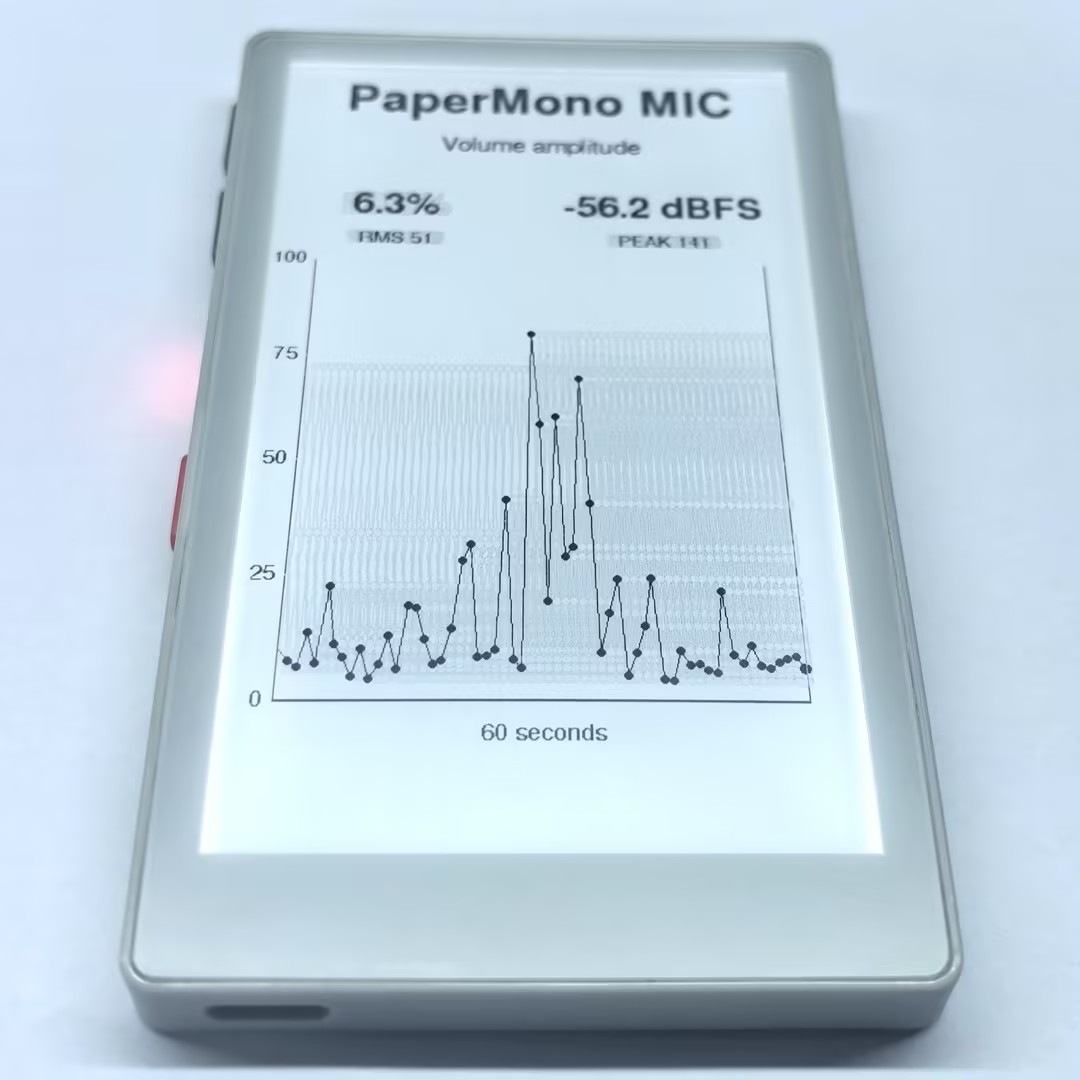
}The program uses the M5IOE1 to enable power to the PDM microphone. It captures 1,600 samples per second at a 16 kHz sampling rate, removes the DC offset, and calculates the RMS, peak, dBFS, and volume percentage. The screen shows the current values and a volume graph covering the most recent 60 seconds, while the data is also output to the Serial Monitor.
API
The PaperMono microphone features use Mic_Class from the M5Unified library. For more information, refer to the following documentation:
Page Tools