

Arduino Quick Start
2. Devices & Examples
3. M5Unified
4. M5GFX
5. Extensions
Unit
Module
Atomic
Tab5
IoT
Accessories
Unit 4EncoderMotor Driver Arduino Tutorial
1. Preparation
- Environment Setup: Follow the Arduino IDE Getting Started Guide to install the IDE, then install the board package and driver libraries required for your development board.
- Required Libraries:
- Required Hardware:
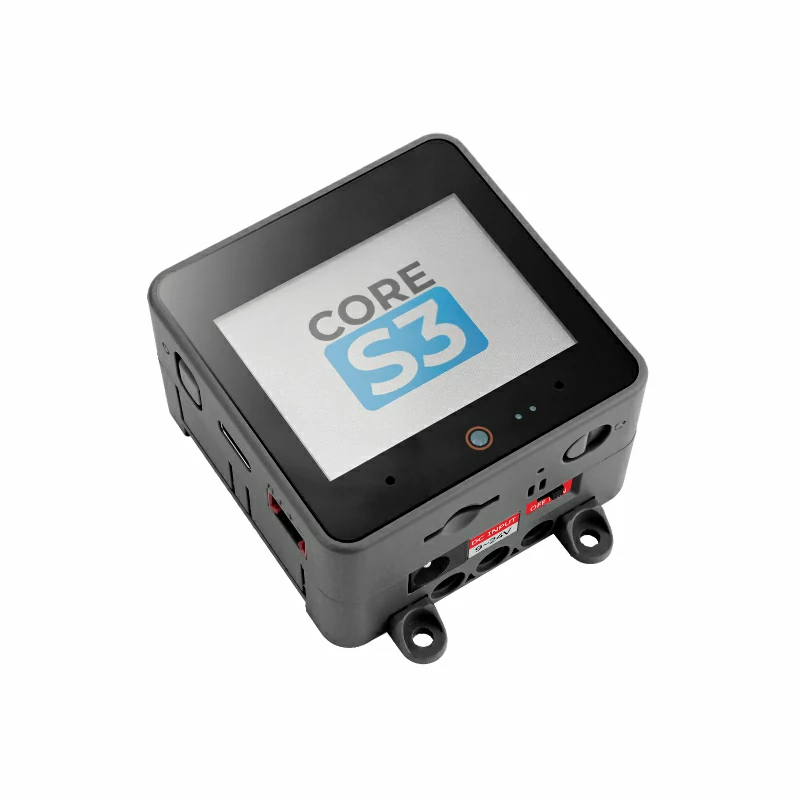
- CoreS3
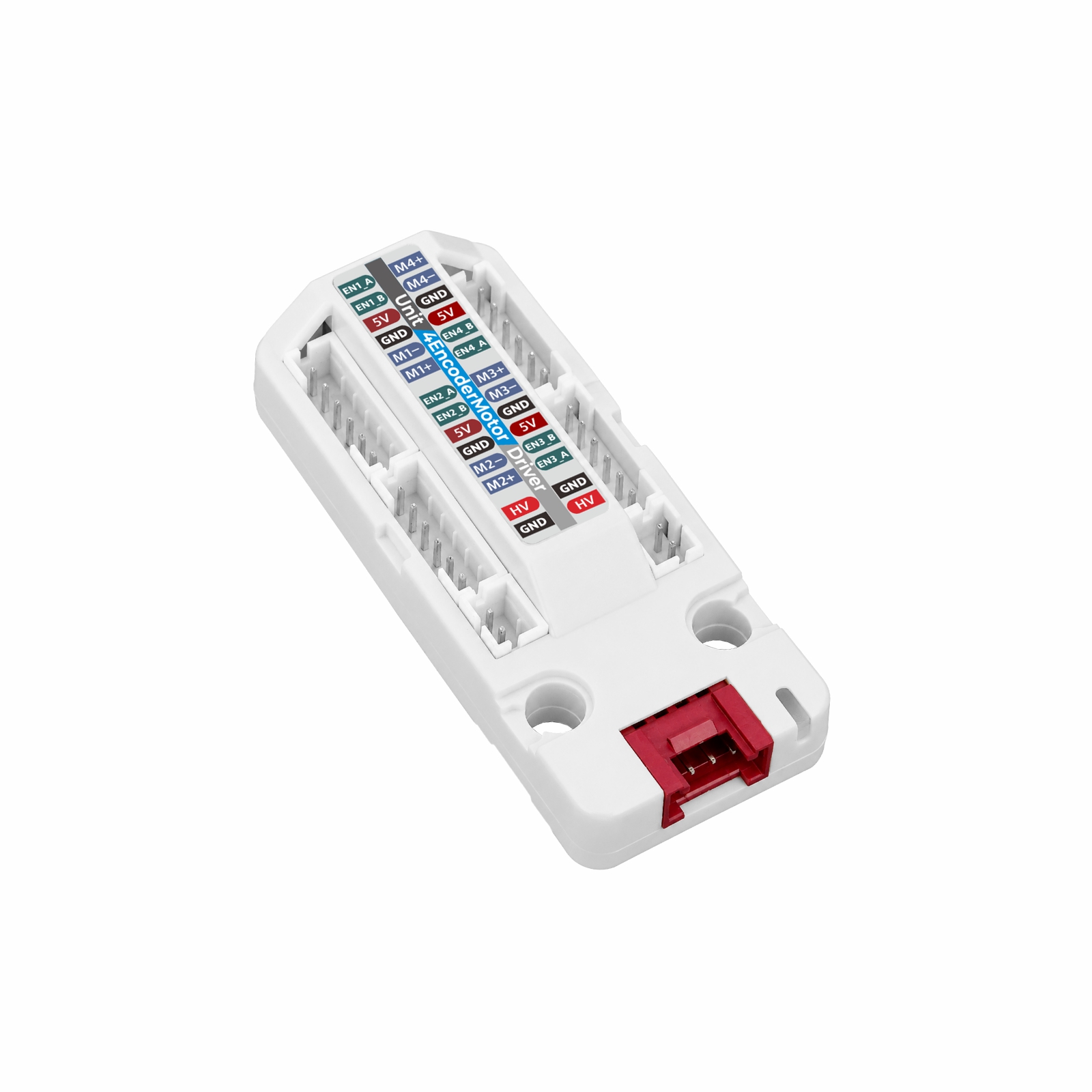
- Unit 4EncoderMotor Driver
- 4 × 6-wire geared motors with encoders (M+ / M- / GND / 5V / EN_B / EN_A)
- External DC 6–12 V power supply
2. Notes
3. Examples
- This tutorial uses CoreS3 with Unit 4EncoderMotor Driver to control four encoder motors. The unit communicates over I2C, using
G2 (SDA)andG1 (SCL)on the CoreS3. The two HY2.0-4P interfaces on the unit are internally connected: either can connect to the host, while the other can be used to add other I2C devices. - The following examples cover the three control methods supported by the driver unit: PWM mode (open-loop speed control), Speed mode (speed loop), and Position mode (position loop). Two additional examples demonstrate soft start/stop and the RGB indicator.
- All examples use the driver library’s
M5UnitEncoderMotorclass with the product selectorM5Unit_4EncoderMotor_Driver(default address0x24, four channels). Include#include <M5Unit-EncoderMotor-Driver.h>; the display functionality also requires the M5Unified and M5GFX libraries listed above.
3.1 PWM Mode (Four-Channel Open-Loop Speed Control)
#include <M5Unified.h>
#include <M5Unit-EncoderMotor-Driver.h>

// Product selector sets the default address and channel count:
// U232 = 0x2F (1 channel), U233 = 0x24 (4 channels)
M5UnitEncoderMotor motors(M5Unit_4EncoderMotor_Driver);

// Draw into an offscreen canvas so a full screen refresh does not flicker
M5Canvas canvas(&M5.Display);

constexpr int8_t I2C_SDA_PIN     = 2;  // CoreS3 PORT.A
constexpr int8_t I2C_SCL_PIN     = 1;
constexpr uint32_t I2C_FREQUENCY = 400000;
constexpr int8_t PWM_DUTY        = 100;   // -127 ~ 127
constexpr uint32_t RUN_MS        = 3000;
constexpr uint32_t STEP_MS       = 200;

void halt(const char *message)
{
    Serial.println(message);
    while (true) {
        delay(1000);
    }
}

// Center the status screen and mix three font sizes so the key value stands out.
void showScreen(const char *title, const char *value, const char *detail1, const char *detail2)
{
    canvas.fillScreen(TFT_BLACK);
    canvas.setTextDatum(middle_center);

    canvas.setFont(&fonts::DejaVu18);
    canvas.setTextColor(TFT_LIGHTGREY);
    canvas.drawString(title, canvas.width() / 2, 32);

    canvas.setFont(&fonts::DejaVu40);
    canvas.setTextColor(TFT_WHITE);
    canvas.drawString(value, canvas.width() / 2, 112);

    canvas.setFont(&fonts::DejaVu12);
    canvas.setTextColor(TFT_LIGHTGREY);
    if (detail1 && detail1[0]) {
        canvas.drawString(detail1, canvas.width() / 2, 176);
    }
    if (detail2 && detail2[0]) {
        canvas.drawString(detail2, canvas.width() / 2, 204);
    }

    canvas.pushSprite(0, 0);
}

void drawStatus(const char *state, int8_t duty)
{
    int8_t speed[4] = {0, 0, 0, 0};
    for (uint8_t channel = 0; channel < motors.motorCount() && channel < 4; ++channel) {
        motors.getSpeed(speed[channel], channel);
    }

    char value[16];
    char detail1[48];
    char detail2[48];
    snprintf(value, sizeof(value), "%+d", speed[0]);
    snprintf(detail1, sizeof(detail1), "%s   duty %+d", state, duty);
    snprintf(detail2, sizeof(detail2), "M2 %+d   M3 %+d   M4 %+d", speed[1], speed[2], speed[3]);
    showScreen("PWM", value, detail1, detail2);
}

// Apply the duty cycle to every channel and keep reporting back
void holdDuty(const char *state, int8_t duty, uint32_t duration_ms)
{
    for (uint8_t channel = 0; channel < motors.motorCount(); ++channel) {
        if (!motors.setPWMDuty(duty, channel)) {
            halt("Failed to set PWM duty.");
        }
    }
    for (uint32_t elapsed = 0; elapsed < duration_ms; elapsed += STEP_MS) {
        drawStatus(state, duty);
        Serial.printf("%s duty=%+d", state, duty);
        for (uint8_t channel = 0; channel < motors.motorCount(); ++channel) {
            int8_t speed = 0;
            int32_t encoder = 0;
            motors.getSpeed(speed, channel);
            motors.getEncoder(encoder, channel);
            Serial.printf(" M%u[speed=%+d encoder=%ld]", channel + 1, speed, static_cast<long>(encoder));
        }
        Serial.println();
        delay(STEP_MS);
    }
}

void setup()
{
    auto cfg = M5.config();
    cfg.output_power = true;
    M5.begin(cfg);
    canvas.createSprite(M5.Display.width(), M5.Display.height());
    Serial.begin(115200);

    while (!motors.begin(&Wire, 0, I2C_SDA_PIN, I2C_SCL_PIN, I2C_FREQUENCY)) {
        Serial.println("Unit 4EncoderMotor Driver not found");
        delay(1000);
    }
    delay(100);  // give the unit time to finish the previous write
    for (uint8_t channel = 0; channel < motors.motorCount(); ++channel) {
        // Soft start is saved in the unit flash; turn it off so this demo runs without a ramp
        if (!motors.setSoftStartStop(false, channel)) {
            halt("Failed to disable soft start / stop.");
        }
        if (!motors.setMotorMode(M5_UNIT_ENCODER_MOTOR_MODE_NORMAL, channel) || !motors.setPWMDuty(0, channel)) {
            halt("Failed to initialise PWM mode.");
        }
    }
    Serial.println("Unit 4EncoderMotor Driver ready");
}

void loop()
{
    holdDuty("forward", PWM_DUTY, RUN_MS);
    holdDuty("coast", 0, 1000);
    holdDuty("reverse", -PWM_DUTY, RUN_MS);
    holdDuty("coast", 0, 1000);
}The program constructs a M5UnitEncoderMotor object with M5Unit_4EncoderMotor_Driver. Passing address 0 to begin() selects the default address 0x24, and motorCount() returns the channel count, 4. APIs with a channel parameter, such as setPWMDuty(), getSpeed(), and getEncoder(), use channel numbers 0 ~ 3; the default is channel 0 if omitted. In the loop, all four motors run forward at duty 100 for 3 seconds, coast at zero duty for 1 second, and run in reverse at -100 for 3 seconds.
Example serial output:
Unit 4EncoderMotor Driver ready
forward duty=+100 M1[speed=+16 encoder=804] M2[speed=+16 encoder=806] M3[speed=+16 encoder=801] M4[speed=+16 encoder=803]
coast duty=+0 M1[speed=+6 encoder=1512] M2[speed=+6 encoder=1515] M3[speed=+6 encoder=1509] M4[speed=+6 encoder=1511]
reverse duty=-100 M1[speed=-15 encoder=1180] M2[speed=-15 encoder=1177] M3[speed=-15 encoder=1182] M4[speed=-15 encoder=1179]3.2 Speed Mode (Four-Channel Synchronization)
#include <M5Unified.h>
#include <M5Unit-EncoderMotor-Driver.h>

// Product selector sets the default address and channel count:
// U232 = 0x2F (1 channel), U233 = 0x24 (4 channels)
M5UnitEncoderMotor motors(M5Unit_4EncoderMotor_Driver);

// Draw into an offscreen canvas so a full screen refresh does not flicker
M5Canvas canvas(&M5.Display);

constexpr int8_t I2C_SDA_PIN     = 2;  // CoreS3 PORT.A
constexpr int8_t I2C_SCL_PIN     = 1;
constexpr uint32_t I2C_FREQUENCY = 400000;
constexpr int8_t TARGET_SPEED    = 15;
constexpr M5UnitEncoderMotorPID SPEED_PID = {10, 1, 15};  // Default speed loop P / I / D
constexpr uint32_t RUN_MS        = 5000;
constexpr uint32_t STEP_MS       = 200;

void halt(const char *message)
{
    Serial.println(message);
    while (true) {
        delay(1000);
    }
}

// Center the status screen and mix three font sizes so the key value stands out.
void showScreen(const char *title, const char *value, const char *detail1, const char *detail2)
{
    canvas.fillScreen(TFT_BLACK);
    canvas.setTextDatum(middle_center);

    canvas.setFont(&fonts::DejaVu18);
    canvas.setTextColor(TFT_LIGHTGREY);
    canvas.drawString(title, canvas.width() / 2, 32);

    canvas.setFont(&fonts::DejaVu40);
    canvas.setTextColor(TFT_WHITE);
    canvas.drawString(value, canvas.width() / 2, 112);

    canvas.setFont(&fonts::DejaVu12);
    canvas.setTextColor(TFT_LIGHTGREY);
    if (detail1 && detail1[0]) {
        canvas.drawString(detail1, canvas.width() / 2, 176);
    }
    if (detail2 && detail2[0]) {
        canvas.drawString(detail2, canvas.width() / 2, 204);
    }

    canvas.pushSprite(0, 0);
}

void drawStatus(const char *state, int8_t target)
{
    int8_t speed[4] = {0, 0, 0, 0};
    for (uint8_t channel = 0; channel < motors.motorCount() && channel < 4; ++channel) {
        motors.getSpeed(speed[channel], channel);
    }

    char value[16];
    char detail1[48];
    char detail2[48];
    snprintf(value, sizeof(value), "%+d", speed[0]);
    snprintf(detail1, sizeof(detail1), "%s   target %+d", state, target);
    snprintf(detail2, sizeof(detail2), "M2 %+d   M3 %+d   M4 %+d", speed[1], speed[2], speed[3]);
    showScreen("SPEED", value, detail1, detail2);
}

// Hold the same target speed on all channels and print the closed loop response
void holdSpeed(const char *state, int8_t target, uint32_t duration_ms)
{
    for (uint8_t channel = 0; channel < motors.motorCount(); ++channel) {
        if (!motors.runSpeed(target, SPEED_PID, channel)) {
            halt("Failed to run in Speed mode.");
        }
    }
    for (uint32_t elapsed = 0; elapsed < duration_ms; elapsed += STEP_MS) {
        drawStatus(state, target);
        Serial.printf("%s target=%+d", state, target);
        for (uint8_t channel = 0; channel < motors.motorCount(); ++channel) {
            int8_t speed = 0;
            int8_t duty = 0;
            motors.getSpeed(speed, channel);
            motors.getPWMDuty(duty, channel);
            Serial.printf(" M%u[measured=%+d duty=%+d]", channel + 1, speed, duty);
        }
        Serial.println();
        delay(STEP_MS);
    }
}

void setup()
{
    auto cfg = M5.config();
    cfg.output_power = true;
    M5.begin(cfg);
    canvas.createSprite(M5.Display.width(), M5.Display.height());
    Serial.begin(115200);

    while (!motors.begin(&Wire, 0, I2C_SDA_PIN, I2C_SCL_PIN, I2C_FREQUENCY)) {
        Serial.println("Unit 4EncoderMotor Driver not found");
        delay(1000);
    }
    delay(100);  // give the unit time to finish the previous write
    for (uint8_t channel = 0; channel < motors.motorCount(); ++channel) {
        // Soft start is saved in the unit flash; turn it off so this demo runs without a ramp
        if (!motors.setSoftStartStop(false, channel)) {
            halt("Failed to disable soft start / stop.");
        }
        if (!motors.setMotorMode(M5_UNIT_ENCODER_MOTOR_MODE_NORMAL, channel) || !motors.setPWMDuty(0, channel)) {
            halt("Failed to initialise Speed mode.");
        }
    }
    Serial.println("Unit 4EncoderMotor Driver ready");
}

void loop()
{
    holdSpeed("run", TARGET_SPEED, RUN_MS);
    holdSpeed("stop", 0, 2000);
}The program calls runSpeed(15, SPEED_PID, channel) for each channel. SPEED_PID = {10, 1, 15} contains the firmware’s default speed-loop parameters, and the target 15 is measured in encoder-count increments per 20 ms. Every 200 ms, the loop iterates through all four channels and prints the target, measured speed, and duty cycle.
Example serial output:
Unit 4EncoderMotor Driver ready
run target=+15 M1[measured=+15 duty=+54] M2[measured=+15 duty=+55] M3[measured=+14 duty=+56] M4[measured=+15 duty=+54]
stop target=+0 M1[measured=+0 duty=+0] M2[measured=+0 duty=+0] M3[measured=+0 duty=+0] M4[measured=+0 duty=+0]3.3 Position Mode (Four-Channel Synchronization)
#include <M5Unified.h>
#include <M5Unit-EncoderMotor-Driver.h>

// Product selector sets the default address and channel count:
// U232 = 0x2F (1 channel), U233 = 0x24 (4 channels)
M5UnitEncoderMotor motors(M5Unit_4EncoderMotor_Driver);

// Draw into an offscreen canvas so a full screen refresh does not flicker
M5Canvas canvas(&M5.Display);

constexpr int8_t I2C_SDA_PIN     = 2;  // CoreS3 PORT.A
constexpr int8_t I2C_SCL_PIN     = 1;
constexpr uint32_t I2C_FREQUENCY = 400000;
constexpr int32_t TARGET_POSITION = 1320;  // One output revolution
constexpr int8_t MAX_SPEED        = 100;    // Position loop output limit
constexpr M5UnitEncoderMotorPID POSITION_PID = {1, 1, 17};  // Default position loop P / I / D
constexpr uint32_t TIMEOUT_MS     = 8000;
constexpr uint32_t STEP_MS        = 200;

void halt(const char *message)
{
    Serial.println(message);
    while (true) {
        delay(1000);
    }
}

// Center the status screen and mix three font sizes so the key value stands out.
void showScreen(const char *title, const char *value, const char *detail1, const char *detail2)
{
    canvas.fillScreen(TFT_BLACK);
    canvas.setTextDatum(middle_center);

    canvas.setFont(&fonts::DejaVu18);
    canvas.setTextColor(TFT_LIGHTGREY);
    canvas.drawString(title, canvas.width() / 2, 32);

    canvas.setFont(&fonts::DejaVu40);
    canvas.setTextColor(TFT_WHITE);
    canvas.drawString(value, canvas.width() / 2, 112);

    canvas.setFont(&fonts::DejaVu12);
    canvas.setTextColor(TFT_LIGHTGREY);
    if (detail1 && detail1[0]) {
        canvas.drawString(detail1, canvas.width() / 2, 176);
    }
    if (detail2 && detail2[0]) {
        canvas.drawString(detail2, canvas.width() / 2, 204);
    }

    canvas.pushSprite(0, 0);
}

void drawStatus(int32_t target)
{
    int32_t encoder[4] = {0, 0, 0, 0};
    for (uint8_t channel = 0; channel < motors.motorCount() && channel < 4; ++channel) {
        motors.getEncoder(encoder[channel], channel);
    }

    char value[16];
    char detail1[48];
    char detail2[48];
    snprintf(value, sizeof(value), "%ld", static_cast<long>(encoder[0]));
    snprintf(detail1, sizeof(detail1), "target %ld", static_cast<long>(target));
    snprintf(detail2, sizeof(detail2), "M2 %ld   M3 %ld   M4 %ld", static_cast<long>(encoder[1]),
             static_cast<long>(encoder[2]), static_cast<long>(encoder[3]));
    showScreen("POSITION", value, detail1, detail2);
}

// Move all channels to the target position and wait until they arrive
void moveTo(int32_t target, uint32_t timeout_ms)
{
    for (uint8_t channel = 0; channel < motors.motorCount(); ++channel) {
        if (!motors.runPosition(target, MAX_SPEED, POSITION_PID, channel)) {
            halt("Failed to run in Position mode.");
        }
    }
    for (uint32_t elapsed = 0; elapsed < timeout_ms; elapsed += STEP_MS) {
        drawStatus(target);
        bool reached = true;
        Serial.printf("target=%ld", static_cast<long>(target));
        for (uint8_t channel = 0; channel < motors.motorCount(); ++channel) {
            int32_t encoder = 0;
            motors.getEncoder(encoder, channel);
            if (abs(target - encoder) > 10) {
                reached = false;
            }
            Serial.printf(" M%u[encoder=%ld]", channel + 1, static_cast<long>(encoder));
        }
        Serial.println();
        if (reached) {
            Serial.println("position reached");
            return;
        }
        delay(STEP_MS);
    }
    Serial.println("position timeout");
}

void setup()
{
    auto cfg = M5.config();
    cfg.output_power = true;
    M5.begin(cfg);
    canvas.createSprite(M5.Display.width(), M5.Display.height());
    Serial.begin(115200);

    while (!motors.begin(&Wire, 0, I2C_SDA_PIN, I2C_SCL_PIN, I2C_FREQUENCY)) {
        Serial.println("Unit 4EncoderMotor Driver not found");
        delay(1000);
    }
    delay(100);  // give the unit time to finish the previous write
    for (uint8_t channel = 0; channel < motors.motorCount(); ++channel) {
        // Soft start is saved in the unit flash; turn it off so this demo runs without a ramp
        if (!motors.setSoftStartStop(false, channel)) {
            halt("Failed to disable soft start / stop.");
        }
        if (!motors.setMotorMode(M5_UNIT_ENCODER_MOTOR_MODE_NORMAL, channel) || !motors.setPWMDuty(0, channel) ||
            !motors.clearEncoder(channel)) {
            halt("Failed to initialise Position mode.");
        }
    }
    Serial.println("Unit 4EncoderMotor Driver ready");
}

void loop()
{
    moveTo(TARGET_POSITION, TIMEOUT_MS);
    delay(1000);
    moveTo(0, TIMEOUT_MS);
    delay(1000);
}First, clearEncoder(channel) clears the count on each of the four channels. Then runPosition(1320, 100, POSITION_PID, channel) moves all four motors to 1320 counts (one output-shaft revolution). The value 100 limits the position-loop output, and POSITION_PID = {1, 1, 17} contains the firmware’s default parameters. The program prints position reached once all four channels reach the target.
Example serial output:
Unit 4EncoderMotor Driver ready
target=1320 M1[encoder=1318] M2[encoder=1319] M3[encoder=1316] M4[encoder=1317]
position reached3.4 Soft Start and Soft Stop (Four-Channel Synchronization)
#include <M5Unified.h>
#include <M5Unit-EncoderMotor-Driver.h>

// Product selector sets the default address and channel count:
// U232 = 0x2F (1 channel), U233 = 0x24 (4 channels)
M5UnitEncoderMotor motors(M5Unit_4EncoderMotor_Driver);

// Draw into an offscreen canvas so a full screen refresh does not flicker
M5Canvas canvas(&M5.Display);

constexpr int8_t I2C_SDA_PIN     = 2;  // CoreS3 PORT.A
constexpr int8_t I2C_SCL_PIN     = 1;
constexpr uint32_t I2C_FREQUENCY = 400000;
constexpr int8_t TARGET_SPEED    = 20;  // Encoder counts per 20 ms
constexpr M5UnitEncoderMotorPID SPEED_PID = {10, 1, 15};  // Default speed loop P / I / D
constexpr uint32_t RUN_MS        = 4000;
constexpr uint32_t STEP_MS       = 50;

void halt(const char *message)
{
    Serial.println(message);
    while (true) {
        delay(1000);
    }
}

// Center the status screen and mix three font sizes so the key value stands out.
void showScreen(const char *title, const char *value, const char *detail1, const char *detail2)
{
    canvas.fillScreen(TFT_BLACK);
    canvas.setTextDatum(middle_center);

    canvas.setFont(&fonts::DejaVu18);
    canvas.setTextColor(TFT_LIGHTGREY);
    canvas.drawString(title, canvas.width() / 2, 32);

    canvas.setFont(&fonts::DejaVu40);
    canvas.setTextColor(TFT_WHITE);
    canvas.drawString(value, canvas.width() / 2, 112);

    canvas.setFont(&fonts::DejaVu12);
    canvas.setTextColor(TFT_LIGHTGREY);
    if (detail1 && detail1[0]) {
        canvas.drawString(detail1, canvas.width() / 2, 176);
    }
    if (detail2 && detail2[0]) {
        canvas.drawString(detail2, canvas.width() / 2, 204);
    }

    canvas.pushSprite(0, 0);
}

void drawStatus(const char *state, int8_t target)
{
    int8_t speed[4] = {0, 0, 0, 0};
    for (uint8_t channel = 0; channel < motors.motorCount() && channel < 4; ++channel) {
        motors.getSpeed(speed[channel], channel);
    }

    char value[16];
    char detail1[48];
    char detail2[48];
    snprintf(value, sizeof(value), "%+d", speed[0]);
    snprintf(detail1, sizeof(detail1), "%s   target %+d", state, target);
    snprintf(detail2, sizeof(detail2), "M2 %+d   M3 %+d   M4 %+d", speed[1], speed[2], speed[3]);
    showScreen("SOFT START", value, detail1, detail2);
}

// Drive all channels and sample the measured speed to show the ramp.
void holdSpeed(const char *state, int8_t target, uint32_t duration_ms)
{
    for (uint8_t channel = 0; channel < motors.motorCount(); ++channel) {
        motors.runSpeed(target, SPEED_PID, channel);
    }
    for (uint32_t elapsed = 0; elapsed < duration_ms; elapsed += STEP_MS) {
        drawStatus(state, target);
        Serial.printf("%s t=%4lums target=%+d", state, static_cast<long>(elapsed), target);
        for (uint8_t channel = 0; channel < motors.motorCount(); ++channel) {
            int8_t speed = 0;
            motors.getSpeed(speed, channel);
            Serial.printf(" M%u[measured=%+d]", channel + 1, speed);
        }
        Serial.println();
        delay(STEP_MS);
    }
}

void setup()
{
    auto cfg = M5.config();
    cfg.output_power = true;
    M5.begin(cfg);
    canvas.createSprite(M5.Display.width(), M5.Display.height());
    Serial.begin(115200);

    while (!motors.begin(&Wire, 0, I2C_SDA_PIN, I2C_SCL_PIN, I2C_FREQUENCY)) {
        Serial.println("Unit 4EncoderMotor Driver not found");
        delay(1000);
    }
    delay(100);  // give the unit time to finish the previous write
    for (uint8_t channel = 0; channel < motors.motorCount(); ++channel) {
        if (!motors.setMotorMode(M5_UNIT_ENCODER_MOTOR_MODE_SPEED, channel) || !motors.setPWMDuty(0, channel)) {
            halt("Failed to initialise speed mode.");
        }
        // The soft start / stop bit is saved in the unit flash, so set it once per channel in setup()
        if (!motors.setSoftStartStop(true, channel)) {
            halt("Failed to enable soft start / stop.");
        }
    }
    Serial.println("Soft start / stop enabled");
    Serial.println("Unit 4EncoderMotor Driver ready");
}

void loop()
{
    holdSpeed("run", TARGET_SPEED, RUN_MS);
    holdSpeed("stop", 0, RUN_MS);
}Soft start/stop is implemented by the unit firmware (register 0xD1). After setSoftStartStop(true) is enabled, changes to the speed command follow an internal ramp rather than a direct step. This setting is saved to the unit flash and retained after power loss, so it only needs to be set once in setup().
This example uses Speed mode: runSpeed(20, SPEED_PID) starts the motor, and runSpeed(0, SPEED_PID) stops it after 4 seconds. The measured speed is sampled every 50 ms. The speed loop quickly drives the duty cycle to its maximum, so speed rises faster than in PWM mode. To observe a more noticeable duty-cycle ramp, use PWM mode instead (see 3.1).
When powered through the 5 V Grove interface, applying a speed-loop step command from rest can cause a large instantaneous current. An external DC power supply is recommended.
Example serial output:
Soft start / stop enabled
Unit 4EncoderMotor Driver ready
run t=   0ms target=+20 M1[measured=+0] M2[measured=+0] M3[measured=+0] M4[measured=+0]
run t= 100ms target=+20 M1[measured=+12] M2[measured=+12] M3[measured=+11] M4[measured=+12]
run t= 200ms target=+20 M1[measured=+20] M2[measured=+20] M3[measured=+19] M4[measured=+20]
stop t=   0ms target=+0 M1[measured=+20] M2[measured=+20] M3[measured=+19] M4[measured=+20]
stop t= 100ms target=+0 M1[measured=+0] M2[measured=+0] M3[measured=+0] M4[measured=+0]3.5 RGB Indicator
#include <M5Unified.h>
#include <M5Unit-EncoderMotor-Driver.h>

// Product selector sets the default address and channel count:
// U232 = 0x2F (1 channel), U233 = 0x24 (4 channels)
M5UnitEncoderMotor motors(M5Unit_4EncoderMotor_Driver);

// Draw into an offscreen canvas so a full screen refresh does not flicker
M5Canvas canvas(&M5.Display);

constexpr int8_t I2C_SDA_PIN     = 2;  // CoreS3 PORT.A
constexpr int8_t I2C_SCL_PIN     = 1;
constexpr uint32_t I2C_FREQUENCY = 400000;

struct ColorStep {
    const char *name;
    uint8_t red;
    uint8_t green;
    uint8_t blue;
};

constexpr ColorStep STEPS[] = {
    {"red", 255, 0, 0},    {"green", 0, 255, 0},    {"blue", 0, 0, 255},
    {"yellow", 255, 255, 0}, {"cyan", 0, 255, 255}, {"magenta", 255, 0, 255},
    {"off", 0, 0, 0},
};
constexpr uint8_t BRIGHTNESS = 80;  // 0 ~ 255
constexpr uint32_t STEP_MS   = 800;

void halt(const char *message)
{
    Serial.println(message);
    while (true) {
        delay(1000);
    }
}

// Center the status screen and mix three font sizes so the key value stands out.
void showScreen(const char *title, const char *value, const char *detail1, const char *detail2)
{
    canvas.fillScreen(TFT_BLACK);
    canvas.setTextDatum(middle_center);

    canvas.setFont(&fonts::DejaVu18);
    canvas.setTextColor(TFT_LIGHTGREY);
    canvas.drawString(title, canvas.width() / 2, 32);

    canvas.setFont(&fonts::DejaVu40);
    canvas.setTextColor(TFT_WHITE);
    canvas.drawString(value, canvas.width() / 2, 112);

    canvas.setFont(&fonts::DejaVu12);
    canvas.setTextColor(TFT_LIGHTGREY);
    if (detail1 && detail1[0]) {
        canvas.drawString(detail1, canvas.width() / 2, 176);
    }
    if (detail2 && detail2[0]) {
        canvas.drawString(detail2, canvas.width() / 2, 204);
    }

    canvas.pushSprite(0, 0);
}

void setup()
{
    auto cfg = M5.config();
    cfg.output_power = true;
    M5.begin(cfg);
    canvas.createSprite(M5.Display.width(), M5.Display.height());
    Serial.begin(115200);

    while (!motors.begin(&Wire, 0, I2C_SDA_PIN, I2C_SCL_PIN, I2C_FREQUENCY)) {
        Serial.println("Unit 4EncoderMotor Driver not found");
        delay(1000);
    }
    if (!motors.setRGBBrightness(BRIGHTNESS)) {
        halt("Failed to set RGB brightness.");
    }
    Serial.println("RGB demo ready");
}

void loop()
{
    for (const auto &step : STEPS) {
        const bool ok = motors.setRGBColor(step.red, step.green, step.blue);
        delay(100);

        uint8_t red = 0;
        uint8_t green = 0;
        uint8_t blue = 0;
        uint8_t brightness = 0;
        const bool read_ok = motors.getRGBColor(red, green, blue) && motors.getRGBBrightness(brightness);

        char value[16];
        char detail1[48];
        char detail2[48];
        snprintf(value, sizeof(value), "%s", step.name);
        snprintf(detail1, sizeof(detail1), "R%3u G%3u B%3u", red, green, blue);
        snprintf(detail2, sizeof(detail2), "brightness %u", brightness);
        showScreen("RGB", value, detail1, detail2);

        Serial.printf("set=%s rgb=(%u,%u,%u) brightness=%u result=%s read=(%u,%u,%u)/%u read_result=%s\n",
                      step.name, step.red, step.green, step.blue, BRIGHTNESS, ok ? "OK" : "FAIL", red, green,
                      blue, brightness, read_ok ? "OK" : "FAIL");
        delay(STEP_MS);
    }
}The four channels share a single RGB indicator. After setting brightness with setRGBBrightness(80), the program sends the seven color steps in sequence. Each step reads back the color and brightness using getRGBColor() and getRGBBrightness(), and the serial output prints both the requested and read-back values.
Example serial output:
RGB demo ready
set=red rgb=(255,0,0) brightness=80 result=OK read=(255,0,0)/80 read_result=OK
set=green rgb=(0,255,0) brightness=80 result=OK read=(0,255,0)/80 read_result=OK
set=blue rgb=(0,0,255) brightness=80 result=OK read=(0,0,255)/80 read_result=OK
set=yellow rgb=(255,255,0) brightness=80 result=OK read=(255,255,0)/80 read_result=OK
set=cyan rgb=(0,255,255) brightness=80 result=OK read=(0,255,255)/80 read_result=OK
set=magenta rgb=(255,0,255) brightness=80 result=OK read=(255,0,255)/80 read_result=OK
set=off rgb=(0,0,0) brightness=80 result=OK read=(0,0,0)/80 read_result=OK4. Compile and Upload
Copy one of the example programs above into the sketch editor and select the device port (see Compile and Upload). Click the Upload button in the upper-left corner of the Arduino IDE and wait for compilation and upload to finish.